 Industrial Solution Finder
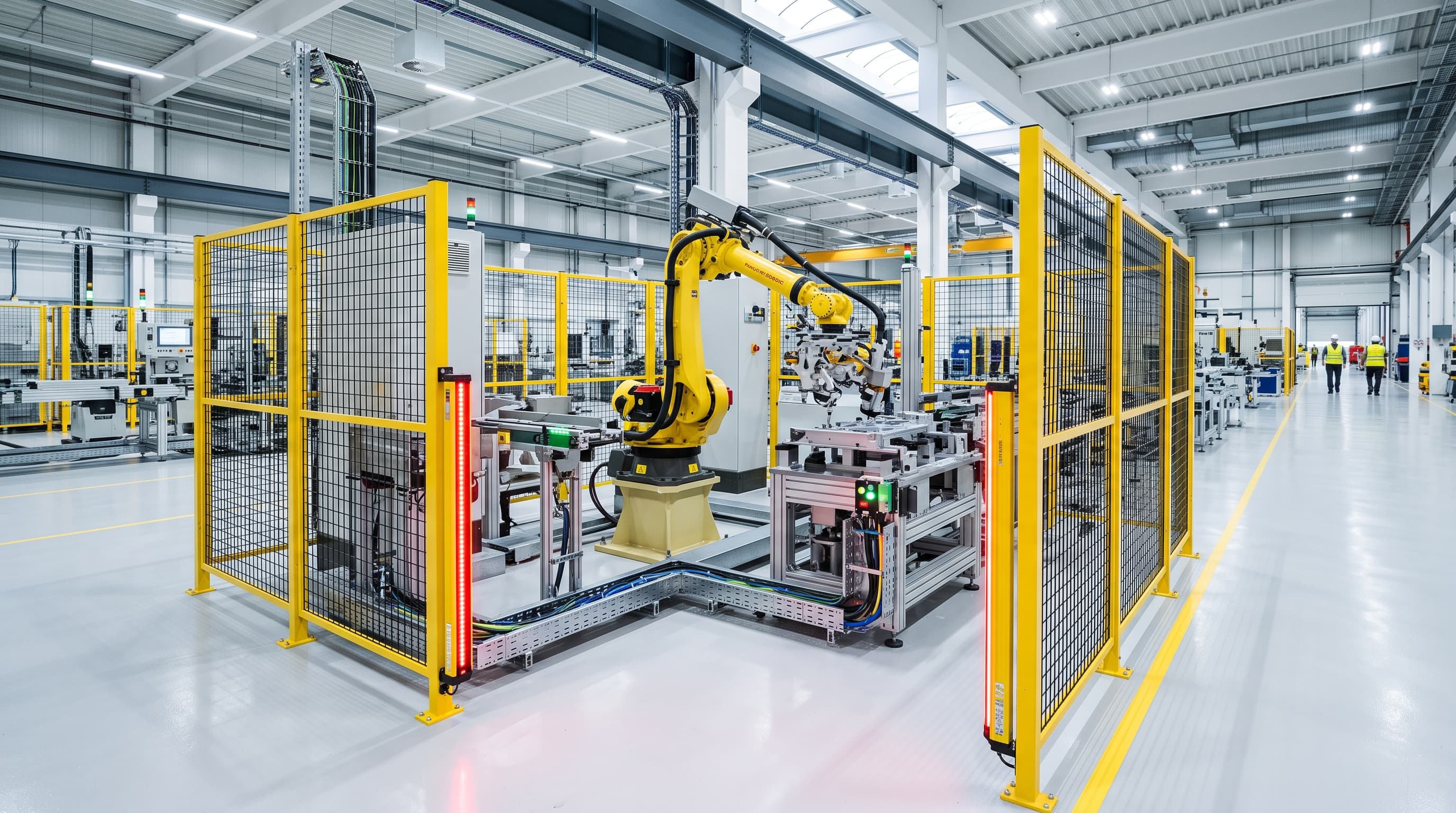
The revised ISO 10218 standards replace blanket PL d mandates with function-specific default PLs, absorb ISO/TS 15066 limits, add controller cybersecurity, and classify robots by hazard potential.
Architectural Evolution: From ISO 10218:2011 to the 2025 Standards Revision
For over a decade, manufacturing plants and automated assembly lines relied on ISO 10218:2011 to govern the safe design, construction, and integration of industrial robotic systems. However, rapid technological shifts—specifically the expansion of human-robot collaboration, smart end-effectors, and interconnected industrial networks—prompted a complete overhaul of the legacy framework. In February 2025, the International Organization for Standardization (ISO) officially published the updated editions: ISO 10218-1:2025 for industrial robots and ISO 10218-2:2025 for industrial robot applications and robot cells1. These standards modernize engineering benchmarks across the entire operational life cycle of automated workcells.
A fundamental update in this revision addresses how safety responsibility is divided across machinery boundaries. Under the revised framework, ISO 10218-1 is specifically targeted at robot manufacturers, establishing construction, control mode, and baseline testing requirements for the robot as partly completed machinery2. In contrast, ISO 10218-2 directs system integrators who incorporate the manipulator, end-of-arm tooling (EOAT), workpieces, sensing equipment, and peripheral enclosures into a complete operating workcell2. This distinct separation clarifies compliance duties and prevents integrators from assuming a cell is inherently safe purely based on manipulator-level declarations.
Manipulator Classification and Embedded Cybersecurity Mandates in Part 1
A major structural innovation introduced in ISO 10218-1:2025 is the formal division of industrial manipulators into two distinct classes based on their inherent risk profiles and physical capabilities12. Class 1 encompasses low-power, lightweight robots that, based on reasonable engineering assessment, do not present significant mechanical hazards; these units are subject to streamlined control requirements, typically aligning with Performance Level b (PL b)1. Class 2 encompasses conventional and heavy industrial robots representing standard factory machinery risks, which remain subject to higher functional safety baselines12. This tiered categorization eliminates the previous standard's rigid one-size-fits-all approach to manipulator design.
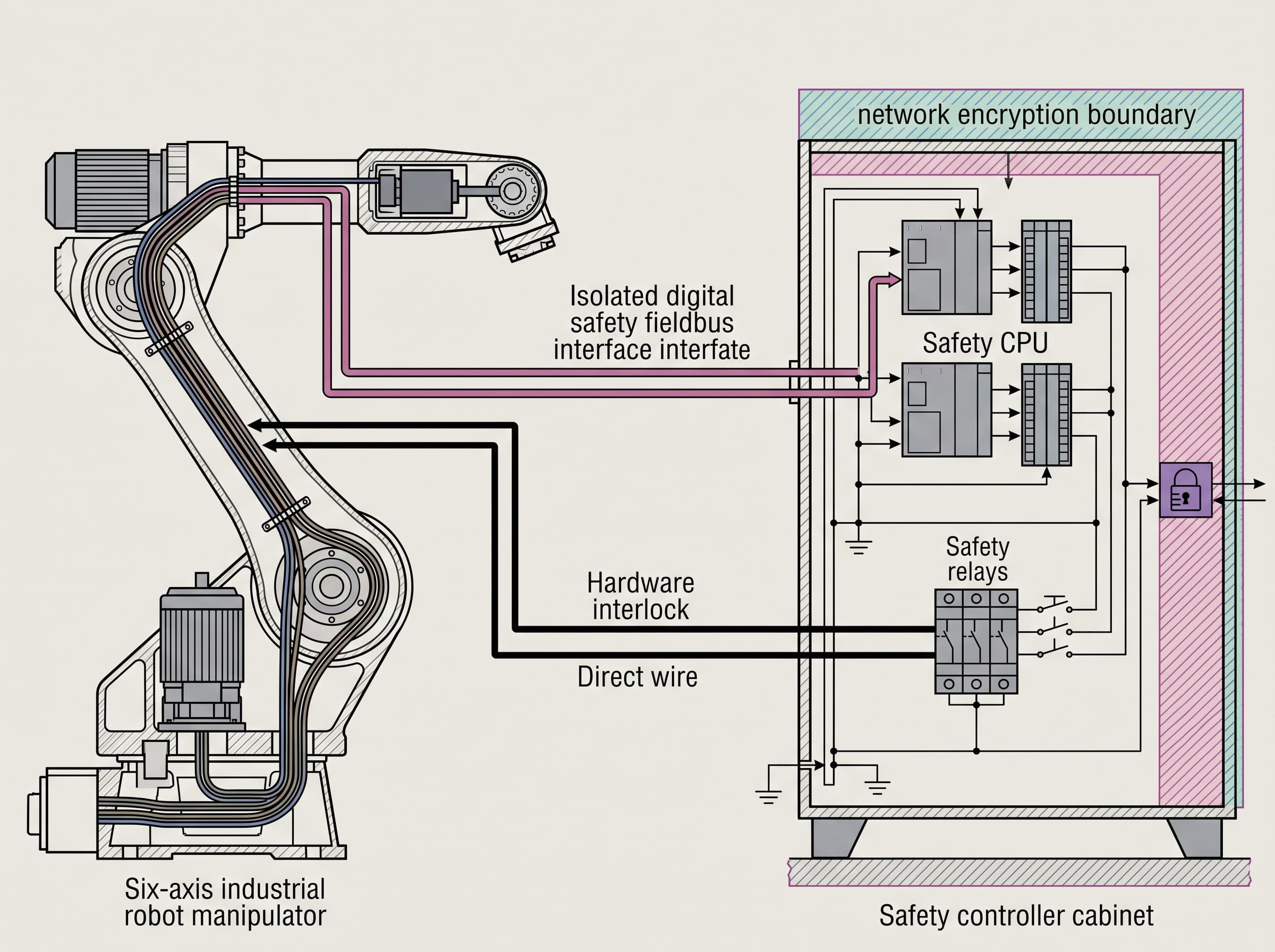
In addition to physical classification, ISO 10218-1:2025 establishes mandatory industrial cybersecurity requirements directly linked to functional safety2. Because modern robotic controllers connect to corporate networks, execution systems, and remote maintenance tools, external communication channels can introduce severe physical safety hazards. The revised standard mandates that controllers protect safety-related software and operational parameters against unauthorized network intrusion, remote tampering, or corrupted safety bus communications2. Manufacturers must implement hardware isolation, role-based cryptographic authentication, and hardened configurations to prevent external network attacks from compromising motion limits or safety stops.
Integration Realities: The 'Collaborative Application' and ISO/TS 15066 Absorption
For system integrators, ISO 10218-2:2025 establishes a definitive conceptual transition: safety compliance applies to the 'collaborative application' rather than an isolated 'collaborative robot'2. A certified lightweight manipulator fitted with sharp cutting blades, handling molten compounds, or gripping heavy stamped steel cannot be considered a safe collaborative installation without protective physical measures. Consequently, integrators must evaluate the entire operational ecosystem, factoring in payload geometry, tooling pinch points, dynamic transfer speeds, and nearby human transit zones during risk assessment2.
To provide legal and engineering certainty, ISO 10218-2:2025 fully incorporates the technical provisions previously established under the interim technical specification ISO/TS 15066 into its normative and informative sections23. Integrators must design protective systems around four operational collaborative methods: Safety-Rated Monitored Stop (SRMS), Hand Guiding (HG), Speed and Separation Monitoring (SSM), and Power and Force Limiting (PFL). Mixed-mode operations are common in high-efficiency facilities, where optical sensors or laser scanners allow a workcell to toggle between high-speed automated production and reduced-speed collaborative interaction based on operator proximity.
| Technical Domain | ISO 10218:2011 Baseline | ISO 10218:2025 Framework |
|---|---|---|
| Functional Safety Demands | Blanket mandate requiring PL d / Category 3 or SIL 2 across safety control functions | Abolition of blanket PL d; introduces informative default PLs per function with comprehensive risk assessment flexibility |
| Collaborative Work Criteria | General operational modes defined; relied on separate technical specification ISO/TS 15066 | Fully absorbed into normative Part 2; focuses on holistic 'collaborative application' rather than the manipulator alone |
| Manipulator Classification | Single industrial manipulator category with uniform mechanical and control criteria | Subdivided into Class 1 (reduced hazard, typically PL b) and Class 2 (higher hazard, standard industrial robots) |
| Biomechanical Verification | Limited annex guidance; lacked formal bio-fidelic apparatus requirements | Annex M pain thresholds (e.g., 140 N hand clamping) validated via calibrated bio-fidelic tools under Annex N |
| Industrial Cybersecurity | Not addressed within functional safety scope; treated as external plant IT policy | Mandatory functional safety protection against remote tampering, configuration manipulation, and fieldbus corruption |
Biomechanical Thresholds and Bio-Fidelic PFL Testing Under Annex M and N
Validating an installation under the Power and Force Limiting (PFL) regime demands rigorous compliance with empirical biomechanical criteria. ISO 10218-2:2025 integrates human pain and injury thresholds into informative Annex M, defining allowable dynamic impact forces and quasi-static pressure values across 29 discrete human body zones3. The standard distinguishes between transient contact (dynamic collision where an operator's body segment can freely recoil) and quasi-static contact (clamping, crushing, or trapping between the robot tooling and stationary fixture surfaces).
In manual load and unload configurations, quasi-static trapping represents the primary hazard. Annex M explicitly establishes that the maximum permissible quasi-static clamping force for human hands and fingers is 140 N3. Integrators cannot demonstrate compliance through nominal manufacturer payload limits, motor current monitoring, or theoretical CAD calculations alone3. Instead, Annex N mandates physical verification using calibrated bio-fidelic measuring equipment fitted with specified spring constants and mechanical damping layers that replicate human tissue properties3. Measurements recorded during worst-case trial strikes must demonstrate that sustained clamping remains strictly below 140 N to validate collaborative deployment without physical fencing3.
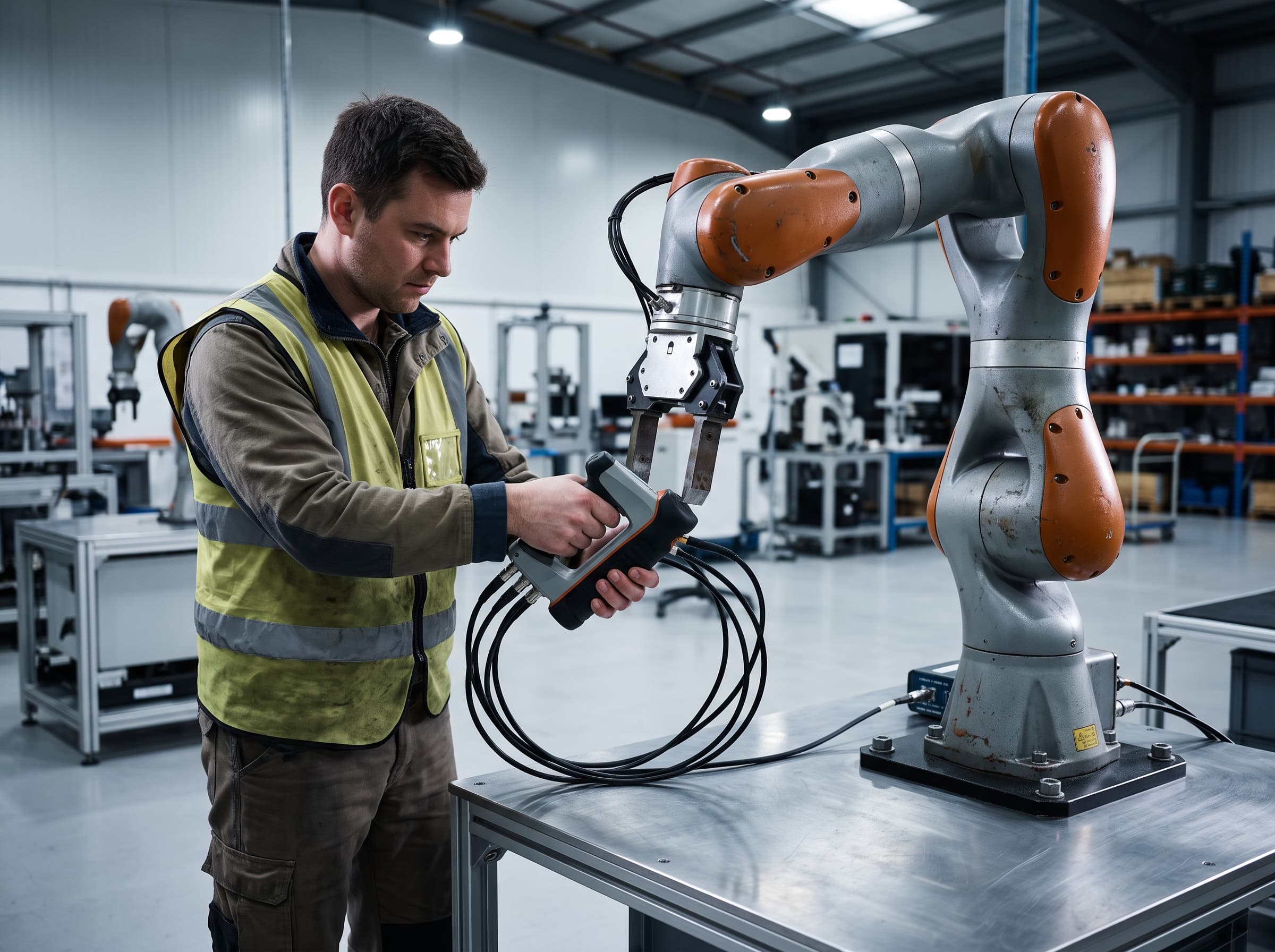
The Shift to Function-Specific Default PLs in Functional Safety Design
A pivotal evolution in ISO 10218-2:2025 is the fundamental departure from the legacy 2011 approach to functional safety architectures12. Previously, safety standards enforced a blanket rule requiring Performance Level d (PL d) with Category 3 architecture under ISO 13849-1, or SIL 2 under IEC 62061, across all safety-related control functions1. The 2025 revision largely abandons this uniform mandate, acknowledging that rigid requirements restrict practical design without necessarily mitigating task-specific risks12. Instead, ISO 10218-2 lists safety functions in an informative annex and assigns a tailored 'default performance level' to each individual function1.
Under this modern differentiated framework, standard Emergency Stop functions default to PL c / SIL 1, whereas active Protective Stop, Enabling Function, and Reduced Speed monitoring functions default to PL d / SIL 21. Integrators have two distinct design pathways: they may implement the specified default performance level directly, or they may execute a comprehensive risk assessment following ISO 10218-2 guidance to justify deviating from the default level1. While selecting an alternative PL requires thorough technical documentation and engineering justification, it grants design flexibility to tailor hardware redundancy and diagnostic coverage to specific operating risks12.
Regulatory Enforcement, EU Machinery Regulation, and Harmonized Timelines
The regulatory urgency surrounding ISO 10218-1:2025 and ISO 10218-2:2025 is directly linked to European machinery legislation. On 4 September 2026, the European Commission adopted Implementing Decision (EU) 2026/2015, which entered into force upon publication in the Official Journal on 7 September 202614. This decision officially added EN ISO 10218-1:2025 and EN ISO 10218-2:2025 to the list of harmonized standards under Directive 2006/42/EC, providing machinery manufacturers and integrators with an official presumption of conformity with essential health and safety requirements14.
This harmonized status serves as an operational stepping stone toward the mandatory enforcement of the new European Union Machinery Regulation (EU) 2023/12304. Regulation (EU) 2023/1230 officially starts to apply on 20 January 2027, the exact date on which Directive 2006/42/EC is repealed4. Any robotic cell placed on the European market, commissioned, or undergoing substantial modification after 20 January 2027 must conform to these modern requirements4. Integrators and plant managers must audit technical construction files, transition safety validation calculations to the default PL framework, and verify bio-fidelic force limits to prevent regulatory delays and non-compliance penalties134.
Frequently asked questions
Q. When do the updated ISO 10218-1:2025 and ISO 10218-2:2025 standards take effect?
A. ISO published both standards in February 2025. In Europe, they were published as harmonized standards in the Official Journal on 7 September 2026 via Decision (EU) 2026/2015, and they align directly with mandatory compliance under EU Machinery Regulation 2023/1230 starting 20 January 2027.
Q. Do robotic safety control circuits still require a mandatory blanket PL d / Category 3?
A. No. ISO 10218-2:2025 abandoned the blanket PL d / Cat 3 requirement. It introduces an informative list of safety functions with function-specific default PLs (e.g., PL c for Emergency Stop, PL d for Protective Stop and Reduced Speed) and permits alternative PLs when justified through comprehensive risk assessments.
Q. What is the maximum permissible quasi-static clamping force for hands and fingers under PFL mode?
A. Under ISO 10218-2:2025 Annex M, the maximum permissible quasi-static clamping force for human hands and fingers is established at 140 N, which must be physically validated using bio-fidelic measuring equipment according to Annex N procedures.
Q. What happened to the technical specification ISO/TS 15066?
A. The technical specifications, biomechanical limits, and collaborative operating modes previously published in ISO/TS 15066 have been formally absorbed into the normative text and annexes (such as Annex M and N) of ISO 10218-2:2025.
Sources