 Industrial Solution Finder

ISA-95 B2MML structures MES-ERP exchange by mapping business orders to shop-floor segments using XML schemas that bind material lots, sublots, and equipment IDs to execution responses.
Architectural Foundations: The ISA-95 Object Model and B2MML Schema
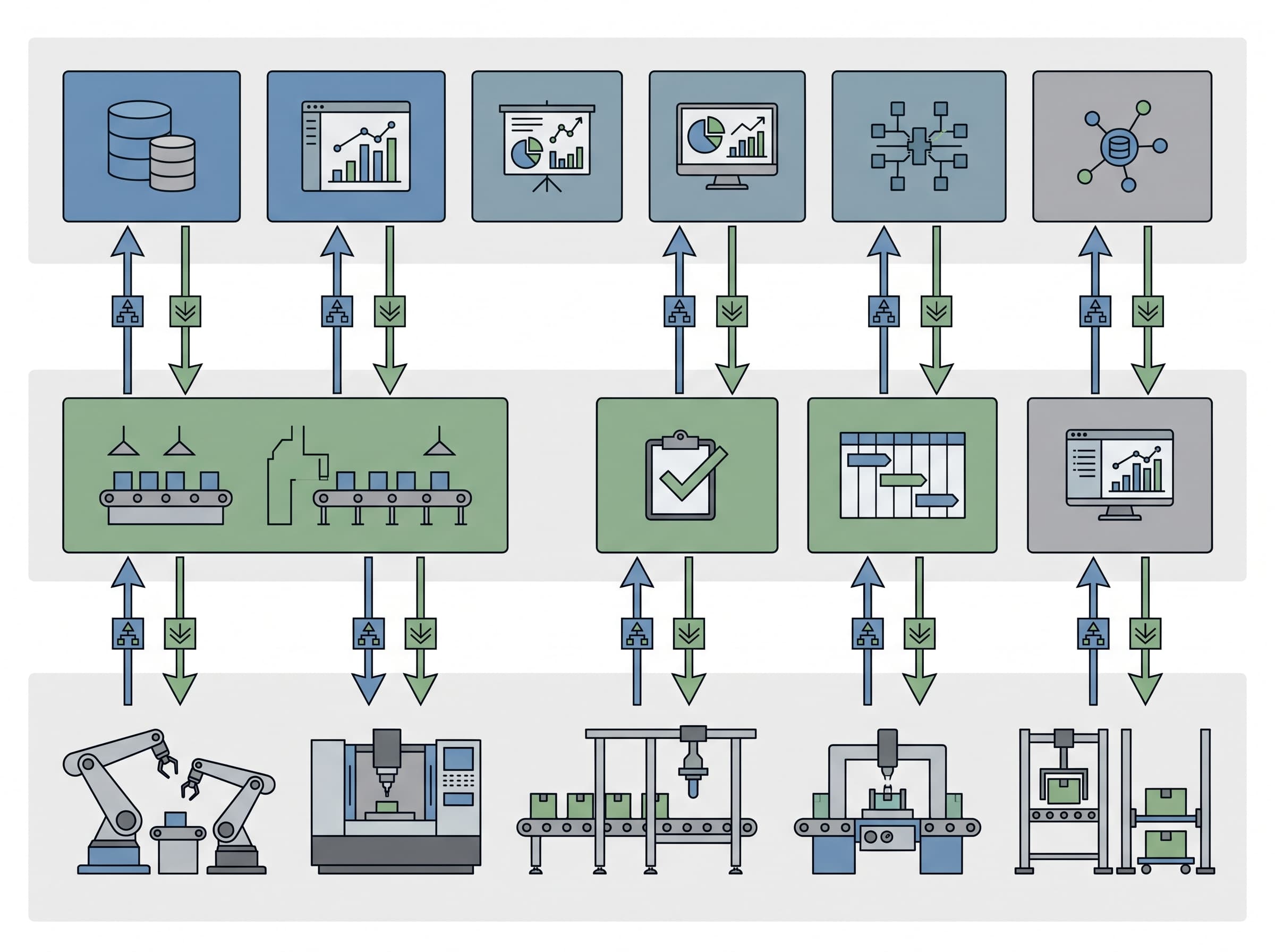
Modern industrial operations require seamless vertical integration between enterprise resource planning (ERP) business systems and manufacturing execution systems (MES) operating on the plant floor. Historically, custom point-to-point interfaces introduced severe maintenance overhead, data siloing, and fragile dependencies. When tracking complex batch conversions or discrete assemblies, proprietary data formats made it nearly impossible to trace raw ingredients through intermediate stages to finished goods. The ANSI/ISA-95 enterprise-control system integration standard, codified internationally as IEC 62264, addresses this friction by providing a universal object model and common terminology. In manufacturing environments as of October 2026, the Business To Manufacturing Markup Language (B2MML) serves as the primary World Wide Web Consortium (W3C) XML schema implementation of ISA-95 models.
Originally introduced by the World Batch Forum (WBF), B2MML governance transitioned to MESA International in June 2012, which maintains and distributes the official schema sets12. ANSI/ISA-95 Parts 1, 2, 4, and 5 establish common definitions across four core manufacturing operations management (MOM) domains: production, quality tests, warehousing and inventory, and maintenance12. According to observations published in a 2012 InTech journal article by Dennis Brandl, applying standardized ISA-95 structures was cited as shortening average integration cycles from years to months while raising project success rates from under 30 percent to over 80 percent2. By abstracting proprietary database structures into vendor-neutral XML definitions, B2MML allows production engineers to model physical equipment hierarchies and material tracking parameters without rewriting low-level adapter logic.
Upstream Dispatch: Translating ERP Schedules into Shop-Floor Work Orders
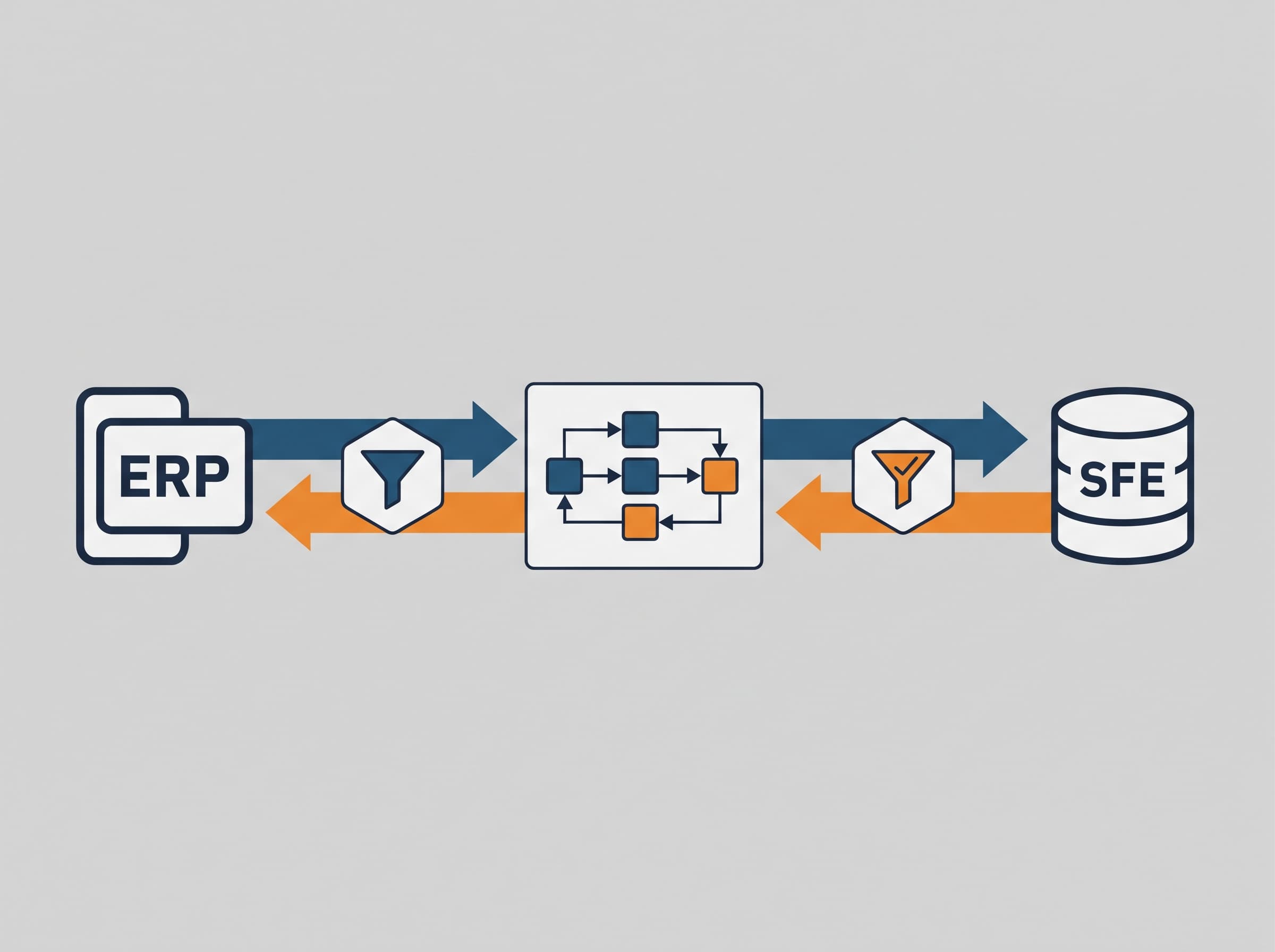
The transaction loop begins at Level 4 (ERP), where production planners generate enterprise work orders driven by customer demand, forecasted inventory targets, and material availability. In an unstandardized ecosystem, these work orders arrive as high-level line items lacking operational constraints, routing nuances, or localized resource allocations. Through B2MML, the enterprise transmits a ProductionSchedule document defined by the ProductionSchedule.xsd schema13. This schema packages essential business headers, target production quantities, Bill of Material (BOM) constraints, and enterprise lot authorizations into a deterministic XML hierarchy. Within this dispatch transaction, the ERP establishes an order identifier inside the ProductionRequest element using the ID tag, establishing a distinct reference for the shop floor13.
Upon receiving the ProductionSchedule payload, the Level 3 MES parses the high-level schedule and splits business orders into granular shop-floor operations. Because Level 4 systems lack visibility into real-time equipment availability, tool calibrations, or operator shift certifications, the MES maps the high-level demand to discrete process segments. Each segment corresponds to a specific physical station, such as weighing, compounding, machining, or heat treating. To maintain strict genealogy, the MES cross-references the enterprise ProductionRequest ID with localized work order IDs, ensuring that every operational segment inherits the parent business parameters13. If an ERP attempts to change schedule priorities, the schema structures bidirectional delta updates, preventing duplicate order generation and mitigating operational latency on the floor.
Downstream Execution: Capturing Granular Genealogy via Segment Responses
While scheduling flows downward, the physical creation of lot genealogy occurs entirely during execution on the shop floor. As workers or automated cells process material, the MES records actual operational parameters, consumable usage, equipment states, and sensor telemetry. When a shift finishes an operational segment or completes an entire production order, the MES compiles an upward data payload using the ProductionPerformance.xsd schema13. The top-level root element in this schema encapsulates one or more ProductionResponse structures1. To close the accounting loop, each ProductionResponse references the original ERP order by populating the RequestID tag with the initial ProductionRequest ID, linking actual execution data directly to enterprise financial and scheduling records13.
Within each ProductionResponse, the B2MML model nests multiple SegmentResponse elements1. These segments represent the lowest logical execution units on the plant floor. For each SegmentResponse, the payload encapsulates critical traceability tags, including MaterialDefinitionID, MaterialLotID, MaterialSubLotID, Quantity, and UnitOfMeasure14. This schema structure enables true bidirectional forward and backward genealogy. When an operator scans an active barcode or RFID tag at a batch reactor, the MES records the raw material lot number into the SegmentResponse as a consumed input. Simultaneously, the reactor discharges an intermediate product tagged with a newly generated sublot identifier. By transmitting this structured response back to the ERP, the enterprise database maintains an unbroken chain linking raw vendor batches to the outbound finished lot.

Material Tracking Hierarchy: Distinguishing Classes, Definitions, Lots, and Sublots
Achieving rigorous traceability requires precise semantic separation between abstract inventory classifications and physical material instances. ISA-95 Part 2 and the MESA B2MML-Material.xsd schema formalize this distinction by defining four interconnected material entities: Material Class, Material Definition, Material Lot, and Material Sublot45. A Material Class groups items with common functional or physical characteristics, such as pharmaceutical grade binders or structural grade aluminum alloys. The Material Definition specifies the formal SKU or part number, outlining engineering specifications and physical properties. While these upper models govern procurement and design rules, they do not carry physical timestamps, batch expiry dates, or vendor shipment credentials.
Physical custody and genealogical chains reside within the Material Lot and Material Sublot constructs. A Material Lot represents a uniquely identified instance of a Material Definition produced or acquired under uniform conditions, often used to track specific shipments or production orders5. In bulk chemical, metal alloy, or pharmaceutical processing, an entire production run might share a single Material Lot identifier. However, if that parent lot is split into individual drums, totes, or pallets, assigning tracking parameters purely at the lot level creates genealogical ambiguity. The Material Sublot resolves this challenge as a uniquely identified subset of a lot that inherits properties from its parent lot, providing tracking resolution within lots—such as tracing ten individual barrels received under a single shipment45. If contamination occurs within a single storage drum, quality teams inspect only the targeted MaterialSubLotID without unnecessarily quarantining or recalling the entire parent MaterialLotID across the enterprise.
| Tracking Entity | B2MML Schema Element | Scope of Application | Primary Role in Lot Genealogy |
|---|---|---|---|
| Material Class | <MaterialClassID> | Enterprise / Plant-wide | Categorizes general material groupings and operational requirements without binding to specific SKUs. |
| Material Definition | <MaterialDefinitionID> | ERP Master Data | Defines specific SKU parameters, nominal specifications, and bill of material component references. |
| Material Lot | <MaterialLotID> | Batch / Production Run | Tracks unique production runs, procurement supplier batches, shelf-life limits, and primary quality test logs. |
| Material Sublot | <MaterialSubLotID> | Unit Container / Pallet | Isolates discrete physical sub-quantities within a lot to enable precise unit-level quarantine and lineage tracking. |
System Integration Architecture: Middleware, OPC UA Mapping, and Failure Handling
Deploying B2MML in production environments involves more than simply exporting raw XML files between servers. Real-world IT and OT convergence depends on message-oriented middleware (MOM) platforms, Enterprise Service Buses (ESB), or modern publish-subscribe event brokers like Apache Kafka. A primary architectural consideration when transmitting B2MML documents is maintaining consistent identifier scoping across enterprise systems. While objects like ProductID and EquipmentID are maintained as globally unique across systems3, B2MML common schema rules state that general element IDs are formally unique within the scope of the exchanged message context1. To avoid collision across multi-site production facilities, integration architectures standardly apply site prefixes, explicit HierarchyScope elements, or enterprise UUID wrappers to localized MaterialLotID values1.
Furthermore, shop-floor integration extends downward to physical controllers. While B2MML handles transactional and document-centric exchanges between MES and ERP, real-time machine telemetry links directly through OPC Unified Architecture (OPC UA). Under the companion specification developed by the OPC Foundation and MESA International, ISA-95 object models—including material, equipment, and physical assets—are mapped directly into OPC UA address spaces5. This unification allows the MES to poll active PLC tags, verify equipment run states, and bind automated sensor readings to B2MML SegmentResponse structures in real time. Systems must also implement robust transactional acknowledgment queues (such as ConfirmBOM or AcknowledgeProductionPerformance) to prevent orphaned work orders if network drops occur between Level 3 and Level 4 networks.
Implementation Criteria and Governance Checklist for Enterprise Traceability
Engineering teams preparing an ISA-95 B2MML deployment must assess several operational and architectural prerequisites before configuring schema mappings. While the standard provides structural consistency, it does not dictate internal business policies, naming conventions, or regulatory validation protocols. Regulatory environments—such as FDA 21 CFR Part 11 for life sciences or aerospace AS9100 standards—impose strict audit trail, electronic signature, and time-stamping mandates that must be built around the B2MML payloads. System architects must clearly demarcate boundaries between master data ownership: typically, the ERP owns master material definitions, while the MES strictly governs physical lot creation, child sublot splits, and equipment assignment records.
To ensure reliable long-term genealogy exchange, implementation teams should evaluate their enterprise architecture against the following core technical criteria:
Frequently asked questions
Q. What is the primary difference between ISA-95 and B2MML?
A. ISA-95 is an abstract conceptual standard (IEC 62264) defining enterprise-control integration models, terminology, and operational activities. B2MML is the official XML schema implementation managed by MESA International that translates ISA-95 conceptual models into machine-readable data exchange structures.
Q. How does B2MML support backward and forward lot traceability?
A. B2MML embeds MaterialLotID and MaterialSubLotID within nested Segment Response elements inside the Production Performance message. This links consumed raw material lot inputs directly to intermediate and final output lots produced at specific operational segments.
Q. Which schema files govern the dispatch and completion of work orders?
A. Work orders are dispatched downward from ERP to MES using the ProductionSchedule.xsd schema, while completed execution results, scrap quantities, and consumed lots return upward via the ProductionPerformance.xsd schema.
Q. Does ISA-95 B2MML mandate a specific networking protocol or middleware?
A. No. B2MML defines data formatting and structure using W3C XML schemas. The transport mechanism—such as HTTPS REST APIs, SOAP, message queues (JMS, AMQP), or event streams like Apache Kafka—is determined by the enterprise architectural design.
Sources
- B2MML-BatchML/Schema/B2MML-Common.xsd at master · MESAInternational/B2MML-BatchMLMESA International
- (PDF) Business-to-shop integration realized through B2MML: XML standard simplifies ISA-95 data exchangeResearchGate
- IEC 62264-2:2013 Enterprise-control system integration - Part 2: Objects and attributes for enterprise-control system integrationiteh.ai
- B2MML-BatchML/Schema/B2MML-Material.xsd at master · MESAInternational/B2MML-BatchMLMESA International
- Modelling Approach of ISA-95 – OPC Unified Architecture - Common Object ModelOPC Foundation