 Industrial Solution Finder
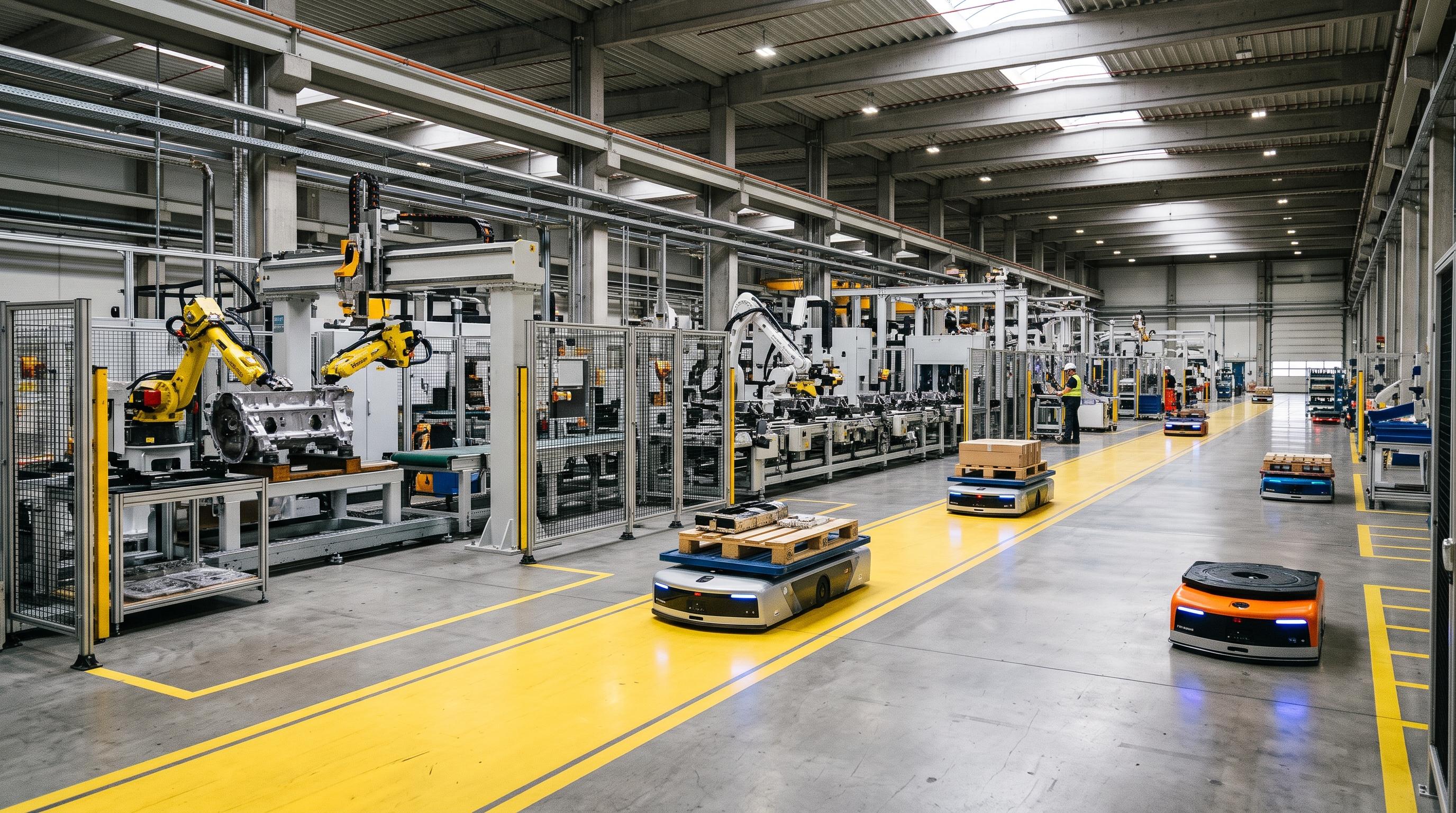
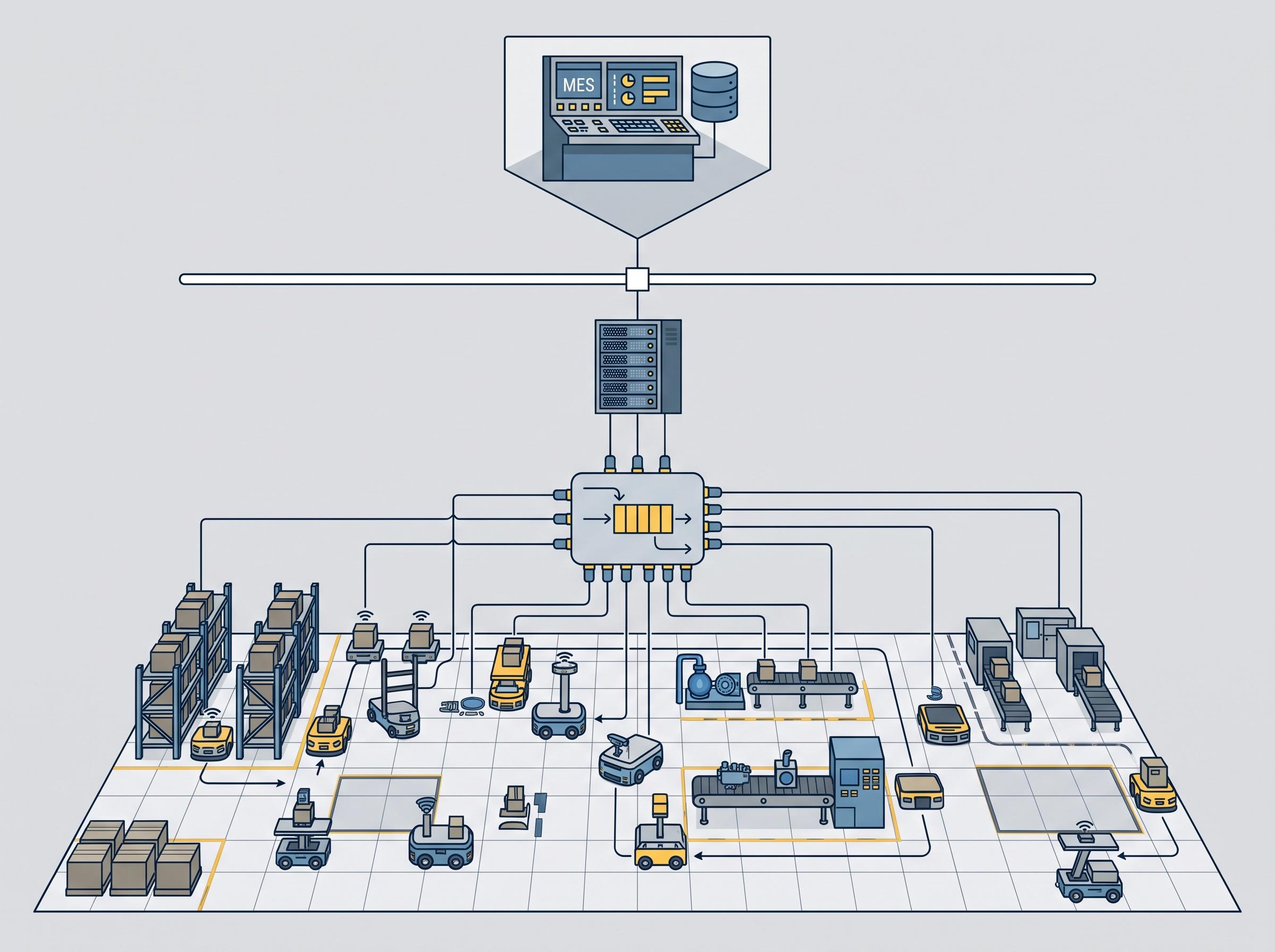
Plants implement VDA 5050 by separating production orders from kinematics: the MES dispatches high-level transport jobs to a master fleet controller, which translates them into VDA 5050 JSON orders published over MQTT to heterogeneous AGVs and AMRs.
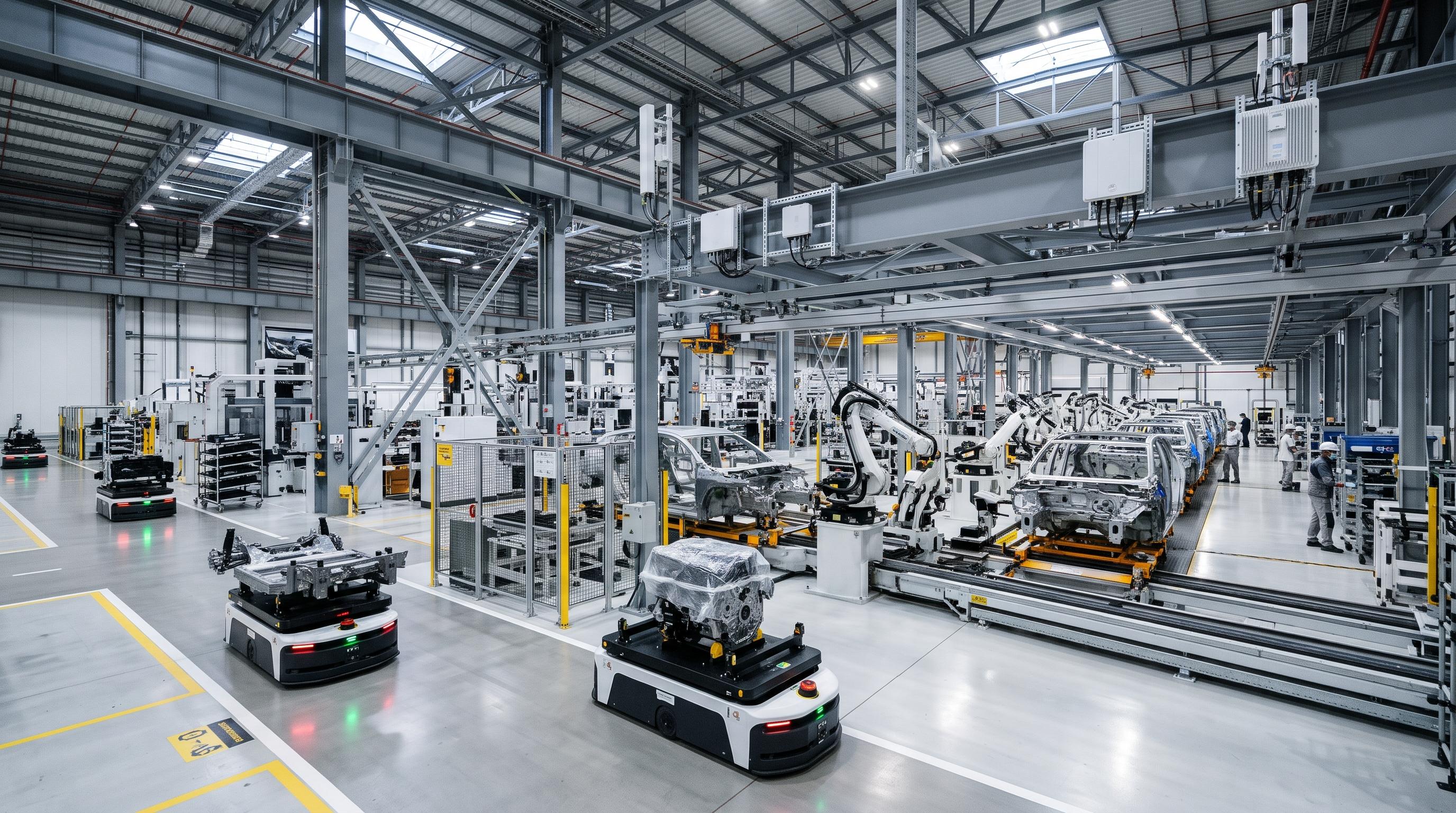
Automated material handling in modern manufacturing facilities frequently encounters operational friction when mobile transport units from different original equipment manufacturers (OEMs) operate within the same facility footprint. Pallet-handling automated guided vehicles (AGVs), autonomous mobile robots (AMRs) for tugging carts, and specialized case conveyors often rely on proprietary fleet management servers. Without a shared communication layer, manufacturing execution systems (MES) must integrate independently with every vendor-specific controller. This fragmentation creates physical deadlocks at shared plant intersections, complicates software maintenance, and blinds the central dispatch engine to aggregate fleet capacity1.
The VDA 5050 interface was created through joint efforts by the German Association of the Automotive Industry (Verband der Automobilindustrie, VDA), the Mechanical Engineering Industry Association (VDMA), and the Karlsruhe Institute of Technology (KIT) to resolve vendor lock-in1. It establishes an open, vendor-neutral protocol over Message Queuing Telemetry Transport (MQTT) and JSON data payloads, enabling a single master fleet control platform to direct heterogeneous mobile units. However, implementing this architecture in active production requires engineering teams to delineate architectural boundaries between business logic in the MES, dynamic path scheduling in the master fleet controller, and physical machine safety enforced at the vehicle hardware layer3.
Architectural Topology: MES, Master Fleet Controller, and the MQTT Layer
A standard pitfall in early-stage deployments is attempting to make the MES issue VDA 5050 messages directly to individual vehicles. An MES is structured for high-level manufacturing state machines: work order dispatch, bill-of-materials routing, process tracking, and enterprise resource planning (ERP) synchronization. It does not operate on high-frequency temporal loops or maintain real-time plant kinematics. Directing node-by-node path movements directly from an MES overwhelms enterprise messaging buses and bypasses topological routing intelligence1.
In a robust implementation, the integration architecture consists of three clean layers. At the top level, the MES communicates with a centralized Master Fleet Controller (Master Control) using industrial interfaces such as OPC Unified Architecture (OPC UA) or REST APIs. The MES transmits abstract material movement orders consisting of pick locations, target process cells, pallet IDs, and delivery deadlines1. The Master Fleet Controller acts as the operational orchestrator: it ingests the master plant CAD layout (often structured using the Layout Interchange Format, LIF), calculates deadlocks, balances fleet utilization, and maps abstract jobs into granular VDA 5050 coordinate trajectories14.
At the field tier, communication between the Master Fleet Controller and individual vehicles flows through an enterprise MQTT message broker running at least MQTT version 3.1.14. Topics follow a strictly standardized hierarchical namespace formatted as majorVersionPrefix/version/manufacturer/serialNumber/subtopic, such as uagv/v2/vendorX/AGV-042/order1. This publish-subscribe pattern allows wildcards for broadcast monitoring while isolating specific command routes for each physical vehicle on the shop floor1.
VDA 5050 Message Contract and the Base-Horizon Routing Concept
The core communication interface is governed by defined topic channels1. The 'order' topic conveys mission assignments from the master controller to the vehicle, while 'instantActions' delivers immediate priority directives such as pausing, canceling, or resuming operations without dropping the current sequence14. Conversely, each mobile unit continuously reports operational telemetry via the 'state' topic, broadcasts high-rate coordinates over the 'visualization' topic, provides a persistent ping via 'connection' using MQTT last-will mechanisms, and declares its hardware geometry and physical limits via the 'factsheet' topic11.
Trajectory execution within the 'order' payload uses a topological graph composed of nodes (points where spatial actions or halts occur) and edges (connecting paths that vehicles traverse)1. To negotiate intersections between competing manufacturers, VDA 5050 splits each order into two discrete segments: the 'Base' and the 'Horizon'1. The Base contains confirmed nodes and edges that the vehicle is explicitly cleared to traverse immediately without intermediate confirmation1. The Horizon contains upcoming planned path elements that provide a preview to the vehicle's local controller but remain subject to dynamic alteration by the master controller1.
By advancing the Base edge-by-edge, the master controller orchestrates mixed fleets through high-traffic convergence zones without physical collisions. For example, when a line-following AGV from Vendor A and an autonomous AMR from Vendor B approach a four-way intersection, the master controller releases the Base up to the threshold node for both units. It then issues an order update appending the crossing edge only to the vehicle with right-of-way, holding the second vehicle safely at its standstill node until the path clears1.
| Topic Channel | Transmission Direction | Primary Message Content | Typical Frequency / Trigger | Standard Status |
|---|---|---|---|---|
| order | Master Control to Vehicle | Topological graph of nodes, edges, base/horizon segments, and station actions | Event-driven on new order or path extension | Mandatory |
| instantActions | Master Control to Vehicle | Immediate execution directives: pause, resume, cancelOrder, trigger | Event-driven on operator or logic override | Mandatory |
| state | Vehicle to Master Control | Full operational telemetry: battery level, node progress, load state, error codes | Event-driven on state change or minimum 30s heartbeat | Mandatory |
| visualization | Vehicle to Visualization/Master | Lightweight payload containing current Cartesian coordinates, heading, and speed | High frequency: typically 1 Hz or faster | Optional |
| factsheet | Vehicle to Master Control | Physical vehicle dimensions, load capacities, kinematic constraints, protocol features | Sent once upon vehicle connection setup | Mandatory |
| connection | Vehicle / Broker to Master Control | Connection status indicators; utilizes MQTT Last Will and Testament (LWT) | Sent upon connect, disconnect, or timeout failure | Mandatory |
| zoneSet | Master Control to Vehicle | Contour-based and kinematic-center spatial zones governing vehicle behavior | Event-driven upon dynamic zoning or perimeter updates | Optional (New in Version 3.0.0) |
| responses | Master Control to Vehicle | Direct responses and acknowledgments from master control to vehicle requests | Event-driven upon receiving actionable vehicle requests | Optional (New in Version 3.0.0) |
Evolving Standards: Version Differences and Dynamic AMR Navigation
A frequent cause of project delays is mismatched version support between vehicle onboard firmware and the master fleet controller software5. While Version 2.0.0 and Version 2.1.0 standardized base factsheets and driving corridors, mobile robot deployments gained enhanced capabilities on March 19, 2026, when VDA 5050 Version 3.0.0 was officially released2. Version 3.0 expands beyond strict deterministic path guidance by formally supporting freely navigating mobile robots2.
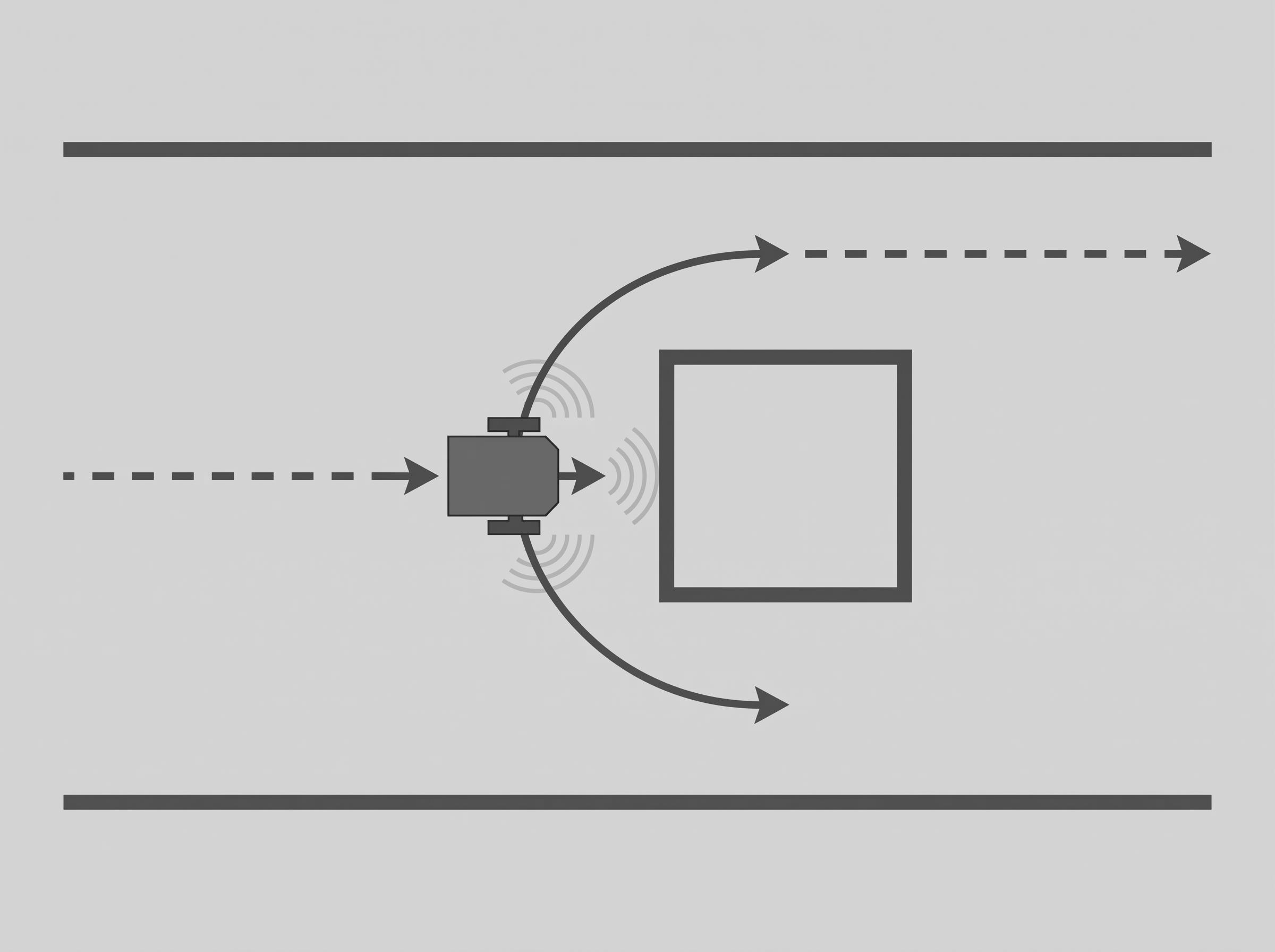
Earlier protocol revisions forced AMRs to emulate rigid guided AGVs, dampening their native obstacle-avoidance autonomy. Under Version 3.0.0, AMRs can transmit their internally computed routes back to the master controller via planned path sharing2. Furthermore, the introduction of dynamic zones allows the master control system to define contour-based and kinematic-based operational zones2. In tight, pedestrian-heavy production cells, the master controller can constrain the AMR's navigation contour, whereas in open staging bays it permits free-roaming path planning. Version 3.0 also adds structured operating modes such as STARTUP and INTERVENED, new error tiers (CRITICAL and URGENT), and the SINGLE blocking type to ensure non-concurrent peripheral actions execute safely without stalling the vehicle's driving motors2.
Functional Safety Boundaries and ISO 3691-4 Separation
Plant safety engineers must enforce a strict separation between software orchestration and functional machine safety. VDA 5050 is an operational logistics protocol; it is not a safety-rated fieldbus certified under IEC 61508 or ISO 13849 Safety Integrity Levels (SIL) / Performance Levels (PL)13. Consequently, safety-critical actions—such as personnel collision avoidance, safety-rated protective stop zones, and emergency stop circuits—must execute locally on each vehicle's onboard Safety PLC and safety laser scanners13.
Mobile robotic equipment deployed in industrial environments must conform to ISO 3691-4:2020 (driverless industrial trucks and their systems), with its core personnel safety criteria reaffirmed in the ISO 3691-4:2023 revision3. The software orchestration layer should never be trusted to enforce stopping distances or human detection. When vehicles dock into machinery or transfer pallets at stationary conveyors, safety fields are often temporarily altered. Under ISO 3691-4:2023 Clause 4.8.2.3, muting (temporary deactivation of active protective detection fields during load transfer) is strictly regulated and permitted only when the vehicle speed is restricted to 0.3 m/s or less (a safety ceiling maintained across both ISO 3691-4:2020 and ISO 3691-4:2023)3. Furthermore, facilities operating within Europe must account for the upcoming EU Machinery Regulation (EU) 2023/1230—enforceable in January 2027—which places even greater regulatory emphasis on mandatory risk assessments for autonomous mobile machinery and software safety functions. These protective limits must be hardwired into safety controllers rather than commanded dynamically via MQTT JSON payloads13.
Step-by-Step Implementation and Verification Roadmap
Successfully integrating mixed-vendor fleets requires a staged execution procedure. Field testing should begin at the interface layer before releasing physical machines into mixed production aisles5. Integration teams can build or adopt open-source client-adapter and master tools, such as the ROS-Industrial vda5050_core library, to validate JSON schema parsing and state-machine transitions across all integrated robot hardware5.
Deployments typically follow a rigorous five-phase engineering lifecycle: 1. Broker Infrastructure Provisioning: Deploy a redundant, clustered MQTT broker with TLS encryption, mutual certificate authentication (X.509), and defined quality of service (QoS) levels (typically QoS 1 for orders, QoS 0 for visualization)11. 2. Adapter Development or Firmware Harmonization: Verify each OEM's compliance. While some vehicles natively support VDA 5050, others require an edge gateway or onboard adapter (such as an embedded micro-PC running a ROS 2 client adapter) to convert the vehicle's native SDK into VDA 5050 topics55. 3. Digital Map and Node Alignment: Standardize facility coordinate systems. Discrepancies between local AMR SLAM maps and global plant CAD grids must be calibrated to ensure identical geographic coordinates across all vendor fleets4. 4. Closed-Loop Hardware-in-the-Loop (HIL) Sandbox: Validate that all vehicles accept standard instantActions (cancelOrder, pause, trigger) and correctly populate the factsheet JSON document before running physical routes2. 5. Safety Sign-off: Complete safety validation under ISO 3691-4 with licensed functional safety certifiers, confirming that laser protective fields, physical stopping distances, and muting conditions perform autonomously during Wi-Fi drops3.
Transfer-Station Handshakes and Peripheral Blind Spots
A standard blind spot during facility commissioning occurs at material transfer stations, such as palletizing cells, automated high-density rack interfaces, and roller conveyors. Section 2 of the VDA 5050 specification expressly states that interfaces to external infrastructure, stationary conveyor PLCs, fire doors, and lifts fall outside the standard's scope4. VDA 5050 standardizes vehicle-level actions (e.g., pick, drop, finePositioning, and waitForTrigger), but it does not specify direct handshakes between a mobile robot and a stationary machine4.
Engineering teams must decide between direct peripheral communication and central master orchestration4. Direct vehicle-to-station communication uses dedicated hardware links such as point-to-point infrared optical sensors or local industrial Wi-Fi I/O to confirm physical load alignment and conveyor interlocks4. Alternatively, master-mediated signaling routes the handshake through the factory network: the vehicle issues a waitForTrigger action and halts; the master controller queries the cell PLC over OPC UA; and once the conveyor confirms pallet readiness, the master sends an instantAction 'trigger' to allow the mobile unit to complete its load cycle42.
Frequently asked questions
Q. Can VDA 5050 be used over public cloud networks for remote fleet control?
A. While MQTT technically operates over WAN networks, industrial mobile robot fleets require low, predictable latency and high reliability. Transport order coordination and collision management should run on local plant networks or on-premise edge servers with redundant local brokers to prevent network timeouts from stranding moving vehicles.
Q. Does VDA 5050 replace the safety laser scanner requirements on AMRs?
A. No. VDA 5050 is strictly a task and traffic orchestration protocol, not a functional safety protocol. All emergency stopping, personnel detection, and compliance with ISO 3691-4 must be handled locally and autonomously by safety-rated controllers and hardware sensors on each vehicle.
Q. What is the difference between VDA 5050 Version 2.0 and Version 3.0?
A. Version 2.0 standardized fixed-path AGV routing using nodes, edges, and factsheets. Version 3.0, released in March 2026, officially introduces full support for autonomous mobile robots (AMRs), including dynamic path sharing, contour- and center-based zones, new operating states (such as STARTUP and INTERVENED), and fine-grained error severity tiers.
Sources
- Official Specification document for the VDA 5050VDA / VDMA (hosted on GitHub by KIT-IFL)
- Releases · VDA5050/VDA5050Karlsruhe Institute of Technology (KIT-IFL) / VDA
- Automatic Guided Vehicles: Safe navigation in intralogisticsTÜV Rheinland
- VDA 5050 in practice: KLT palletizing and AMR handoverUnchained Robotics
- GitHub - ros-industrial/vda5050_core: VDA5050 Library and Support ToolsROS-Industrial