 Industrial Solution Finder

Private 5G URLLC is justified over Wi-Fi 6E when AMR safety loops require sub-10 ms deterministic latency at 99.999% availability, seamless DAPS handovers to avoid ISO 3691-4 safety stops, and plant downtime costs surpass private cellular deployment overhead.
Operational Boundaries and Deterministic Requirements for Industrial AMRs
In large automotive, aerospace, and heavy machinery assembly plants, Autonomous Mobile Robots (AMRs) execute high-frequency intralogistics tasks alongside human operators. Operating these platforms requires resilient wireless communication links between onboard vehicle controllers, fleet management supervisory software, and programmable logic controllers (PLCs). Under standard operating conditions, unmanaged wireless variations force vehicles into safety fault routines. Plant engineering teams must distinguish between general data exchange—such as telemetry monitoring or mission dispatch—and real-time cyber-physical closed-loop control where timing deterministic guarantees are mandatory.
The industrial baseline for cyber-physical control requires strict communication service availability between 99.9% and 99.999% alongside bounded end-to-end user-plane latency ranging from 1 to 10 ms1. Furthermore, if a communication link exceeds its agreed survival time—the duration an application can tolerate missing data packets before requiring safety intervention—the system enters an unrecoverable state1. Choosing between cellular Ultra-Reliable Low-Latency Communication (URLLC) and unlicensed enterprise wireless standards like Wi-Fi 6E requires evaluating physical layer RF propagation across metal-dense structures, handoff protocol mechanics, and regulatory machine safety liabilities.
Handover Mechanics: Seamless Cellular Handoffs vs. Client-Driven Roaming
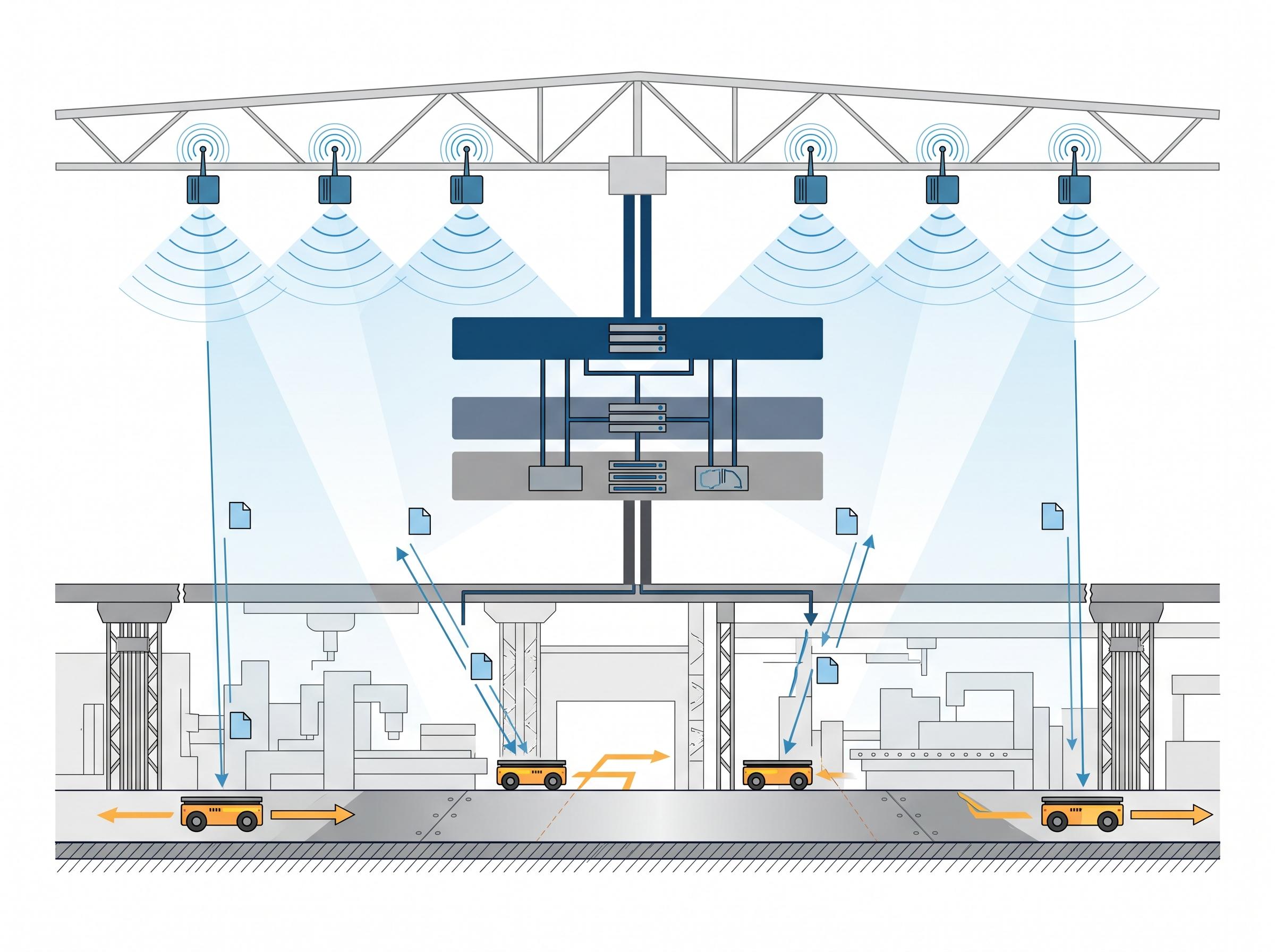
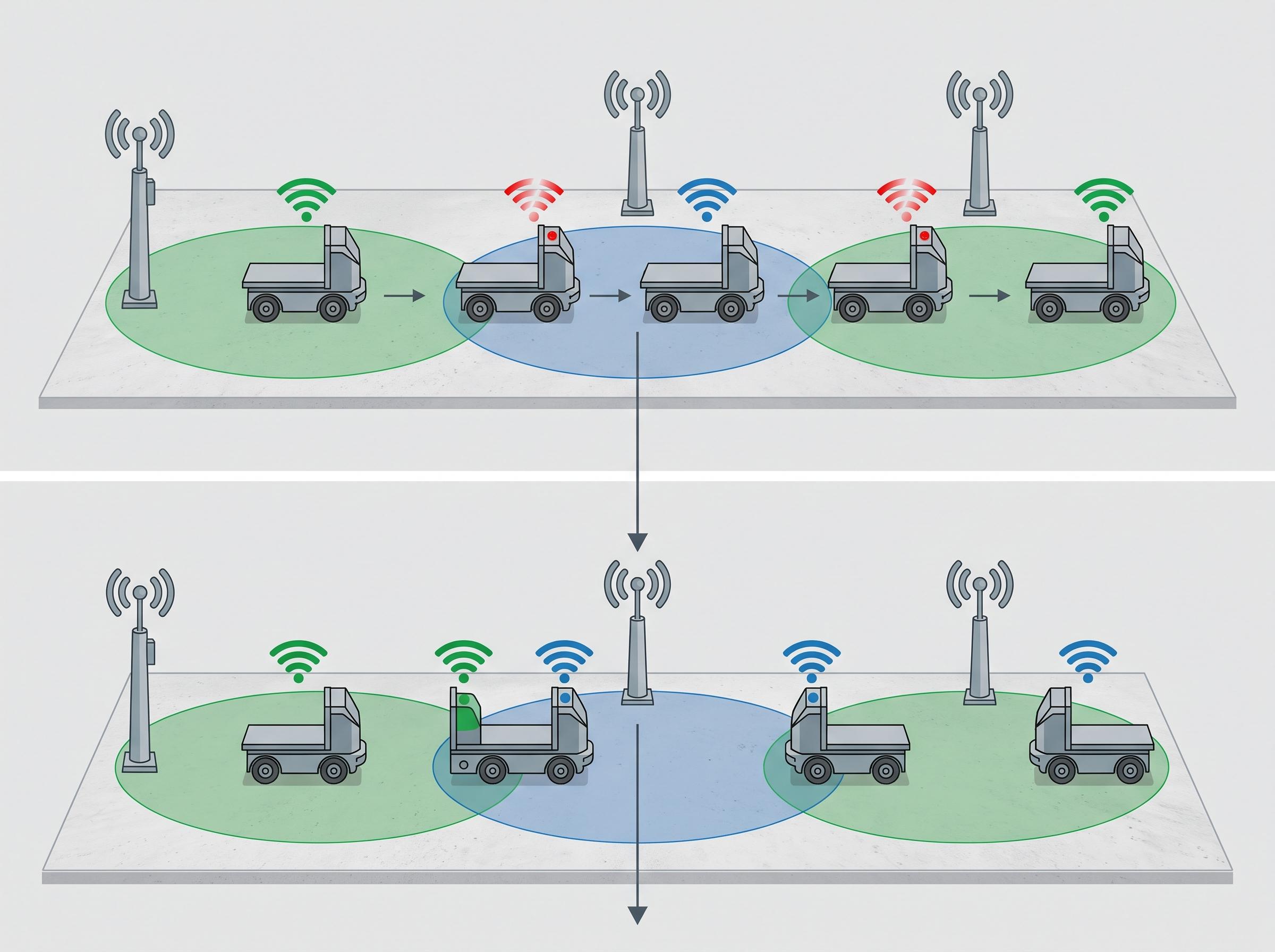
The fundamental architectural divergence between Private 5G Standalone (SA) URLLC and Wi-Fi 6E lies in how roaming between radio access nodes is governed. Wi-Fi 6E relies entirely on client-driven roaming algorithms implemented in the AMR onboard radio firmware. When an AMR traverses metal-dense corridors, the client monitors Received Signal Strength Indicator (RSSI) degradation before initiating channel scans. In dense industrial environments subject to severe multipath reflections, this probe, authentication, and re-association sequence can introduce substantial tail latency spikes and transient packet loss.
In contrast, Private 5G utilizes network-controlled handovers defined by 3GPP standards. In basic Standalone deployments using standard single-radio hard handovers, brief interruption windows between 10 and 40 ms occur during target cell re-attachment2. However, when leveraging 3GPP Release 16 Dual Active Protocol Stack (DAPS) with dual-carrier or dual-stack user equipment, the mobile robot maintains simultaneous active user-plane sessions with both source and target gNodeBs, driving handover interruption time down to ~0 ms (under 1 ms)2. This eliminates localized packet drops when AMRs transit between radio coverage zones.
Safety Standard Compliance and the Impact of Micro-Stoppages
Industrial driverless mobile platforms are governed by international machinery safety standards, notably ISO 3691-4:2023. Under Clause 4 (specifically subclause 4.11 covering safety-related parts of control systems), the standard dictates that any detected communication fault, safety circuit disruption, or loss of control integrity must initiate an automated protective response, bringing the vehicle into a monitored stop or safe state in compliance with IEC 60204-1 stop categories3.
While ISO 3691-4 sets the mandatory functional safety framework, specific watchdog heartbeat timeouts—frequently engineered between 60 and 100 ms—are parameterized within higher-layer safety fieldbus protocols such as PROFIsafe or CIP Safety based on site risk assessments. When client-driven Wi-Fi roaming or heavy RF reflection causes transient latency spikes exceeding this watchdog interval, the AMR executes a nuisance emergency stop. Techno-economic evaluations published by 5G-ACIA demonstrate that deploying industrial 5G for intralogistics AGV and manufacturing use cases can yield productivity improvements of up to +10% and enhance mobile platform mobility by up to +35%4.
Technical Specifications and Radio Architecture Comparison
Evaluating whether plant operations necessitate 5G URLLC or can operate reliably on Wi-Fi 6E requires analyzing physical layer mechanics. Wi-Fi 6E leverages the unlicensed 6 GHz band, which offers wide channels but suffers from rapid free-space path loss and steep attenuation through industrial structural steel. Furthermore, Wi-Fi 6E continues to rely on contention-based carrier-sense multiple access, making transmission timing unpredictable during peak traffic. In contrast, Private 5G operating in dedicated local sub-6 GHz spectrum uses centralized gNodeB scheduling to deliver guaranteed uplink grants without RF collision.
| Technical Metric | Wi-Fi 6E (Industrial Profile) | Private 5G URLLC (3GPP Rel-16/18) |
|---|---|---|
| Spectrum Allocation | Unlicensed 6 GHz (5.925–7.125 GHz, shared contention) | Dedicated licensed or local shared enterprise spectrum (sub-6 GHz) |
| User-Plane Latency | 2–8 ms uncontended; elevated tail latency under RF contention | 1–10 ms bounded deterministic scheduling1 |
| Handover Latency | 50–150+ ms (client-driven re-association and probe delays) | 10–40 ms (standard SA); <1 ms with 3GPP Rel-16 DAPS enabled2 |
| Availability Guarantee | Best-effort (CSMA/CA contention backoff) | 99.9% to 99.999% bounded target service availability1 |
| Indoor Coverage Radius | 30–60 m line-of-sight per industrial access point | 100–250 m per small cell radio unit |
| Functional Safety Readiness | Subject to nuisance trips if roaming exceeds safety fieldbus watchdogs | Fully compatible with bounded deterministic safety loops under ISO 3691-413 |
The operational trade-off highlighted in the table directly influences physical installation complexity. Because sub-6 GHz cellular signals exhibit higher permitted effective isotropic radiated power (EIRP) and superior diffraction around metal storage racks and heavy machinery, private cellular access nodes can cover significantly larger service volumes per unit compared to high-frequency Wi-Fi access points. This node consolidation directly curbs overhead structured cabling requirements and physical penetration work.

Total Cost of Ownership (TCO) and Economic Breakeven Framework
Evaluating the economics of Private 5G versus Wi-Fi 6E requires examining both initial infrastructure capital and recurring plant downtime costs. In a large manufacturing facility covering 20,000 to 25,000 m², servicing dense AMR routes with Wi-Fi 6E typically requires 60 to 80 access points to overcome RF shadow zones. Conversely, sub-6 GHz Private 5G covers the equivalent space using approximately 15 to 20 industrial radio units. In hazardous or high-ceiling manufacturing spaces, installing armored ethernet drops, optical uplinks, and power drops often costs between £1,000 and £3,000 per location, meaning cellular consolidation generates significant passive infrastructure savings.
However, Private 5G introduces distinct software licensing, on-premises core deployment, and annual operational maintenance fees that exceed commodity enterprise Wi-Fi. The business case for Private 5G therefore hinges on operational continuity and micro-stoppage prevention. In highly integrated automotive assembly operations, line-stoppage bottlenecks can cost tens of thousands of pounds per hour. Under site-specific engineering cost estimation models—such as a plant operating 30 to 50 active mobile units where downtime costs reach £20,000 per hour—eliminating even two to three safety watchdog tripping events per shift justifies the cellular core investment.
Implementation Pitfalls, Exceptions, and Regulatory Boundaries
Private 5G is not justified for every manufacturing environment. Facilities smaller than 10,000 m² operating fewer than 15 AMRs at low velocities (under 1.0 m/s) on fixed magnetic or optical guide lines rarely incur sufficient roaming issues to justify dedicated 5G core capital. In these smaller installations, enterprise Wi-Fi 6E utilizing fast BSS transition protocols provides sufficient reliability, provided access point placements are thoroughly surveyed to avoid intense electromagnetic interference from spot-welding equipment.
Engineering teams must also avoid critical deployment misconfigurations when deploying private cellular. A frequent mistake is failing to deploy an on-premises User Plane Function (UPF) adjacent to the AMR fleet management controller. If safety and control packets must traverse a remote cloud core, wide-area network latency will invalidate 3GPP URLLC guarantees. Furthermore, local industrial spectrum access rules and transmission limits are strictly governed by regional telecommunications regulators, requiring verification prior to equipment procurement.
Frequently asked questions
Q. Can Wi-Fi 6E achieve the sub-millisecond handover performance of Private 5G?
A. No. Wi-Fi roaming is inherently client-driven, meaning the AMR onboard radio must detect link deterioration, scan available channels, and negotiate re-association, which typically incurs 50 to 150 ms delays with potential tail latencies under RF contention. Private 5G achieves sub-millisecond handovers when utilizing 3GPP Release 16 Dual Active Protocol Stack (DAPS), which maintains simultaneous active connections to both source and target base stations.
Q. Does ISO 3691-4 define a mandatory 60 to 100 ms communication watchdog timer?
A. No. ISO 3691-4:2023 Clause 4 mandates that any communication loss or control fault must safely transition the industrial truck to an automated stop (IEC 60204-1 stop category). The specific 60 to 100 ms watchdog interval is an engineering parameter configured in higher-layer functional safety fieldbus protocols (such as PROFIsafe or CIP Safety) based on site hazard and risk assessments.
Q. What plant scale and fleet threshold justify deploying Private 5G URLLC?
A. Private 5G URLLC is generally justified in facilities larger than 20,000 square meters when supporting large AMR fleets under high downtime penalties. In engineering estimation models where production line downtime exceeds £20,000 per hour across a 30 to 50 vehicle fleet, the elimination of roaming micro-stoppages and the reduction in cabling drops compensate for private cellular core and licensing expenses.
Sources
- TS 122 104 - V18.4.0 - 5G; Service requirements for cyber-physical control applications in vertical domains (3GPP TS 22.104 version 18.4.0 Release 18)ETSI / 3GPP
- ETSI TS 138 300 V17.11.0 - 5G; NR; NR and NG-RAN Overall description; Stage-2 (3GPP TS 38.300 version 17.11.0 Release 17)ETSI / 3GPP
- ISO 3691-4:2023 Industrial trucks — Safety requirements and verification — Part 4: Driverless industrial trucks and their systemsInternational Organization for Standardization (ISO)
- Business Value and Return-on-Invest Calculation for Industrial 5G Use Cases5G Alliance for Connected Industries and Automation (5G-ACIA)