 Industrial Solution Finder
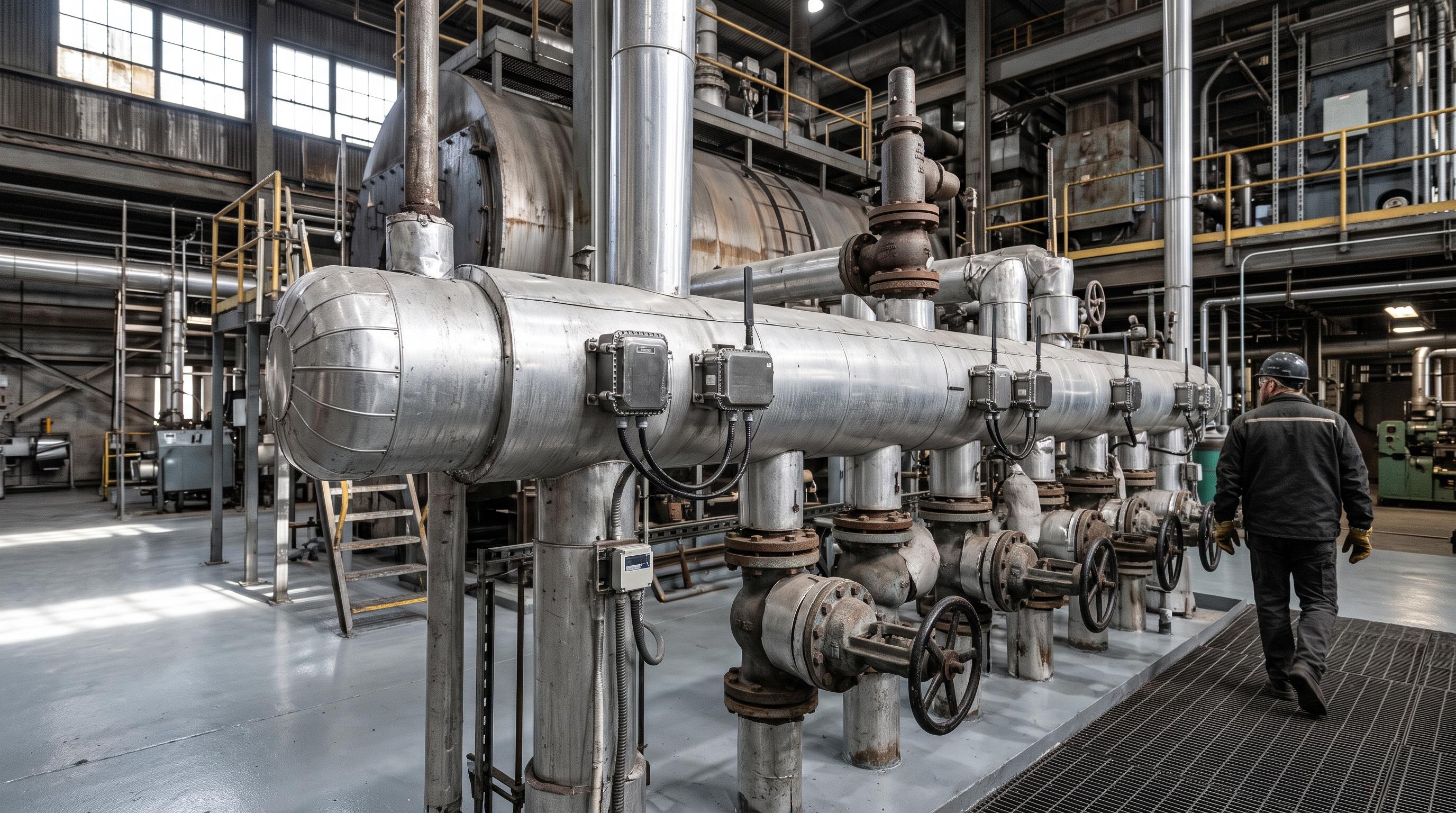
Contact ultrasound and edge AI distinguish blow-through from normal cycles by analyzing high-frequency acoustic patterns: normal discharge shows periodic valve transients and silence, while blow-through exhibits continuous broadband turbulence.
The Operational Scope and Cost of Steam Trap Failures in Industrial Piping
Industrial steam networks deliver immense thermal energy across refining, chemical synthesis, power generation, and food processing plants. Within these closed loops, automatic steam traps discharge liquid condensate and non-condensable gases while preventing the escape of live steam. When maintenance teams rely solely on manual walk-arounds or infrequent surveys, trap performance degrades silently over time. Facilities that operate without maintenance for 3 to 5 years frequently see 15% to 30% of their installed steam traps operating in a failed state, allowing live steam to escape into the condensate return system1. Conversely, implementing structured continuous or scheduled inspection routines maintains leaking trap populations under 5% across utility piping1. The primary mode of catastrophic thermal loss occurs when an internal valve mechanism fails in the fully open position, a state known as blow-through.
The thermodynamic and monetary consequences of blow-through scale rapidly with operating pressure. In a 150 psig steam distribution header, an internal valve orifice measuring 1/8 inch (approximately 3.18 mm) stuck wide open releases roughly 75.8 pounds of steam per hour directly into the condensate return line1. Over an annual baseline run time of 8,760 hours, this single failed component purges approximately 664,000 pounds of live steam1. Assuming an industrial steam production valuation of $10.00 per 1,000 pounds, this localized defect dissipates $6,640 each year in lost boiler fuel and chemically treated feedwater1. Multiply this loss across dozens of undetected failed traps throughout an aging industrial complex, and the operational penalty reaches hundreds of thousands of dollars annually alongside elevated boiler emissions.
Acoustic and Thermal Physics: The Diagnostic Limitation of Temperature Alone
Historically, maintenance personnel attempted to identify malfunctioning traps using infrared pyrometers or external contact thermocouples mounted upstream and downstream of the trap housing. The premise was that a clogged or closed trap remains cold, while an active trap stays hot. However, thermographic methods encounter a fundamental physical limitation when discriminating between blow-through and normal condensate purging. When high-pressure saturated condensate passes through the trap orifice into a lower-pressure return manifold, it experiences rapid depressurization and instantly flashes into low-pressure vapor, known as flash steam. This flash vapor elevates downstream piping surface temperatures close to the saturation point of the downstream pressure, closely mimicking the thermal profile of a trap blowing live steam4.
Because surface temperature measurements cannot independently confirm whether downstream heat originates from benign flash steam or catastrophic live steam loss, fluid turbulence acoustics become the decisive physical indicator. Contact ultrasound sensors overcome temperature ambiguities by recording high-frequency mechanical vibrations transmitted through the metal wall of the trap body and downstream piping. Standard reliability engineering protocols mandate placing contact acoustic probes directly on the downstream side of the valve body, focusing signal evaluation on resonant bands between 20 kHz and 100 kHz2. At these frequencies above 20 kHz, plant machinery noise and structural vibrations—which generally produce noise below 5 kHz—attenuate sharply, isolating acoustic signatures produced by internal fluid dynamics2.
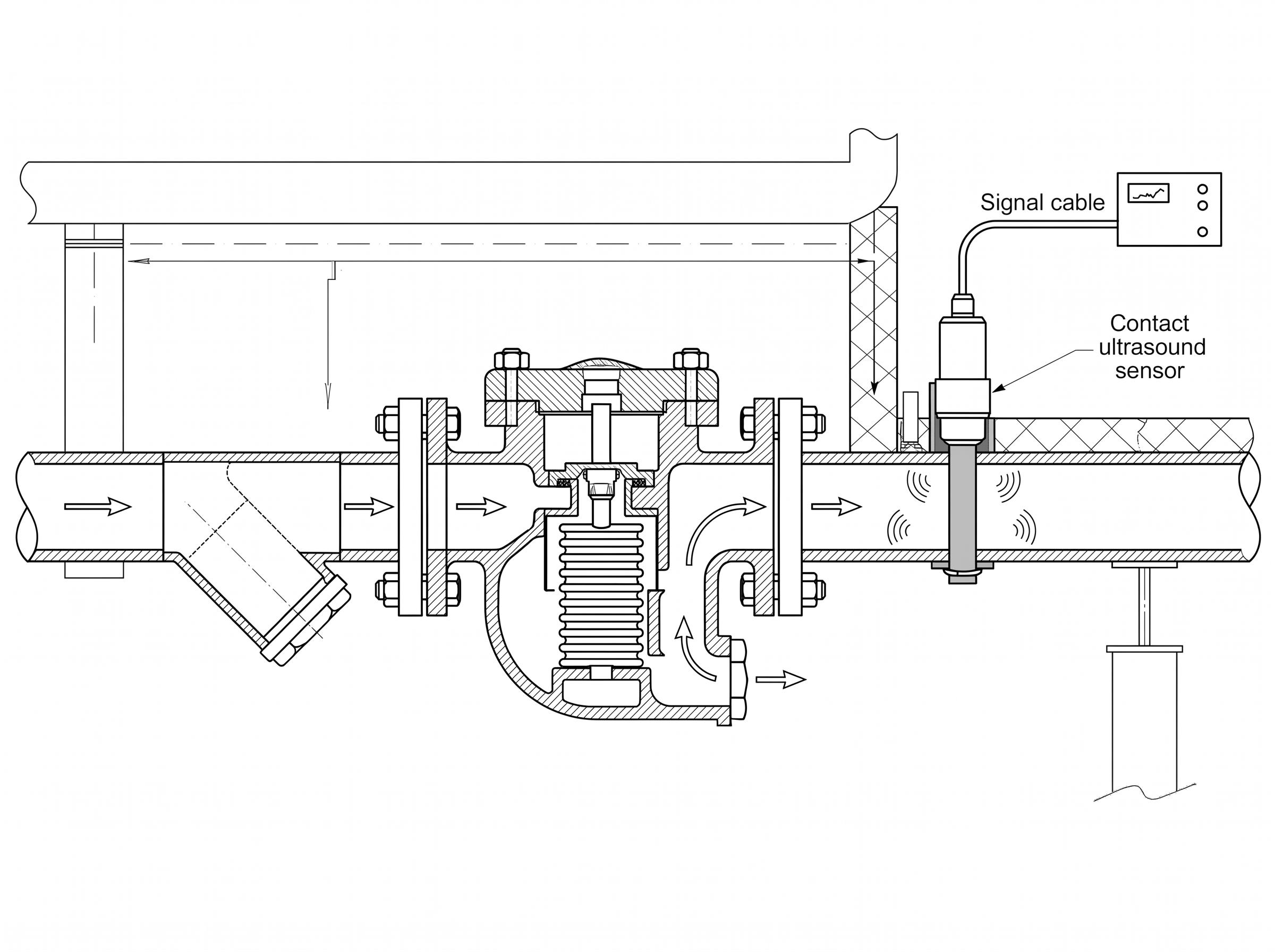
Acoustic Signatures: Intermittent Cycling Versus Continuous Blow-Through
The acoustic profile of a steam trap depends directly on its internal mechanical construction and operating cycle. Thermodynamic disc traps, inverted bucket traps, and certain thermostatic designs operate discontinuously. During a healthy discharge cycle, an intermittent trap produces distinct, recognizable phases: a quiet phase during condensate accumulation, a sharp transient pulse as the valve seat opens, a brief interval of rushing fluid noise as subcooled liquid condensate exhausts, and a decisive, crisp acoustic snap when the valve seats firmly shut2. In thermodynamic disc traps, this operational cadence repeats anywhere from a few times per minute to once every several minutes depending on thermal load, creating an acoustic time-series characterized by clear duty cycles and pronounced baseline silence.
In stark contrast, a steam trap suffering from blow-through exhibits complete failure of the closing mechanism due to mechanical erosion, scale accumulation, disc warping, or broken internal linkages. With no physical barrier to stem the flow, live steam races across the orifice at sonic or near-sonic velocities. This violent, continuous fluid expansion generates intense acoustic cavitation and broadband turbulent friction against the interior walls. The resulting acoustic signature lacks cycling, transitional clicks, or periods of acoustic silence. Instead, the signal presents as an uninterrupted, high-amplitude rushing sound that registers sustained acoustic energy well above nominal operating baselines2. While airborne gas leaks to atmosphere are standardized for handheld inspection tools under ASTM E1002-11(2022)3, detecting internal through-valve turbulence across closed piping relies on surface-mounted acoustic emission principles such as high-frequency boundary vibration monitoring.
Edge AI Architecture: Transforming High-Frequency Acoustic Data into Decisions
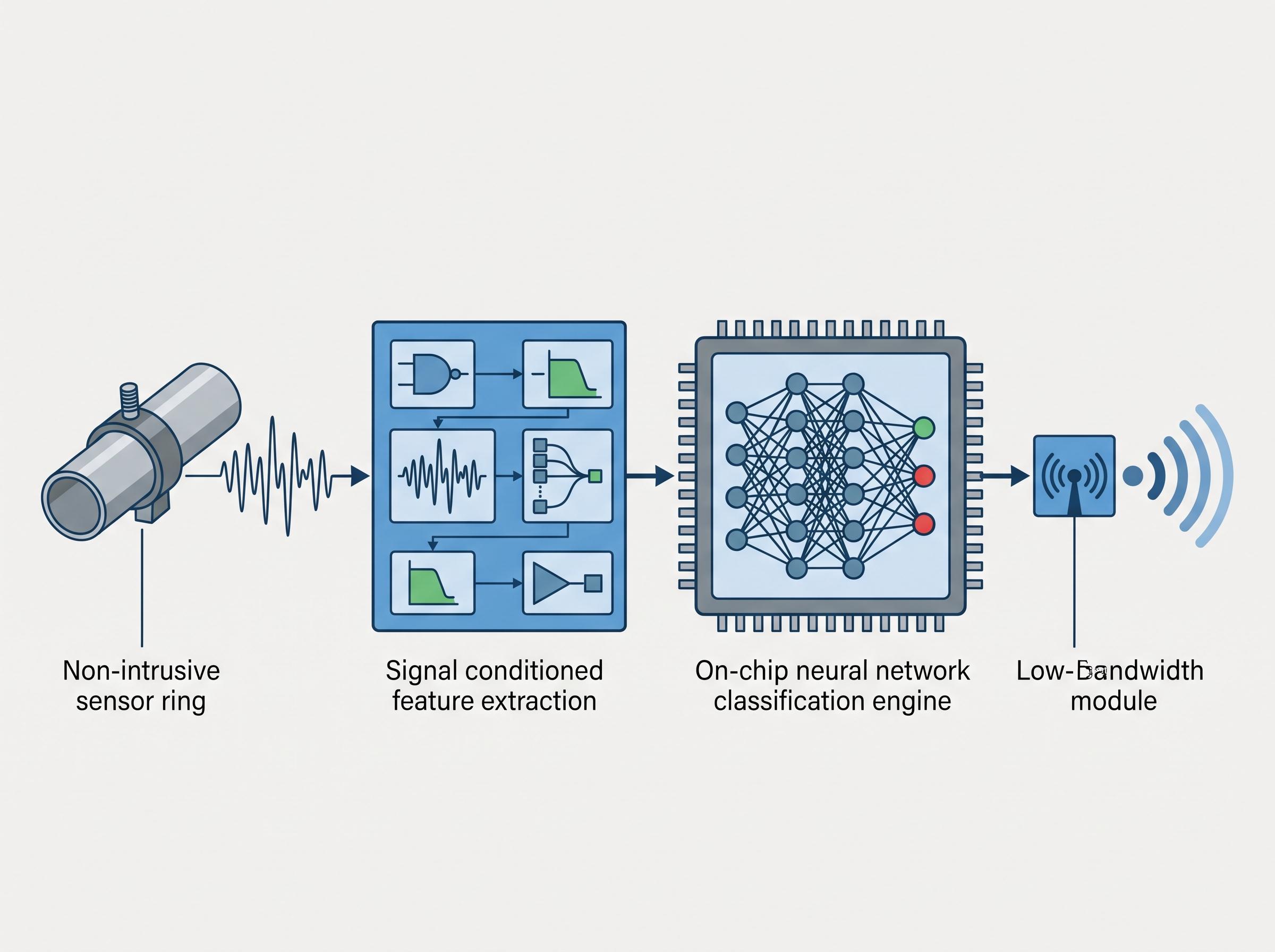
While human technicians using handheld ultrasonic listen-only devices can identify blatant failures, manual audits cannot monitor hundreds of traps continuously. Transmitting raw, high-frequency ultrasonic waveforms across industrial wireless mesh networks like WirelessHART or LoRaWAN is technically unfeasible due to strict bandwidth limitations and severe battery depletion. Edge artificial intelligence resolves this bandwidth bottleneck by executing signal transformation and machine learning inference directly inside the sensor casing attached to the steam pipe. The embedded microcontroller captures short acoustic bursts, computes mathematical descriptors on-chip, and transmits only low-payload operational states and anomaly scores to supervisory control software4.
The edge AI algorithmic pipeline typically processes raw ultrasonic waveforms through feature extraction followed by classification. In the time domain, edge firmware calculates root mean square (RMS) energy, peak amplitude, crest factor, and kurtosis over rolling temporal windows. In the frequency domain, lightweight Fast Fourier Transforms (FFT) or discrete filter banks generate spectral band energy distributions, isolating the high-frequency turbulence bands from structural pipe ringing. Machine learning models optimized for microcontrollers classify the processed data into discrete operational classes such as Normal, Failed-open (Blow-through), and Failed-closed4. In empirical studies on industrial pharmaceutical steam networks using 108 engineered features, gradient-boosted decision architectures achieved an operational classification test accuracy of 0.98534. However, researchers note that this high concordance was evaluated against engineering pseudo-labels, and field validation sets exhibited partial data absence for certain normal and failed-closed operating regimes4. By continuously tracking duty cycles over extended observation windows, the edge classifier differentiates an unusually long condensate purge from true, uninterrupted blow-through.
Comparative Analysis: Acoustic Characteristics Across Trap States
Selecting the appropriate acoustic thresholds and AI evaluation windows requires understanding how mechanical trap designs alter acoustic signatures. Continuous-discharge traps, such as float and thermostatic (F&T) units common on large heat exchangers, do not snap open and shut like disc traps. Instead, they modulate an internal ball float to release condensate continuously as it accumulates. An edge AI model deployed on an F&T trap must recognize that continuous low-level fluid sounds are normal during high thermal loads, whereas blow-through on the same unit exhibits a dramatic spike in high-frequency spectral energy indicative of gas bypass rather than dense liquid discharge. The following criteria illustrate the diagnostic parameters monitored across distinct operating conditions.
| Operational State | Acoustic Pattern (20 kHz–100 kHz) | Time-Domain Characteristics | Surface Temperature Profile | Edge AI Primary Classification Metric |
|---|---|---|---|---|
| Normal Intermittent Discharge | Cyclic bursts followed by near-complete silence | High kurtosis, intermittent crest factor, cyclic RMS | Hot upstream, moderate downstream (flashing delta) | Periodic transient recognition and duty-cycle ratio |
| Normal Continuous Discharge (Float Type) | Continuous low-to-moderate fluid rolling noise | Stable low RMS amplitude, low acoustic kurtosis | Normal operating temperature delta matching process load | Spectral energy focused below dry steam turbulence bands |
| Live Steam Blow-Through | Continuous, high-intensity broadband rushing sound | High sustained RMS, near-zero temporal amplitude variance | Near-zero delta: downstream pipe matches header saturation temperature | Persistent acoustic energy exceeding threshold without silent intervals |
| Cold Plugged / Mechanical Blockage | Zero acoustic emission above ambient electrical noise floor | Extremely low flatline RMS, zero transient activity | Severe temperature drop below process saturation temperatures | Joint acoustic null combined with low thermal threshold breach |
Integrating multimodal inputs—specifically marrying contact acoustic emission with localized surface pipe temperature—prevents edge models from misclassifying low-load standby periods as plugged traps4. If the boiler plant reduces production and steam headers drop into idle states, acoustic activity drops to zero, but temperature sensors confirm line temperatures remain within standard standby limits. Conversely, when both high temperature saturation and continuous high-intensity ultrasonic energy persist concurrently, the edge device immediately flags a high-confidence blow-through alarm, allowing maintenance teams to schedule targeted valve servicing long before standard audit rotations take place.
Implementation Realities: Sensor Coupling, Power, and Field Commissioning
Achieving reliable edge AI classification requires strict adherence to physical installation guidelines. Contact ultrasound waves at 20 kHz to 100 kHz experience dramatic acoustic attenuation across air gaps. Therefore, acoustic sensors must be mechanically coupled to the pipe wall using solid metal wave-guides, specialized high-temperature magnetic mounts, or secure pipe clamp fixtures torqued to manufacturer specifications. Loose clamps or sensors mounted over exterior fiberglass insulation jackets completely disrupt high-frequency signal capture, degrading model accuracy. Sensor placement must also respect standard distance guidelines: mounting the transducer too far downstream from the trap orifice allows acoustic energy to disperse along piping elbows, while mounting upstream introduces cross-talk from line desuperheaters or control valves2.
Power management represents another critical engineering boundary in field deployments. Continuously running high-speed analog-to-digital converters and computing 1,024-point FFTs would deplete standard industrial lithium thionyl chloride (Li-SOCl2) batteries in weeks. Practical industrial edge monitors utilize aggressive duty-cycling firmware: waking periodically to sample acoustic bursts, running on-device inference, and returning to micro-ampere sleep states. Advanced edge nodes deployed in high-heat steam environments increasingly leverage pipe-mounted thermoelectric generators (TEGs) that harvest waste heat from the steam line to power the sensing and edge computing hardware autonomously4. Before deploying algorithms across an entire plant, reliability teams must validate models against OEM trap specifications and establish baseline acoustic signatures under varying seasonal boiler loading conditions.
Frequently asked questions
Q. Why is contact ultrasound superior to thermal imaging for detecting steam trap blow-through?
A. Thermal imaging cannot reliably distinguish hot live steam from hot flash steam created when normal condensate depressurizes downstream. Contact ultrasound detects the continuous high-velocity acoustic turbulence created solely by escaping live steam.
Q. What acoustic frequency range is used for steam trap monitoring?
A. Steam trap monitoring generally utilizes high-frequency acoustic emission bands between 20 kHz and 100 kHz, effectively isolating valve turbulence from lower-frequency plant machinery noise which typically occurs below 5 kHz.
Q. How does edge AI differentiate normal continuous float traps from blow-through?
A. Edge AI evaluates high-frequency spectral band energy and acoustic amplitude. Dense liquid condensate moving through a float trap produces lower acoustic turbulence, whereas escaping dry steam generates elevated broadband high-frequency acoustic power.
Q. How often should steam traps be inspected according to industrial energy guidelines?
A. According to U.S. Department of Energy Steam Tip Sheet #1 guidelines, high-pressure steam traps operating above 150 psig should be inspected weekly to monthly, medium-pressure traps (30 to 150 psig) monthly to quarterly, and low-pressure traps (below 30 psig) annually. Routine programs keep system failure rates below 5%, compared to 15% to 30% in unmaintained systems.
Sources
- Energy Tips: STEAM — Steam Tip Sheet #1: Inspect and Repair Steam TrapsU.S. Department of Energy Advanced Manufacturing Office
- Reliability-Centered Maintenance Guide for Facilities and Collateral EquipmentNational Aeronautics and Space Administration (NASA)
- ASTM E1002-11(2022) Standard Practice for Leaks Using UltrasonicsASTM International
- Self-Powered IIoT Steam-Trap Condition Monitoring Using Thermoelectric Energy Harvesting, Multimodal Sensing, and Machine LearningMDPI Sensors