 Industrial Solution Finder
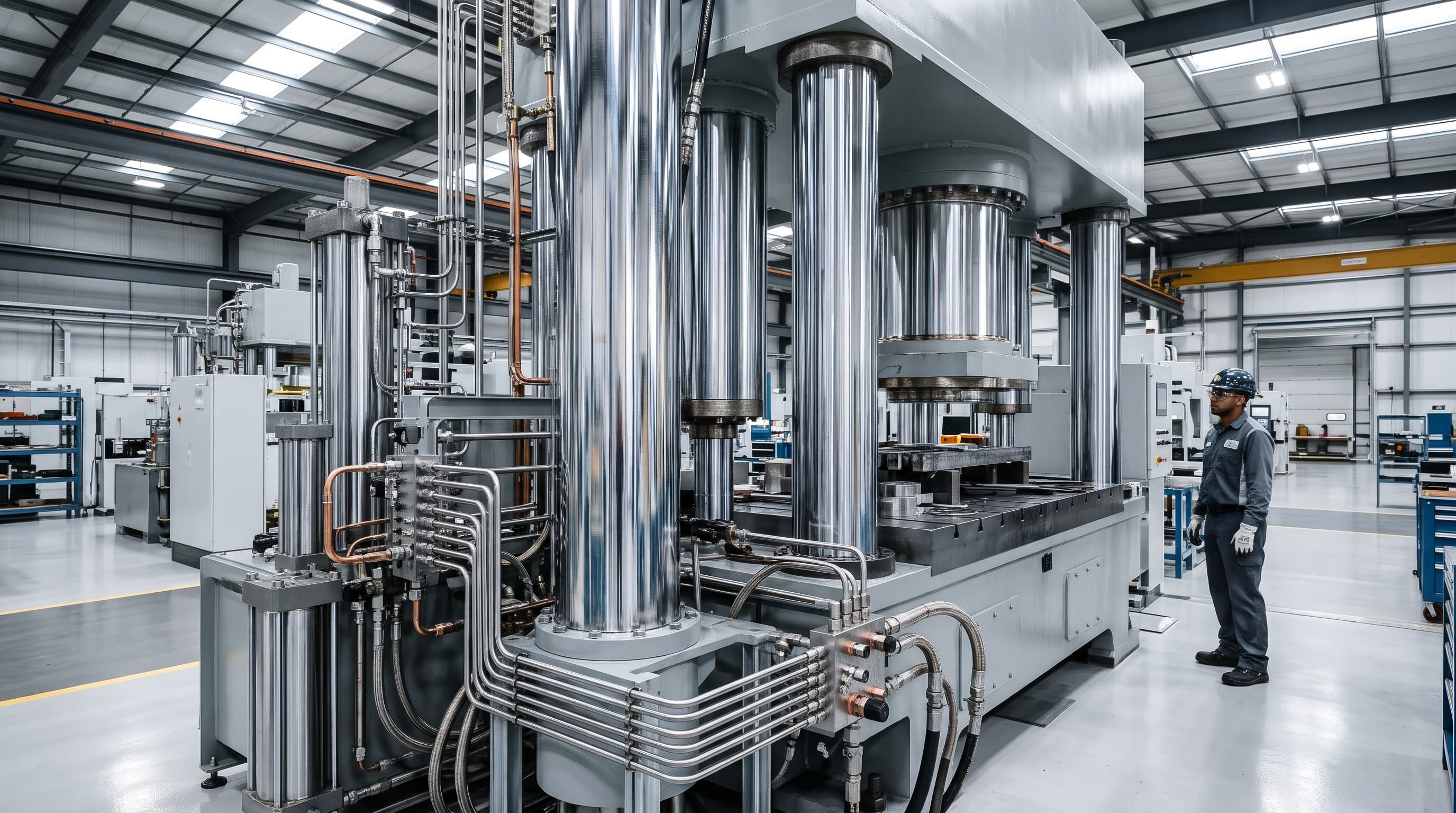
AI inline oil analysis uses sensor fusion—tracking dielectric permittivity, conductivity, and viscosity shifts—to detect dissolved sub-micron oxidation precursors weeks before servo valves stick.
The Silent Vulnerability: Why Servo Valves Seize in High-Tonnage Presses
Industrial hydraulic presses relied on for heavy stamping, forging, and composite molding depend entirely on high-frequency electrohydraulic servo valves to regulate ram positioning, velocity, and tonnage. While conventional preventative maintenance regimens emphasize fluid particulate cleanliness through standard filter elements, catastrophic servo valve failures continue to induce unplanned press outages across precision manufacturing plants. The primary failure mode is not macroscopic mechanical debris, but microscopic chemical deposition known as oil varnish4.
The physical clearances within critical hydraulic components explain this sensitivity. Precision servo valves operate with radial spool-to-sleeve clearances between 0.5 and 5 microns45. In contrast, conventional directional control valves operate with broader clearances ranging between 3 and 13 microns45. When dissolved oxidation oligomers precipitate out of thermal solution, they plate directly onto these polished metal surfaces, generating boundary-layer stiction. According to benchmark engineering testing conducted by Eaton Hydraulics, a 1/8-inch spool valve subjected to 3,000 PSI operating pressures that accumulates silt and sub-micron degradation products can demand up to 30 pounds of shifting force to stroke, whereas a standard electromagnetic actuation solenoid exerts only 10 pounds of force4. This 3:1 mechanical deficit leads to severe silt-lock, positioning lags, erratic ram drift, and eventual electrical solenoid coil burnout4.
Chemical Oxidation Kinetics and the Blind Spots of Traditional Lab Sampling
Mineral and synthetic hydrocarbon hydraulic fluids undergo progressive thermal and oxidative degradation under sustained high-pressure operation. Beyond uniform bulk oil heating, severe localized thermal stresses drastically accelerate degradation kinetics. In high-cycling presses, entrained air bubbles passing through high-pressure pump outlets undergo rapid adiabatic compression—a phenomenon known as microdieseling—which generates localized flash temperatures exceeding 1,000°C. Similarly, high-velocity fluid shearing through tight non-conductive filter matrices induces electrostatic discharge (ESD) spark events reaching thousands of degrees. These localized thermal spikes rapidly crack fluid molecules and deplete sacrificial hindered phenolic and aromatic amine antioxidant reserves67. Once inhibitors are exhausted, free-radical chain cascades generate polar carbonyl compounds such as aldehydes, ketones, esters, and carboxylic acids with characteristic absorption bands between 1,800 and 1,670 cm⁻¹ in Fourier Transform Infrared (FTIR) spectrometry under ASTM D74146.
Standard quarterly or monthly off-site bottle sampling routines fail to prevent valve seizure due to two inherent physical limitations: latency and particle size boundaries. Standard optical particle counters complying with ISO 4406 quantify solid contaminants across three specific thresholds: 4 microns, 6 microns, and 14 microns1. However, early-stage varnish precursors and soft polar degradation oligomers measure well below 1 micron and remain completely dissolved or colloidally suspended while operating at high sump temperatures1. Consequently, an oil sample can demonstrate an immaculate ISO 4406 cleanliness rating (such as 14/12/9) while carrying a critical burden of dissolved varnish-forming compounds1.
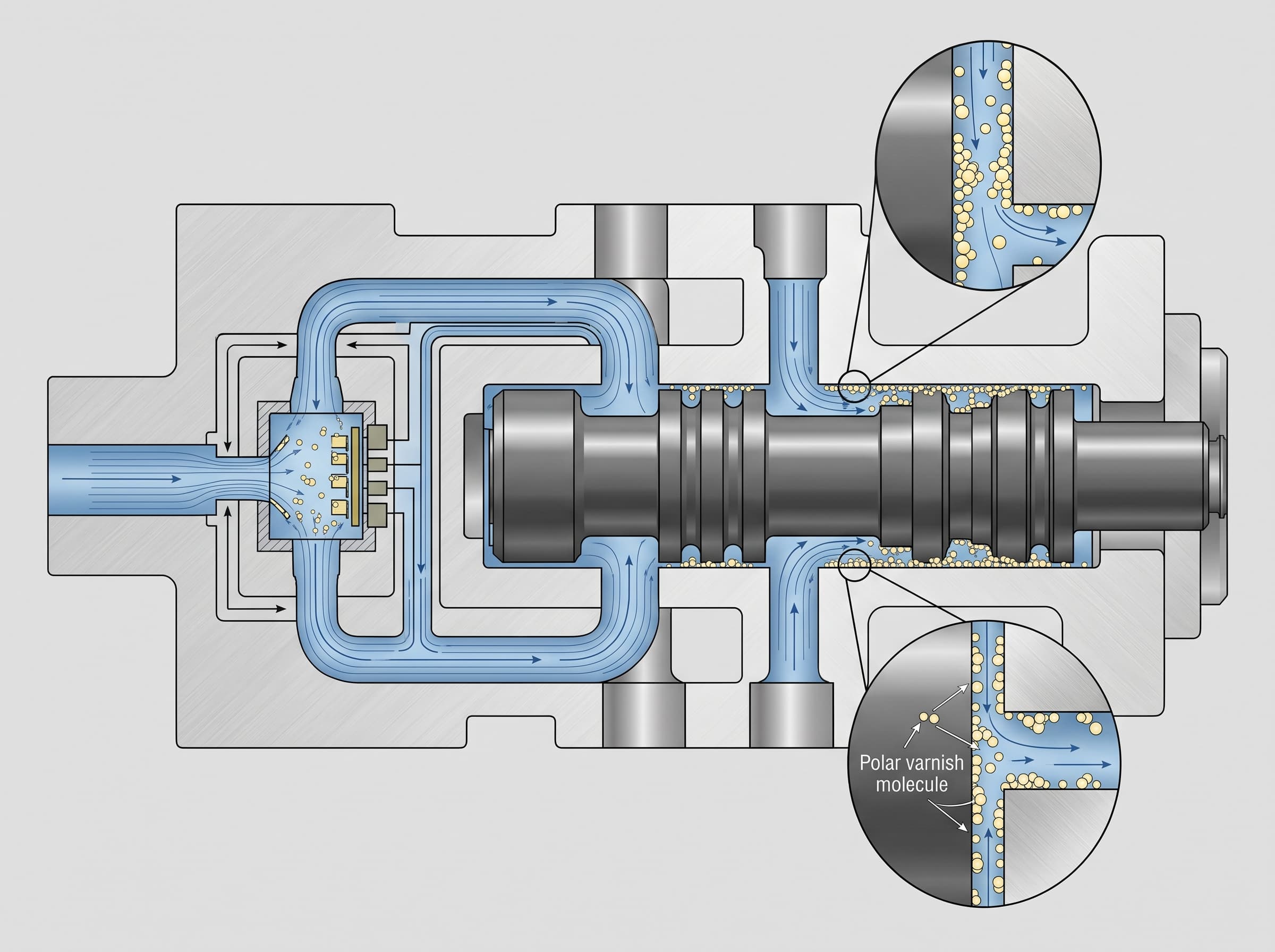
Furthermore, static off-site laboratory testing, such as Membrane Patch Colorimetry (MPC) under ASTM D7843, isolates insolubles onto a 0.45-micron nitrocellulose patch and assigns a CIELAB ΔE rating where values exceeding 40 ΔE denote critical varnish risk12. Yet laboratory MPC can produce a false sense of security if oil samples are pulled after varnish has already dropped out of solution3. When fluid insolubles deposit onto press components, heat exchangers, and reservoir walls, the circulating fluid's measured MPC ΔE value can unexpectedly plateau or decline despite escalating mechanical fouling inside the valve manifold3.
The Architecture of AI-Driven Inline Sensor Fusion
Inline predictive maintenance architectures bypass sampling latency by deploying continuous high-frequency multi-parametric sensor cells directly into the high-pressure pilot or kidney-loop recirculation line of the hydraulic press. These multi-sensing clusters capture fluid degradation by monitoring complementary physical and electrical vectors: relative dielectric permittivity, electrical conductivity, and acoustic-wave dynamic viscosity.
The primary sensor transduces relative dielectric permittivity. Pristine non-polar hydrocarbon base oils possess a low, stable dielectric constant typically around 2.1 to 2.3. As base-oil hydrocarbons oxidize, the formation of polar carbonyl groups (aldehydes, ketones, and carboxylic acids) introduces electrical dipole moments that cause fluid permittivity to climb progressively6. Simultaneously, micro-conductometric electrodes track electrical conductivity. As oxidation advances and polar organic acids accumulate, ionic mobility increases, providing an early physical indicator of chemical fluid degradation long before total acid number titration reveals macroscopic changes in off-site testing6.
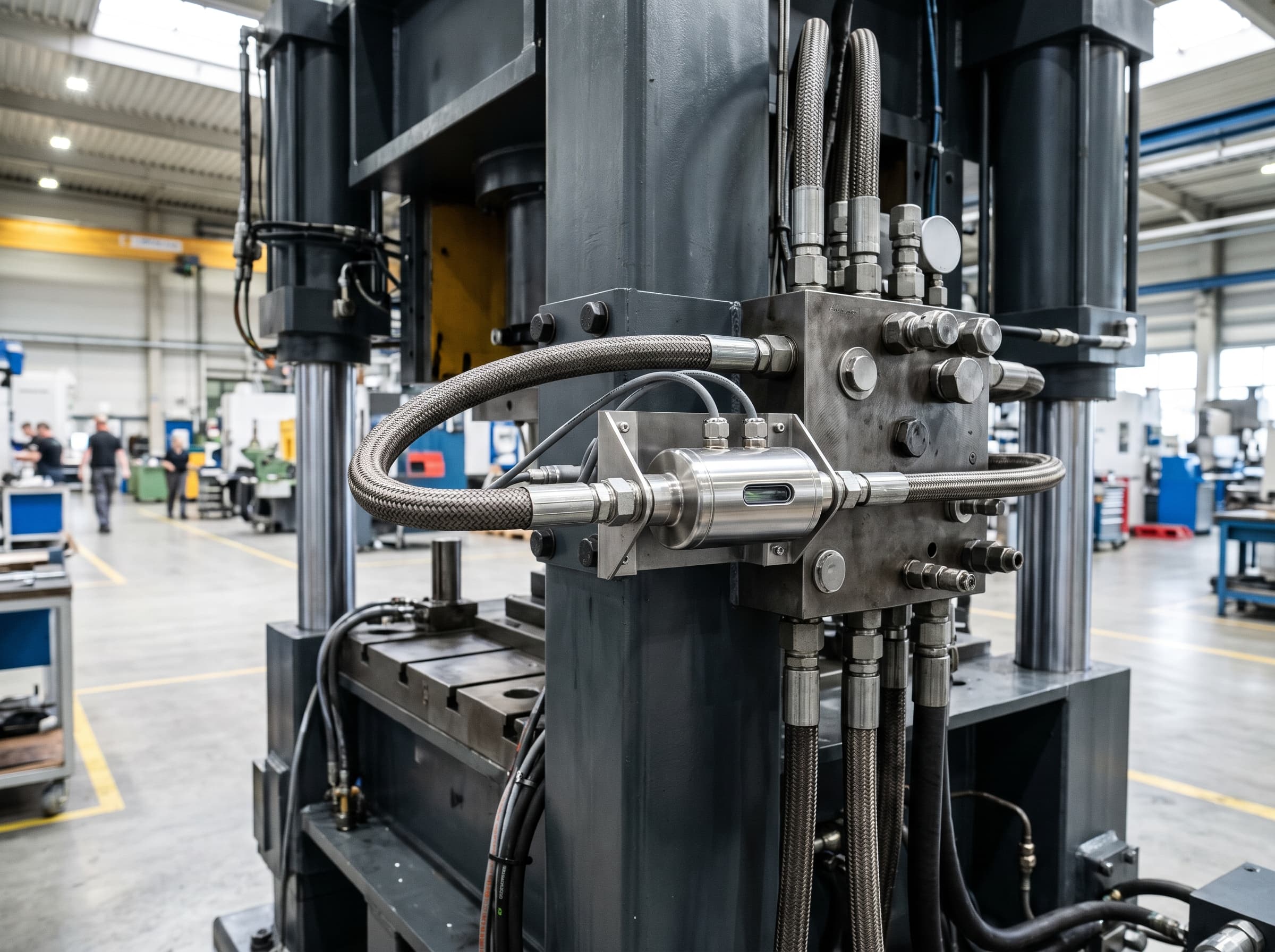
Complementing dielectric and conductometric monitoring, solid-state acoustic-wave or micro-mechanical resonators measure dynamic viscosity alongside continuous fluid temperature. The critical analytical challenge in inline monitoring is that fluid viscosity and electrical properties are heavily non-linear functions of operating temperature. A normal hydraulic fluid temperature fluctuation between 40°C and 65°C can mask or mimic chemical dielectric drift. In modern commercial sensor packages, embedded edge algorithms apply multivariate temperature compensation models, decoupling baseline thermal variations from permanent chemical oxidation shifts.
Comparing Oil Monitoring Methods for Press Reliability
To establish an optimal predictive maintenance protocol, reliability engineers must understand how different analytical methodologies behave in response to early chemical fluid oxidation and soft insoluble formation. Relying solely on optical particle counters leaves servo systems unprotected against sub-micron resin build-up, whereas periodic lab testing lacks the temporal resolution required to catch sudden thermal excursions.
| Monitoring Methodology | Measurable Parameters | Particle/Molecular Sensitivity | Response Latency | Varnish Precursor Detection Capability | Case Study Economic Profile & Overhaul Avoidance (1,000–3,000 Ton Press Baseline) |
|---|---|---|---|---|---|
| Inline Optical Particle Counter | ISO 4406 Cleanliness Codes (counts at 4, 6, 14 μm) | Solid particulate >4 μm only | Real-time (<30 seconds) | None; blind to dissolved soft contaminants and sub-micron precursors | Module cost ~$3,000–$6,000; primarily protects pumps from abrasive wear but achieves low stiction prevention (<20% overhaul avoidance estimate due to physical inability to detect sub-micron silt and soft varnish) |
| Off-site Lab MPC & RULER | CIELAB ΔE varnish rating, % hindered phenolic/amine reserve | Insoluble color bodies >0.45 μm and dissolved antioxidants | 3 to 14 business days | High analytical fidelity, but vulnerable to post-deposition false negatives | Periodic test routine (~$100–$350/sample); comprehensive chemical visibility, but sampling turnaround delays risk missing rapid degradation excursions leading to $15,000–$50,000 servo overhaul expenses |
| Multi-Parameter Inline Sensor Fusion | Dielectric constant, ionic conductivity, dynamic viscosity, temp | Molecular polarity, ionic acid precursors, polymer agglomeration | Continuous real-time (<1 second) | High; tracks ongoing oxidation rate and warns prior to valve deposition | Instrumentation suite ~$8,000–$15,000 per circuit; eliminates sudden stiction failures, typically delivering ROI payback within 6–12 months in critical continuous-operation plants |
As summarized above, multi-parameter inline sensing bridges the operational gap between blind particle counters and slow off-site testing. By tracking continuous dielectric permittivity, conductivity, and viscosity deviations relative to calibrated baseline oil curves, predictive analytics can identify accelerated degradation trajectories. When monitoring systems detect a sustained upward drift in normalized dielectric constant and electrical conductivity alongside antioxidant depletion signatures, maintenance teams receive actionable warnings weeks before mechanical actuation forces increase or valve response lags46.
Deployment Protocols and Failure Mode Prevention Strategies
Implementing an inline tribology system on a multi-thousand-ton hydraulic press demands strict sensor placement protocols. The multi-sensing cell should be installed in an active kidney-loop filtration circuit or directly on the low-pressure case-drain / pilot return manifold rather than inside dead-leg reservoir pockets. Installing sensors in stagnant reservoir zones allows thermal stratification and settled sediment to distort continuous impedance readings. Flow velocity across the sensor face must remain laminar and stable, avoiding cavitation bubbles that disrupt dielectric permittivity measurements.
A common operational pitfall occurs when plants top up hydraulic reservoirs with fresh fluid or introduce incompatible fluid chemistries. Fresh oil contains an unreacted additive package with distinct dielectric characteristics. Without an adaptive machine learning model, a sudden top-up can trigger false oxidation warnings. Modern industrial AI models manage this by monitoring multi-channel step functions: an abrupt drop in viscosity coupled with a discrete baseline shift in dielectric properties is classified as an oil top-up event rather than a chemical oxidation runaway, prompting the algorithm to automatically recalibrate its predictive baseline.
When fluid varnish potential crosses critical thresholds, relying on standard mechanical filters cannot reverse the condition; chemical remediation through electro-magnetic separation or ion-exchange resin systems is essential.
When predictive indicators flag an imminent varnish risk (equivalent to an ASTM D7843 rating exceeding 30–40 ΔE), maintenance teams must deploy targeted remediation before spool binding occurs12. Standard 3-to-10 micron glass-fiber filter elements cannot capture sub-micron soft varnish precursors14. Operations must initiate kidney-loop electro-physical filtration, such as electrostatic oil cleaners, depth-media adsorption cartridges, or electro-magnetic particle separators, which extract polar oxidation agglomerates from solution1. Once fluid solvency is restored, the clean oil actively redissolves existing surface varnish films from the servo spools, preserving valve response without requiring press disassembly3.
Operational Boundaries and Compliance Interlocks
While AI inline sensor fusion provides superior early warning capabilities, plant engineers must maintain clear operational boundaries regarding mechanical safety. Inline sensors track fluid health; they do not directly inspect mechanical clearances or internal fatigue inside valve bodies45. If a servo valve has already suffered mechanical scoring, valve-seat erosion, or severe seal extrusion, fluid remediation alone will not restore hydraulic response precision5.
From a regulatory and safety standpoint, industrial hydraulic press installations are governed by strict machinery safeguarding mandates, specifically OSHA 29 CFR 1910.212 for general machine guarding and ANSI B11.2 for hydraulic power press safety requirements, rather than mechanical power press standards. Servo valve stiction can compromise ram synchronization or interfere with anti-drift safety drop blocks. AI predictive oil monitoring must be integrated as an advisory tier within the plant Computerized Maintenance Management System (CMMS) or supervisory control architecture. It must never bypass hardwired dual-redundant safety interlocks, position feedback encoders, or emergency hydraulic shutoff valves required by machinery safety mandates.
Frequently asked questions
Q. Why do standard ISO 4406 particle counters fail to detect hydraulic varnish?
A. ISO 4406 optical counters measure hard particulate larger than 4, 6, and 14 microns. Varnish precursors are dissolved soft polar oxidation products measuring under 1 micron, making them invisible to optical extinction counters.
Q. What is the critical radial clearance of a precision hydraulic servo valve?
A. Precision servo valves operate with extremely tight radial spool-to-sleeve clearances between 0.5 and 5 microns, making them vulnerable to stiction from sub-micron varnish deposits.
Q. Which fluid properties do inline oil sensors measure to detect oxidation?
A. They continuously measure relative dielectric permittivity (polar molecules), electrical conductivity (organic acid formation), and dynamic acoustic viscosity, using multivariable models to compensate for temperature fluctuations.
Q. What ASTM D7843 MPC Delta E level indicates critical varnish risk in hydraulic circuits?
A. Under ASTM D7843 membrane patch colorimetry, a value above 30 to 40 Delta E is classified as critical, indicating severe deposit potential that can seize control spools.
Sources
- MPC Varnish Test Explained: What ASTM D7843 Means for Oil Analysis and Varnish RemovalDelta-Xero
- Interpreting results for the new ASTM standard for varnish potentialTurbomachinery Magazine
- Understanding MPC ResultsTestOil
- Why Hydraulic Spool Valves StickPower & Motion Tech
- Spool Valve Leak Diagnosis and Repair GuideAHS Hydraulics
- ASTM D7414 - Standard Test Method for Condition Monitoring of Oxidation in In-Service Petroleum and Hydrocarbon Based Lubricants by Trend Analysis Using Fourier Transform Infrared (FT-IR) SpectrometrySavant Labs
- Monitoring antioxidant content of in-service industrial lubricants with voltammetryMetrohm