 Industrial Solution Finder
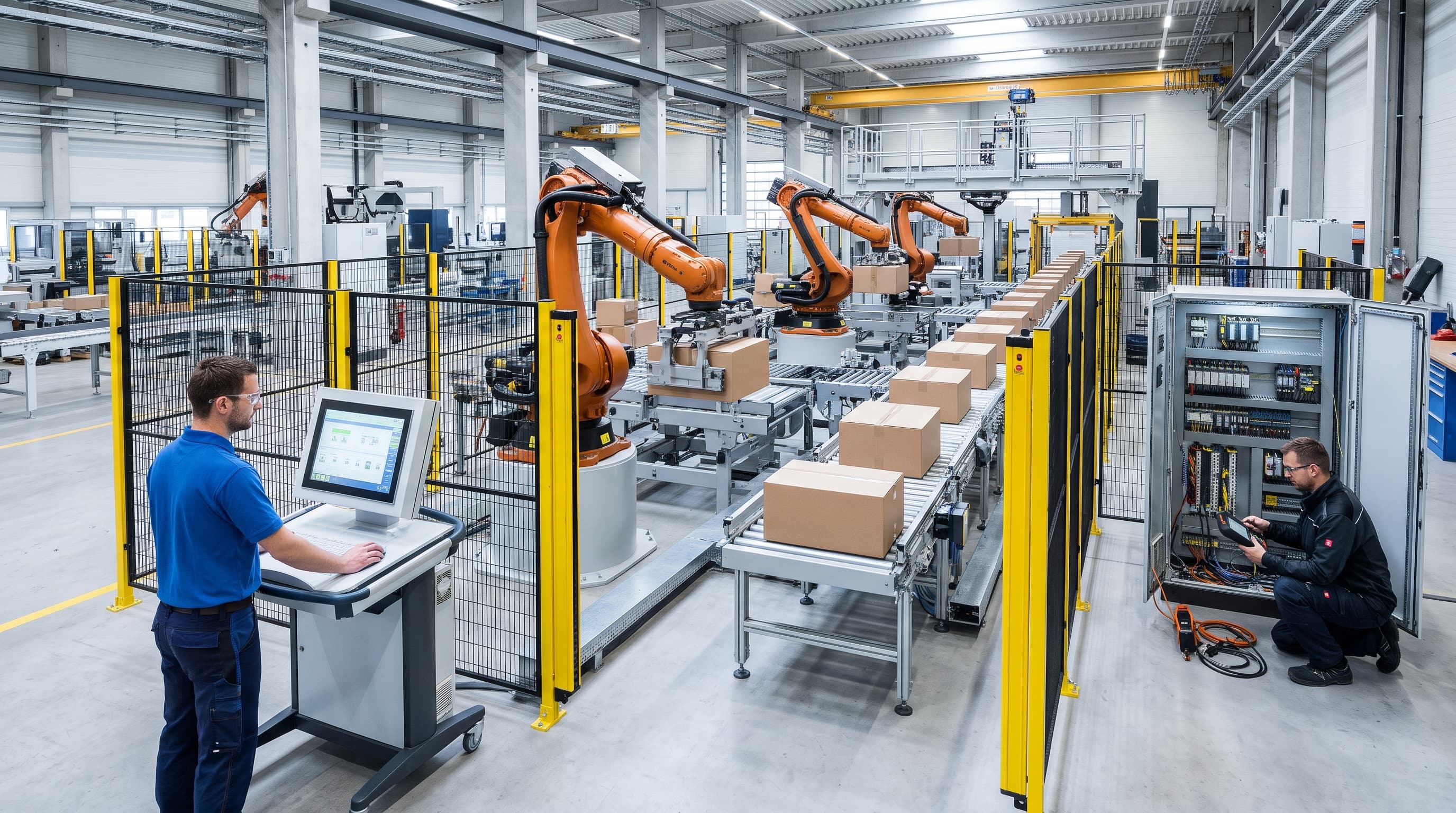
Machinery builders must update technical files to Annex IV Part A, evaluate Annex III cybersecurity (Clause 1.1.9) and AI boundaries (1.2.1), retain intervention logs for 5 years, and issue Regulation declarations by January 20, 2027.
The Regulatory Transition: Transitioning from Directive 2006/42/EC to Regulation (EU) 2023/1230
For industrial machine builders placing equipment on the European Union market, the regulatory framework governing CE compliance is undergoing an absolute cut-over. Regulation (EU) 2023/1230 of the European Parliament and of the Council officially replaces Directive 2006/42/EC1. Unlike the outgoing directive, which required transposition into the domestic laws of 27 individual EU Member States, Regulation (EU) 2023/1230 is an EU regulation that applies directly and identically across the Union without national legislative divergence12. Article 51 of the Regulation repeals Directive 2006/42/EC with effect from January 20, 202712.
Crucially for production planning, there is no transitional grace period permitting machines built according to the old Directive to be newly placed on the market after the cut-off date2. Every individual machine placed on the EU market or put into service on or after January 20, 2027 must conform strictly to Regulation (EU) 2023/123012. While existing machines legally placed on the market prior to January 20, 2027 remain lawful under Article 52(1), any newly manufactured unit or imported second-hand machine from a non-EU country clearing customs on or after that date requires technical files and EU Declarations of Conformity aligned with the new legislation2.
Mandatory Structural Overhauls in the CE Technical Documentation File
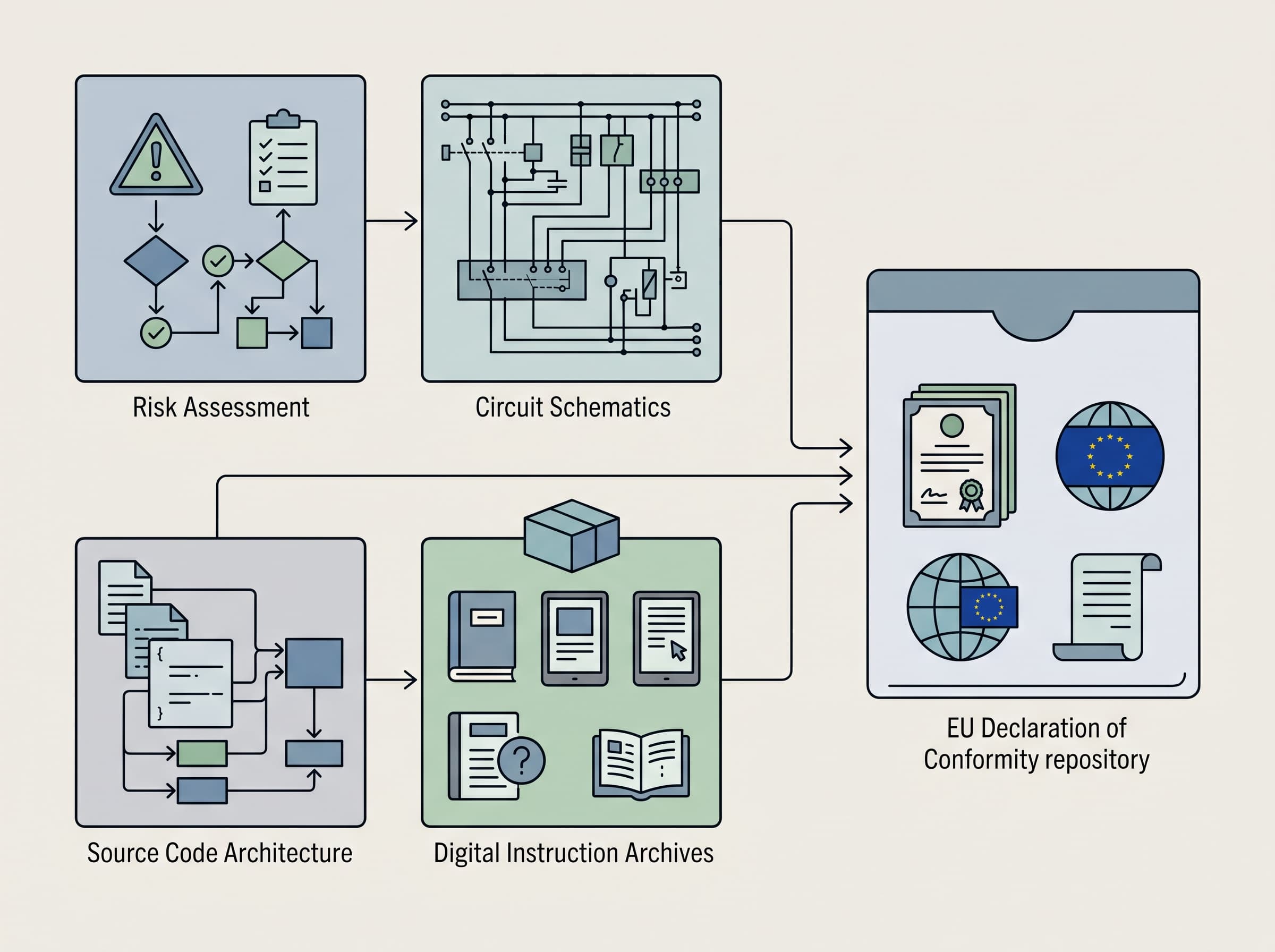
Machine builders must restructure the foundational layout of their technical files. The core requirements for technical documentation, previously located in Annex VII Part A under Directive 2006/42/EC, are now codified in Annex IV Part A of Regulation (EU) 2023/12301. Manufacturers cannot merely execute a find-and-replace command across existing templates. Annex IV Part A establishes an explicit legal obligation to detail the precise protective measures implemented to comply with each individual applicable Essential Health and Safety Requirement (EHSR) set out in Annex III1. Documenting vague blanket statements such as 'compliant' or 'safety circuits applied' no longer fulfills the burden of proof required by market surveillance authorities1.
Beyond mechanical schematics and design calculations, Annex IV Part A introduces heightened transparency for safety-related software logic1. Manufacturers are obliged to maintain verification records demonstrating that software fulfilling safety functions operates reliably and remains uncorrupted13. Upon a reasoned request from a competent national market surveillance authority, the manufacturer or designated economic operator must be prepared to make available the programming logic or source code of safety-related software to demonstrate conformity1. Under Article 10(2) and Annex VI point 4.2, the full technical file, together with the newly referenced EU Declaration of Conformity under Annex V, must be retained and kept available for market surveillance authorities for at least 10 years after the machinery is placed on the market11.
Annex III Risk Assessments: Industrial Cybersecurity and Autonomous Control Logic
The most significant evolution in machinery risk assessment is the inclusion of digital threats within physical safety domains. Annex III Clause 1.1.9 ('Protection against corruption') mandates that the connection to machinery of any external hardware device or remote transmission channel must not lead to a hazardous situation3. Machinery builders must conduct a cybersecurity risk analysis identifying all communication vectors—including industrial Ethernet ports, wireless programming modules, remote telemetry links, and USB interfaces3. Hardware transmitting safety-relevant data and software governing safety functions must be designed to resist accidental or intentional corruption3.
Compliance under Clause 1.1.9 and Clause 1.2.1 goes beyond static documentation; it dictates embedded machine functional behavior. Machinery must actively identify the installed safety-relevant software version and maintain the capability to display or extract this information at all times3. Furthermore, machinery control systems must withstand reasonably foreseeable malicious attempts from third parties3. The control system must automatically log interventions and modifications made to safety software or its configuration, and this tracing log of uploaded safety software versions must be enabled and retained for a minimum of 5 years following upload3. If safety functions utilize machine learning algorithms exhibiting fully or partially self-evolving behavior, Clause 1.2.1 requires the risk assessment to define physical operating boundaries and task limitations, while data on the safety decision-making process must be recorded and preserved for at least 1 year1.
In addition to digital systems, Annex III Clause 1.1.6 formally broadens the scope of ergonomic risk assessment. Engineering teams must evaluate not only physical fatigue and repetitive strain but also the psychological stress experienced by operators interacting with complex human-machine interfaces, collaborative robotics, and adaptive automation systems1.
Conformity Assessment Routes: High-Risk Reclassification and Substantial Modification
Machinery classification has been restructured under Annex I, replacing the old Annex IV high-risk machinery list14. Annex I is now formally bifurcated into Part A and Part B. For categories listed in Annex I Part A—which includes vehicle servicing lifts, removable mechanical transmission devices, and safety components or machinery with self-evolving behavior using machine learning to ensure safety functions—manufacturers can no longer utilize internal production control (Module A)4. Third-party involvement through a Notified Body via EU-type examination (Module B + C), full quality assurance (Module H), or unit verification (Module G) is strictly mandatory, even if the manufacturer applies harmonized European standards in full14.
For Annex I Part B machinery, such as industrial metal cold-working presses and woodworking circular saws, internal production control (Module A) remains permissible solely if the machine builder designs and manufactures the equipment entirely in accordance with harmonized European standards or common specifications covering all relevant health and safety requirements4. If harmonized standards do not exist, or if the manufacturer deviates from them in part, a Notified Body must be engaged4. Machinery not listed in Annex I continues to follow internal production control (Module A) under the sole responsibility of the builder4.
| Machinery Category | Scope and Example Equipment | Permitted Conformity Assessment Modules | Notified Body Requirement | Key Technical File Additions |
|---|---|---|---|---|
| Annex I, Part A | Self-evolving AI safety logic, vehicle servicing lifts, removable transmission devices | Module B + C, Module H, or Module G | Mandatory in all cases (Module A prohibited) | Third-party certificate, AI boundary constraints, 5-year intervention log validation |
| Annex I, Part B | Metal cold-working presses, band saws, plastics moulding equipment | Module A (only if harmonized standards applied in full), otherwise Module B + C, H, or G | Conditional (required if harmonized standards are absent or partially applied) | Full harmonized standards cross-reference matrix, Annex III Clause 1.1.9 cyber evaluation |
| Standard Machinery (Non-Annex I) | Standard automated packaging lines, CNC milling centers, palletizers | Module A (Internal Production Control) | None (Self-declaration by manufacturer) | Annex IV Part A technical documentation, cybersecurity ingress analysis, 10-year digital retention |
| Substantially Modified Machinery | In-house retrofits adding unscheduled automation, speed increases requiring new safety logic | Module applicable to the modified portion or complete assembly | Depends on whether modified scope falls into Annex I | New risk assessment under EN ISO 12100, updated control architecture, new EU Declaration under Article 18 |
System integrators, plant operators, and rebuilding specialists must also heed the statutory codification of 'substantial modification' under Article 3(16) and Article 1855. A substantial modification occurs when a machine already in service undergoes physical or digital modifications that were not planned or foreseen by the original manufacturer, resulting in a new hazard or an increased risk that necessitates new guards or protective devices whose integration requires modifying the safety control system, or additional measures for mechanical stability55. Anyone who executes a substantial modification legally assumes all obligations of the 'manufacturer' under Article 10, requiring a new risk assessment, updated technical file, and a fresh EU Declaration of Conformity55.
Digital Documentation, Operating Instructions, and Declaration Protocols
Regulation (EU) 2023/1230 modernizes documentation logistics by formally authorizes the provision of operating instructions in digital format under Article 10(7)6. Manufacturers may provide manuals via online portals or QR codes affixed to the equipment or packaging, provided that users can easily download, store, and print the documentation6. Digital operating instructions must remain continuously accessible online throughout the expected operational lifetime of the equipment and for a statutory minimum of 10 years following placement on the market6.
However, digital delivery does not relieve language requirements. Operating instructions and safety information must remain available in the official language or languages determined by the Member State where the machine is deployed6. Furthermore, if a customer requests a paper manual at the time of purchase, the manufacturer is legally mandated to provide the complete printed documentation free of charge within one month6. For machinery accessible to non-professional users, fundamental safety information must invariably accompany the product in physical print6. Similarly, under Article 10(8), the EU Declaration of Conformity can be supplied digitally via a printed URL or QR code, provided it cites Regulation (EU) 2023/1230 rather than the defunct 2006/42/EC directive16.

Step-by-Step Implementation Roadmap for Machinery Builders
Machine builders preparing for the January 20, 2027 enforcement deadline must implement a structured audit across engineering and compliance departments. First, engineering teams must conduct an Annex I scope analysis to verify whether any machines, components, or embedded machine-learning systems fall into Part A or Part B4. If Annex I Part A applies, engagement contracts with a Notified Body listed in the NANDO database must be initiated well ahead of cut-over4. Second, the risk assessment workflow must be revised to incorporate cybersecurity hazard identification under Annex III Clause 1.1.9, establishing hardware protection boundaries and verifying software intervention logging functionality3.
Third, technical files must be reindexed from Annex VII of 2006/42/EC to Annex IV Part A of Regulation 2023/1230, populating detailed engineering evidence against each applicable EHSR1. As confirmed by the European Commission Directorate-General for Internal Market, Industry, Entrepreneurship and SMEs, references to harmonised standards are officially published in the Official Journal through Commission Implementing Decisions to confer presumption of conformity7. While the Commission prepares the implementing decision listing harmonised standards directly under Regulation (EU) 2023/1230, manufacturers must perform technical gap analyses against Annex III EHSRs to demonstrate compliance7. Fourth, digital instruction repositories must guarantee a 10-year online availability SLA and a one-month paper fulfillment procedure6. Finally, template EU Declarations of Conformity must be prepared to transition to the new Regulation citation on January 20, 2027, as pre-dating declarations or applying the Regulation prior to full application is legally impermissible12. Machinery builders encountering novel autonomous logic or complex multi-vendor interfaces should consult accredited Notified Bodies to establish definitive boundaries.
Frequently asked questions
Q. Can machinery builders apply Regulation (EU) 2023/1230 early and issue new Declarations of Conformity before January 20, 2027?
A. No. The cut-over date of January 20, 2027 is a strict statutory deadline. Prior to January 20, 2027, machines placed on the market must reference Directive 2006/42/EC on their EU Declarations of Conformity. Regulation (EU) 2023/1230 becomes legally binding for all units placed on the market or put into service on or after January 20, 2027.
Q. What happens to existing machinery fleets already installed in production plants prior to January 20, 2027?
A. Machinery lawfully placed on the EU market or put into service prior to January 20, 2027 under Directive 2006/42/EC remains entirely lawful to use and circulate. Plant operators are not required to retroactively recertify existing installed machinery unless a subsequent modification qualifies as a 'substantial modification' under Article 3(16).
Q. What specific software logging requirements must be built into machinery control systems under Annex III?
A. Under Annex III Clause 1.1.9 and Clause 1.2.1, machinery control systems must identify installed safety software, collect evidence of legitimate or illegitimate interventions, and maintain an automated tracing log of safety software versions uploaded after placement on the market for a minimum of 5 years. For self-evolving machine learning logic, decision-making data must be recordable and retained for at least 1 year.
Q. Under what circumstances is internal production control (Module A) prohibited for high-risk machinery?
A. Internal production control (Module A self-certification) is strictly prohibited for all machinery categories listed in Annex I Part A, such as self-evolving AI safety components and vehicle servicing lifts, which require third-party Notified Body assessment (Module B+C, Module H, or Module G). For Annex I Part B machinery, Module A is only permitted if the manufacturer has fully applied harmonized standards covering all relevant EHSRs.
Sources
- Regulation (EU) 2023/1230 of the European Parliament and of the Council on machineryEUR-Lex (Official Journal of the European Union)
- EU Machinery Regulation 2023/1230: What Changes in 2027CE Copilot
- Navigating the New EU Machinery Regulation (EU) 2023/1230Rockwell Automation
- EU Machinery Regulation (EU) 2023/1230Intertek
- New EU Machinery Regulation: What You Need to KnowTÜV SÜD
- Machinery Regulation EU 2023/1230Certification Company
- Machinery (MD) - Internal Market, Industry, Entrepreneurship and SMEsEuropean Commission (DG GROW)