 Industrial Solution Finder

Machinery builders comply with the EU CRA by classifying PLCs/HMIs as default products for Module A self-assessment, generating SBOMs, and operating active 24-hour vulnerability reporting.
Regulatory Framework: The Dual Mandate of the CRA and Machinery Regulation
For original equipment manufacturers (OEMs) and industrial machine builders delivering equipment into the European Union, cybersecurity is no longer an optional engineering consideration or a secondary IT support responsibility. With the entry into force of Regulation (EU) 2024/2847, formally known as the Cyber Resilience Act (CRA), direct and indirect network connections across industrial machinery place the entire automation footprint under horizontal European cybersecurity law1. Industrial control panels housing programmable logic controllers (PLCs), human-machine interfaces (HMIs), industrial PCs (IPCs), and remote I/O modules must satisfy mandatory baseline requirements across their entire commercial lifecycle.
Compliance requires understanding how the CRA interacts with Regulation (EU) 2023/1230, the EU Machinery Regulation (MR). While the Machinery Regulation applies directly from 20 January 2027 and governs the physical safety consequences of control system corruption under Annex III sections 1.1.9 and 1.2.1, the CRA establishes horizontal digital product resilience across hardware and software under Annex I5. Machine builders cannot assume that satisfying safety regulations inherently discharges cybersecurity duties. CRA Recital 53 emphasizes that while cybersecurity controls can establish synergies with machinery safety mandates, manufacturers must execute distinct conformity assessments and maintain separate or coordinated technical files demonstrating digital resilience alongside machinery safety5.
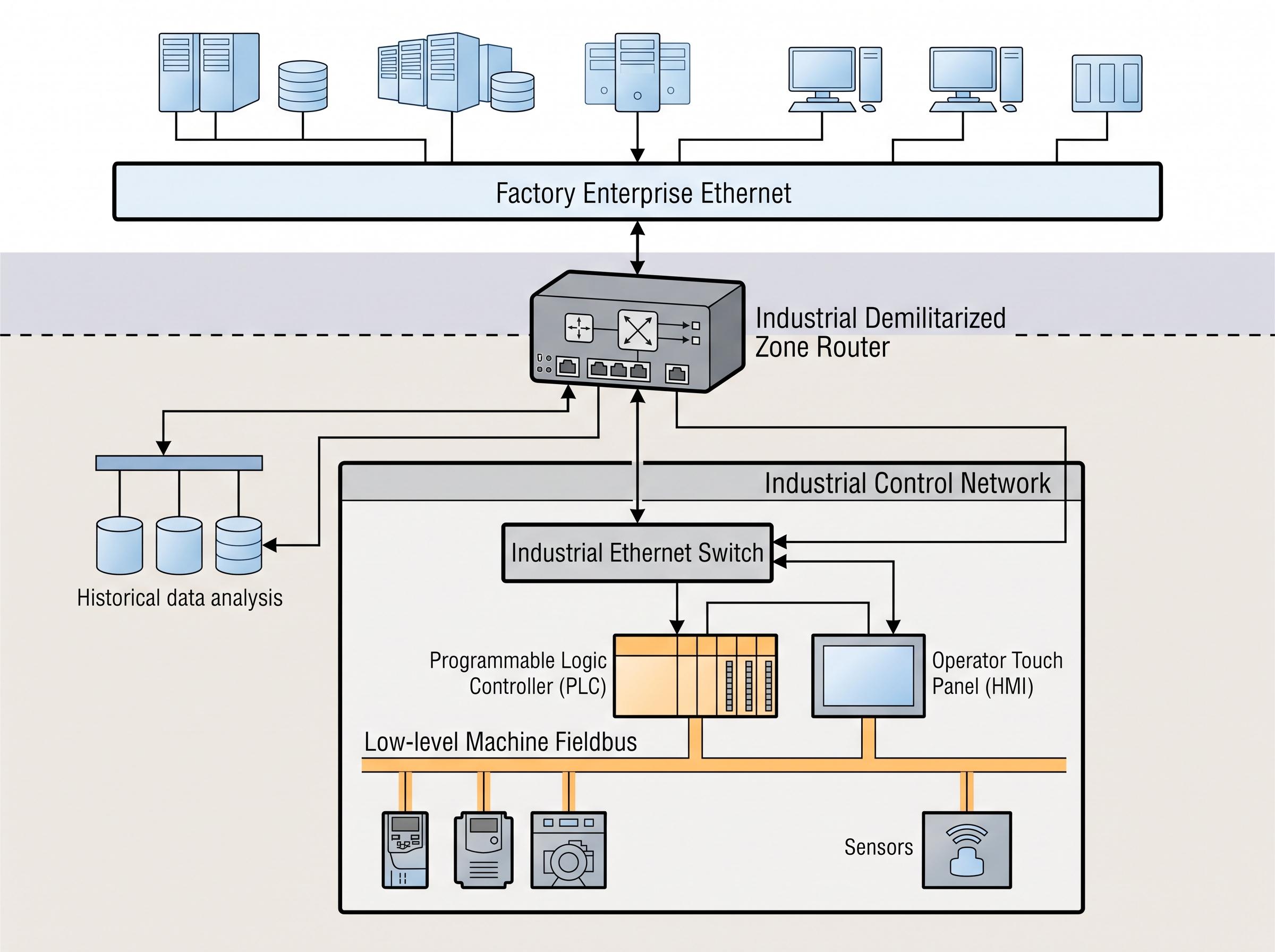
Product Classification: Navigating Default, Important, and Critical Classes
A common point of confusion among automation engineers stems from early legislative drafts that categorized all industrial automation and control systems (IACS) as Class II products. In the finalized text of Regulation (EU) 2024/2847, general-purpose PLCs, motion controllers, and operator HMI touch panels are not enumerated in Annex III or Annex IV1. Consequently, unless an industrial controller's primary core function constitutes a standalone firewall, intrusion detection appliance, or router, the controller falls into the CRA 'Default' category1. This classification allows machine builders to utilize conformity assessment Module A (Internal Production Control), enabling engineering self-assessment without mandatory third-party notified body intervention1.
However, machine builders must evaluate modular accessories and integrated network edge appliances individually based on their core function under Commission Implementing Regulation (EU) 2025/23921. When an OEM integrates a dedicated industrial router or managed switch directly into a machine's electrical cabinet, that networking sub-assembly falls under Annex III Class I (point 12)1. If an OEM integrates an industrial deep-packet inspection firewall or hardware intrusion prevention appliance to safeguard the cell, that component escalates to Class II (point 2), requiring mandatory third-party conformity assessment involving a designated notified body1. Integrating such components into a complete production machine does not automatically escalate the machine's overall PLC control system to Class II, provided the machine's primary function remains physical processing and fabrication1.
| Component Function | CRA Classification | Applicable Clause | Conformity Route | Notified Body Required? |
|---|---|---|---|---|
| Standard Machine PLC / Remote I/O | Default Category | Article 7(1) / Non-Annexed | Module A (Internal Control) | No (Self-assessment permitted) |
| Industrial HMI Touch Panels & SCADA | Default Category | Article 7(1) / Non-Annexed | Module A (Internal Control) | No (Self-assessment permitted) |
| Industrial Routers & Managed Switches | Important Class I | Annex III, Point 12 | Module A (if standard applied) or B+C / H | Conditional (Required if standard not applied) |
| Industrial Firewalls & Hardware IDS/IPS | Important Class II | Annex III, Class II, Point 2 | Module B+C (Type Examination) or Module H | Yes (Mandatory third-party review) |
Technical Requirements: Hardening PLCs and HMIs Under Annex I
Compliance with CRA Annex I Part I requires machine builders to execute systematic hardware and software hardening before placing machinery on the European single market. Machine builders can no longer ship equipment with static or default administrator credentials (such as 'admin/admin') printed in maintenance manuals or set in firmware1. Every PLC and HMI interface must enforce role-based access control (RBAC), segregating operator screens, maintenance menus, and engineering programming backplanes. Interfaces must incorporate brute-force mitigation mechanisms, session timeouts, and cryptographic protection of transmitted credentials across local industrial networks1.
Operational technology network protocols must be audited to restrict unnecessary attack surfaces under Annex I Part I(2)(j). Control engineers must disable unused services on embedded PLCs and HMIs, including legacy Telnet, unencrypted HTTP web servers, FTP, and exposed diagnostic ports. Where unauthenticated industrial protocols such as Modbus TCP or raw EtherNet/IP are deployed on machine field networks, the physical or logical network must isolate these communications from broader corporate infrastructure. The industrial standard series EN IEC 62443-4-1 (secure product development lifecycle) and EN IEC 62443-4-2 (technical requirements for IACS components) serves as the primary technical foundation for harmonised standards under development by CENELEC TC65X to demonstrate presumption of conformity7.
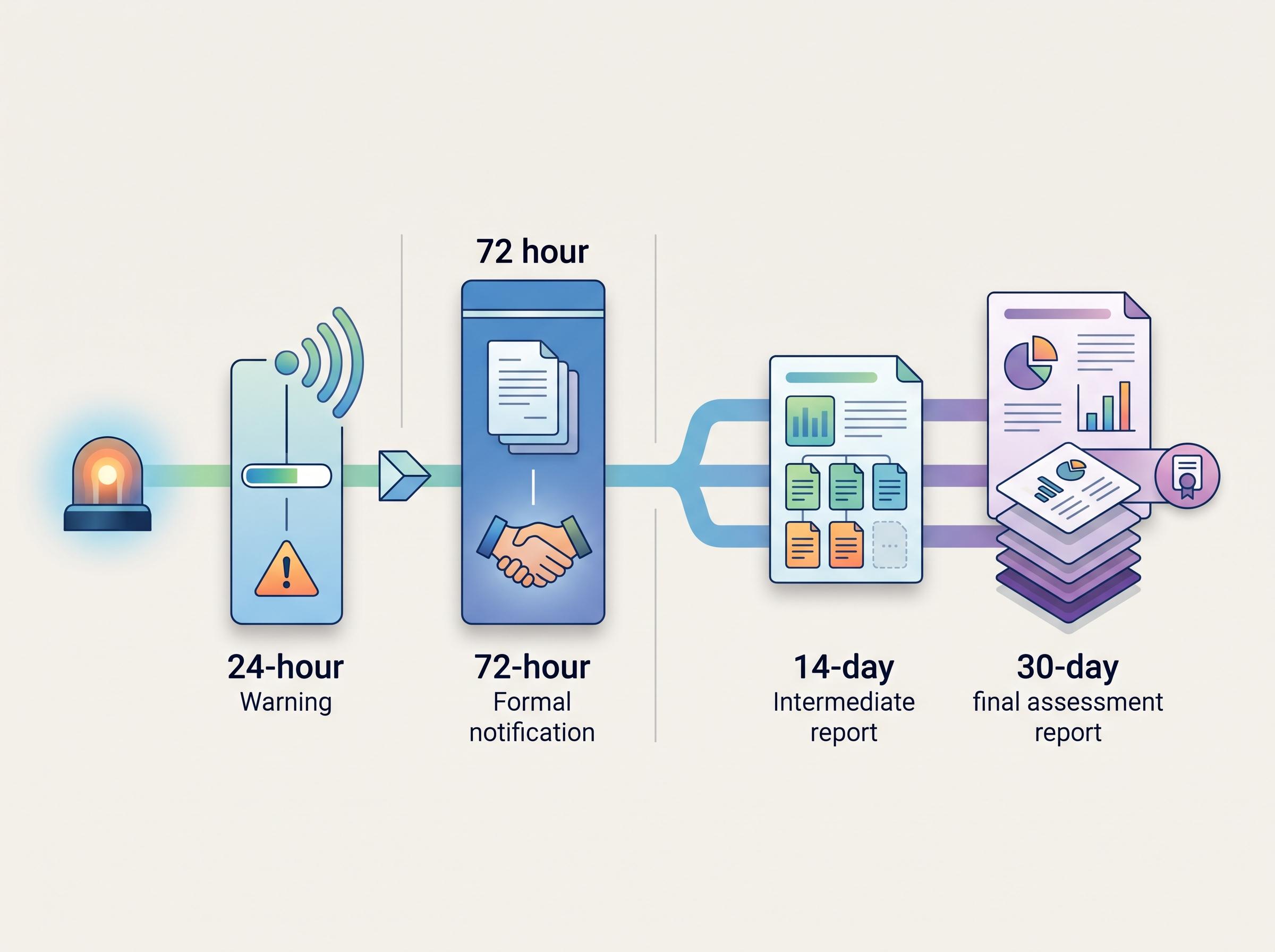
Active Regulatory Timelines and Operational Article 14 Reporting
A widespread compliance misstep among manufacturing executives is the belief that CRA compliance can be deferred until December 2027. Under Article 71(2) of Regulation (EU) 2024/2847, the mandatory reporting obligations codified in Article 14 have been legally binding since 11 September 20261. Furthermore, under Article 69(3), this reporting requirement applies retrospectively to in-scope connected digital products placed on the EU market before 11 December 20271. If an actively exploited zero-day vulnerability or severe security incident impacts a connected PLC, HMI runtime, or remote access bridge, the machinery builder must initiate regulatory reporting immediately1.
The Article 14 framework establishes a rigid notification sequence managed through the European Union Agency for Cybersecurity (ENISA) Single Reporting Platform and national designated Computer Security Incident Response Teams (CSIRTs)1. Manufacturers must submit an early warning within 24 hours of becoming aware of an actively exploited vulnerability or severe incident, indicating whether it stems from malicious action or poses cross-border risks1. A detailed vulnerability notification must follow within 72 hours, culminating in an actionable final report submitted within 14 days for vulnerabilities (once a mitigation is available) or within one month for security incidents1. Failure to establish internal Product Security Incident Response Teams (PSIRTs) capable of executing this schedule exposes manufacturers to administrative fines of up to €15 million or 2.5% of worldwide annual turnover under Article 641.
Software Bill of Materials (SBOM) and Lifecycle Vulnerability Handling
Under Annex I Part II point (1), machinery builders must compile and maintain a Software Bill of Materials (SBOM) in a machine-readable format covering at least top-level software dependencies, runtime libraries, and third-party packages embedded within machine controllers7. While the European Commission will issue specific implementing technical standards, Germany's Federal Office for Information Security (BSI) guideline TR-03183-2 v2.1.0 serves as the prevailing industrial benchmark, establishing CycloneDX 1.6+ or SPDX 3.0.1+ serialized in JSON or XML as acceptable formats7. Crucially, SBOM files must inventory exact software components and cryptographic hashes rather than static vulnerability data, as vulnerability disclosures are tracked dynamically through associated Vulnerability Explanability (VEX) documents7.
Machine builders must maintain these inventories across a defined support period that reflects the expected operational lifespan of the industrial machinery, which is typically a minimum of five years unless the machine's operational lifecycle is demonstrably shorter7. Manufacturers must verify that embedded PLC firmware, HMI operating systems, and communication drivers can receive digitally signed security patches that install without corrupting functional safety programs. Furthermore, security updates must be delivered separately from functional feature updates whenever feasible, ensuring that plant operators can remediate critical CVEs without undergoing costly machine re-validation or unexpected production line downtime1.
Practical Implementation: A Step-by-Step OEM Compliance Roadmap
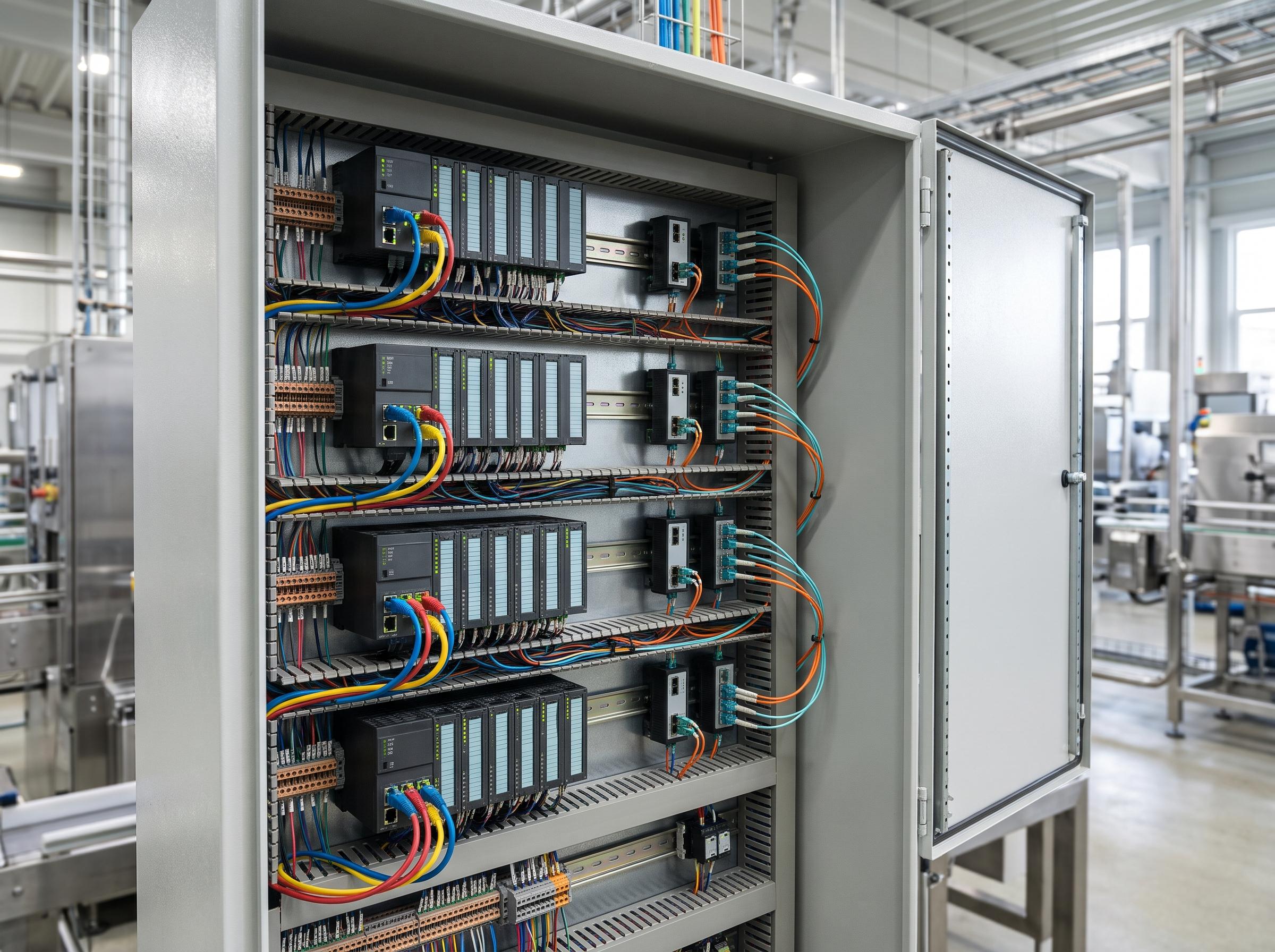
Executing a CRA readiness program requires machinery builders to bridge the traditional organizational gap between electrical design engineers, software developers, and compliance managers. The first operational phase involves cataloging every networked element across all active machine bills of materials (BOMs). Automation teams must identify every microcontroller, communication processor, HMI touch computer, and industrial protocol gateway, determining IP addresses, exposed open ports, physical interfaces (such as external USB or serial connectors), and third-party software libraries. This baseline inventory enables engineering teams to execute the comprehensive cybersecurity risk assessment required by CRA Article 13(2)1.
The second phase focuses on formalizing procurement requirements and vendor contractual agreements. Machine builders integrate automation components manufactured by tier-one vendors (e.g., Siemens, Rockwell Automation, Beckhoff, Schneider Electric). OEMs must mandate that suppliers provide compliant CycloneDX or SPDX SBOMs, formal declarations of vulnerability support periods, and certified secure development practices aligned with EN IEC 62443-4-17. When configuring HMIs and IPCs, engineers must verify cryptographic code signing on all deployed runtimes, validate tamper-resistant log storage mechanisms required by Machinery Regulation Annex III section 1.1.9, and document rollback protection for firmware updates5.
Substantial Modifications, Retrofits, and the Limits of Compliance
A critical boundary in industrial automation law involves post-commissioning modifications and legacy plant retrofits. Under CRA Article 69(2), products placed on the EU market prior to 11 December 2027 are grandfathered and exempt from Annex I essential requirements, provided they do not undergo a 'substantial modification'1. However, under Article 3(16) of the Machinery Regulation and aligned CRA guidance, if a system integrator or plant operator alters a machine's control logic, modifies physical safety parameters, or introduces remote connectivity that introduces unmitigated cyber hazards or escalates machinery risk, that party legally becomes the manufacturer5. The modifying entity must then execute a complete conformity assessment, re-issue the EU Declaration of Conformity, and apply updated CE marking5.
Finally, machinery builders must recognize what technical compliance cannot resolve without end-user cooperation. The CRA mandates that manufacturers deliver equipment with a 'secure-by-default' configuration and provide security updates throughout the declared support period1. However, the machine builder cannot physically force a factory operator to install firmware updates or maintain physical perimeter security around control cabinets. To protect against commercial liability, machine builders must document precise operating instructions, security administration handbooks, and clear demarcation boundaries within user technical manuals under CRA Annex II, detailing the end-user's responsibility for network segregation, firewall isolation, and credential rotation1.
Frequently asked questions
Q. Does a standard PLC require third-party notified body certification under the EU CRA?
A. No. Under the finalized text of Regulation (EU) 2024/2847, PLCs and HMIs are not listed in Annex III or IV and are classified as default category products. Machinery builders can execute conformity assessment using Module A (Internal Production Control) via self-assessment, provided the PLC does not serve as a dedicated industrial router or firewall.
Q. When did the EU CRA reporting obligation take effect for machine builders?
A. Under Article 71(2) and Article 69(3), the Article 14 reporting mandate took effect on 11 September 2026. This obligation applies retrospectively to connected machinery already on the market if an actively exploited vulnerability or severe security incident occurs.
Q. How does the EU CRA interact with the new Machinery Regulation (EU) 2023/1230?
A. Both regulations apply concurrently. The Machinery Regulation applies from 20 January 2027 and addresses cybersecurity risks that could cause physical safety hazards (Annex III 1.1.9 and 1.2.1). The CRA applies its essential cybersecurity requirements from 11 December 2027 across all digital product aspects. Compliance with both must be documented in the technical file.
Q. What standard should industrial machinery builders follow to demonstrate CRA conformity?
A. CENELEC TC65X is harmonising EN IEC 62443-4-1 (secure product development lifecycle) and EN IEC 62443-4-2 (technical requirements for IACS components) to provide presumption of conformity under the CRA, alongside prEN 50742 for Machinery Regulation protection against corruption.
Q. What format is required for the CRA Software Bill of Materials (SBOM)?
A. Annex I requires a machine-readable format covering top-level dependencies. The established benchmark in the EU, referenced in BSI TR-03183-2 v2.1.0, requires standard machine-readable formats such as CycloneDX 1.6+ or SPDX 3.0.1+ in JSON or XML format.
Sources
- Regulation (EU) 2024/2847 of the European Parliament and of the Council (Cyber Resilience Act)EUR-Lex
- Cyber Resilience Act: what applies from 11 September 2026 (Article 14 reporting) and the full CRA timelineISMS Copilot
- Is a PLC Class II Under the CRA? PLCs, SCADA and HMIsGoRegulus
- CRA Compliance Checklist: Industrial Controllers & PLCsCVD Portal
- Machinery Regulation and Cyber Resilience Act: who does whatEU Representa
- CRA FAQ - What is the interplay between the CRA and the Machinery Regulation?Open Regulatory Compliance Working Group (ORCWG)
- EU CRA SBOM Requirements: Formats, Fields, DeadlinesCyBeats
- IEC 62443: parts of the standard, security levels, zones and conduits, certification and link with the CRATech for Industry Show