 Industrial Solution Finder
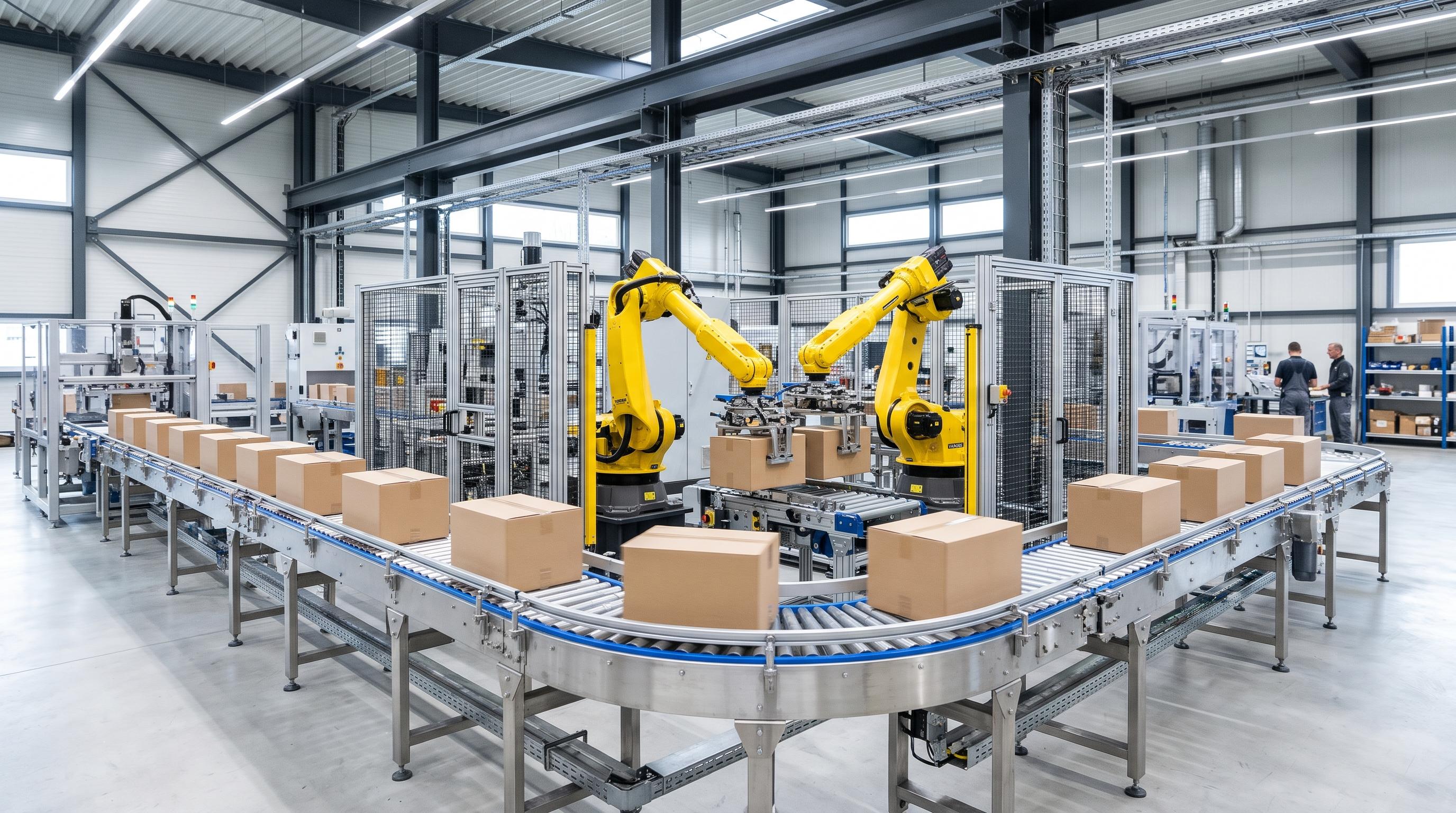
Integrators choose Delta robots for lightweight picks under 3 kg requiring continuous conveyor tracking over 120 picks/min, whereas SCARAs excel for payloads up to 20–50 kg with compact footprint constraints.
Kinematic Distinctions: Parallel Delta vs. Serial SCARA Architectures
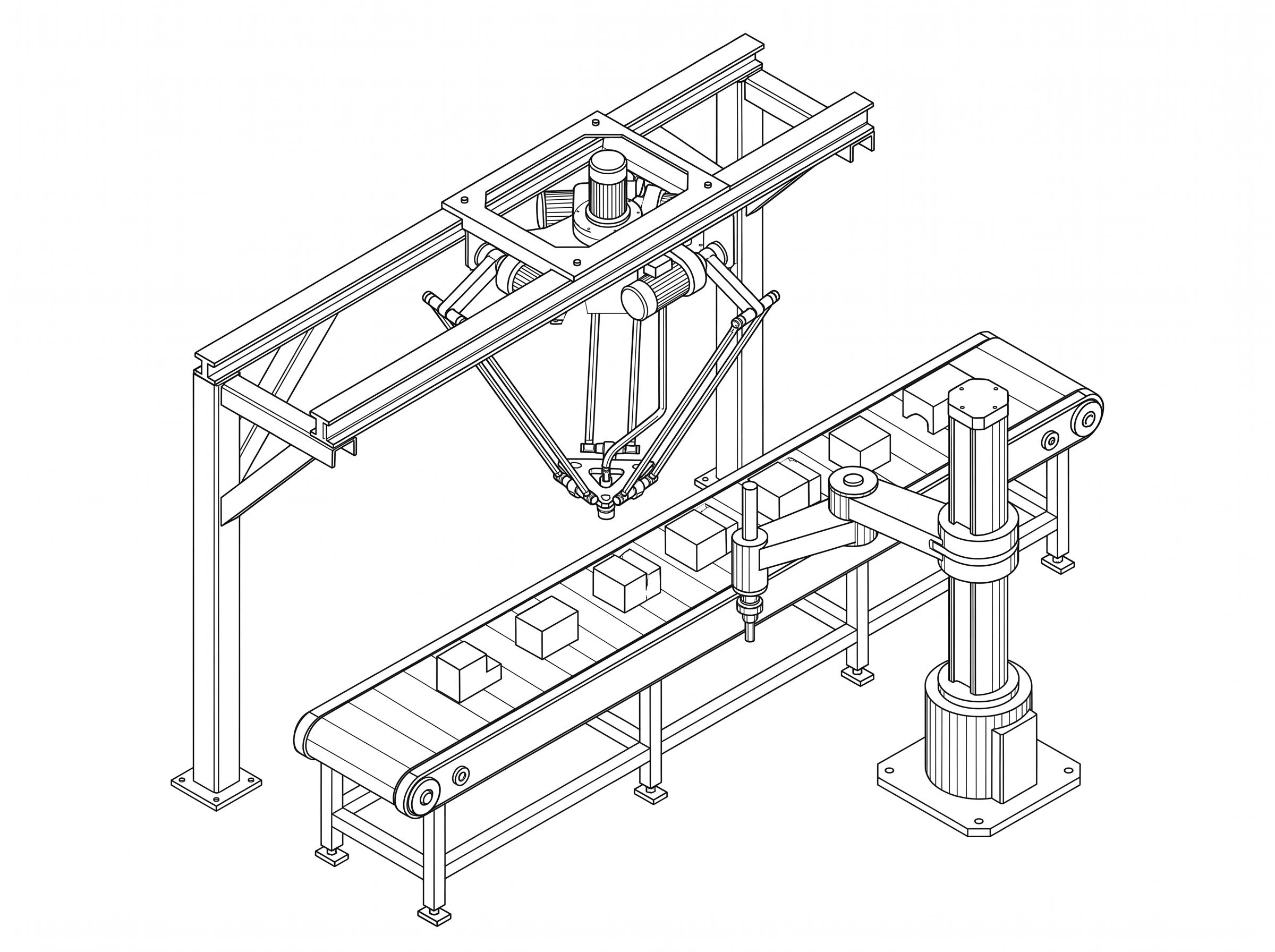
In secondary packaging automation—the stage where primary packages such as wrapped bars, pouches, or blister packs are collated and loaded into cartons, cases, or trays—selecting the proper robotic manipulator determines the operational ceiling of the entire packaging line. The fundamental engineering divergence between a Delta robot and a Selective Compliance Articulated Robot Arm (SCARA) stems from their kinematic architecture. A Delta robot utilizes a parallel kinematic mechanism where three or four closed kinematic chains connect a stationary overhead base plate to a mobile tool plate. Because the drive motors are housed entirely on the rigid overhead superstructure, the moving linkage consists of lightweight carbon-fiber or titanium arms, resulting in minimal moving inertia. This mechanical arrangement enables rapid accelerations exceeding 100 m/s² with minimal settling times across working diameters that reach up to 1,600 mm1.
In contrast, a SCARA robot operates on a serial kinematic chain consisting of two horizontal rotary joints, a vertical linear quill (Z-axis), and a rotational axis mounted in series. Because the outer joints carry the mass of successive links, bearings, and motors, the overall moving inertia of a SCARA is inherently higher than that of an equivalent-reach parallel robot. However, the serial configuration delivers exceptional torsional stiffness along the vertical axis, high downward insertion force capability, and superior directional repeatability often reaching ±0.010 mm. Integrators must recognize that this serial layout concentrates structural stresses onto the mounting base plate, whereas parallel Delta robots disperse dynamic reaction forces across an overhead gantry truss spanning the conveyor envelope.
Throughput and Payload Boundaries Across Common Packaging Tasks
Cycle speed and end-of-arm tooling (EOAT) payload capacity form the primary boundary conditions for secondary packaging line design. The vast majority of secondary packaging lines utilizing Delta robots handle payloads centered between 1 kg and 3 kg to maximize rapid pick rates, with typical configurations achieving 65 to over 150 cycles per minute depending on stroke geometry and product stability. Commercial parallel offerings across major robot builders provide specific payload tiers: the ABB IRB 360 FlexPicker series delivers payload capacities ranging from 1 kg up to 8 kg across 1,130 mm and 1,600 mm reach diameters1. Similarly, the FANUC M-2iA series offers payload ratings from 3 kg up to 6 kg with reach options up to 1.13 m2, while the four-arm Omron Quattro and iX4 parallel robot series supports standard payloads of 4 kg to 6 kg and heavy-handling variants handling up to 10 kg to 15 kg3. These high-speed parallel architectures require dedicated dynamic conveyor tracking modules and vision synchronizers to intercept moving product flows reliably12.
SCARA manipulators operate across a complementary payload and inertia profile. High-speed serial SCARA units, such as Epson GX and LS models, achieve standard arch cycle times ranging from 0.28 to 0.39 seconds under lightweight 2 kg loads. In high-precision food or secondary medical assembly, Stäubli TS2 SCARA models maintain an 8.4 kg maximum payload capacity with repeatability up to ±0.01 mm across enclosed designs. When secondary packaging tasks require lifting heavier multi-cavity vacuum manifolds, heavy carton inserts, or bulk multipacks, heavy-duty SCARA designs expand payload capabilities far beyond standard Delta limits: the Yamaha YK1200XG features an arm length of 1,200 mm with a maximum payload rating of 50 kg and a standard cycle time of 0.92 seconds under a 40 kg load4. When secondary packaging demands multipack carton collation, heavy pouch handling, or mechanical tucking, the serial arm delivers the requisite torque that lightweight parallel linkages cannot sustain.
Spatial Constraints, Overhead Clearance, and Facility Envelope
Floor layout and spatial utilization dictate robotic form factors in brownfield manufacturing facilities. A standard Delta robot requires an extensive overhead steel support framework spanning across the infeed and discharge conveyors. While the space beneath the parallel robot remains completely clear of floor-anchored machinery—allowing zero-footprint floor clearance for waste removal or conveyor routing—the gantry superstructure requires significant vertical ceiling clearance. Delta workspaces typically feature a cylindrical or dome reach profile ranging from 800 mm to 1,600 mm in diameter13. The structural framework must be designed to withstand high dynamic reaction loads induced by arm accelerations, preventing vibration transmission to adjacent sensitive checkweighers.
Conversely, conventional SCARAs are pedestal-mounted beside the conveyor line, occupying physical plant floorspace that can restrict operator walkways and cart transit. However, ceiling-mounted or inverted SCARA configurations eliminate the floor footprint entirely, offering reach radii between 350 mm and 550 mm with a full 360-degree envelope that eliminates dead zones. For facilities with low structural ceiling clearances, mezzanine levels, or pre-existing ductwork that prevents high gantry installations, the side-mounted or low-profile inverted SCARA provides a viable physical alternative without requiring building structural modifications.
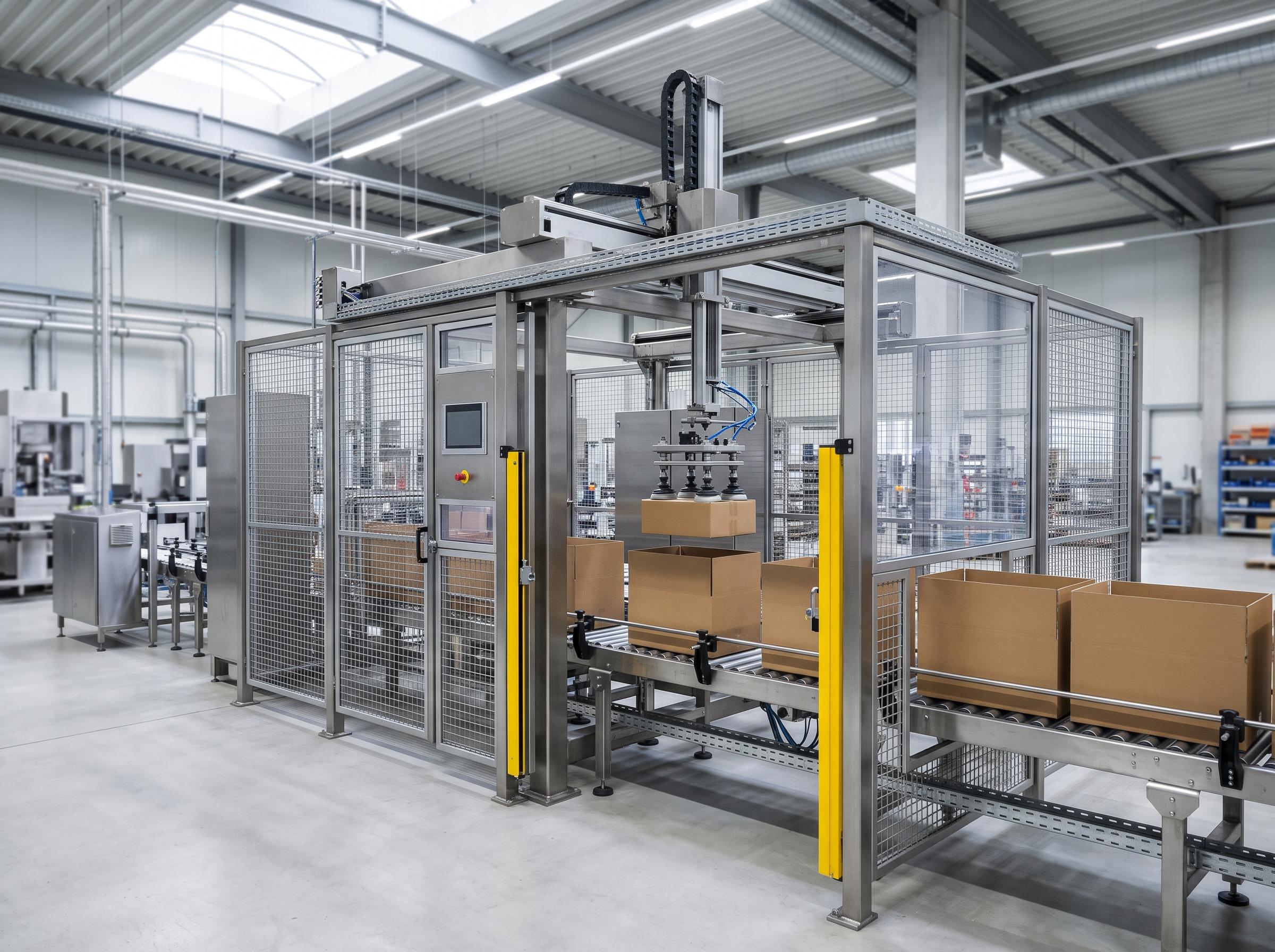
Decision Matrix: Technical and Operational Specification Comparison
Selecting the optimal secondary packaging robot requires evaluating interrelated mechanical, process, and cleanability factors. Integrators must avoid treating peak speed ratings in isolation. Real-world continuous throughput depends on payload mass, acceleration curves, gripper response times, and pneumatic valve switching latencies. The following multi-attribute matrix presents baseline technical capabilities across standard commercial parallel Delta and serial SCARA systems based on established manufacturer and industrial benchmarks.
| Evaluation Metric | Parallel Delta Robot | High-Speed SCARA Robot |
|---|---|---|
| Primary Kinematic Configuration | Parallel (3 or 4 closed-loop linkages) | Serial (revolute horizontal joints + vertical Z-quill) |
| Practical Packaging Payloads | 1 to 3 kg common (e.g., FANUC M-2iA/3; ABB IRB 360 up to 8 kg; Omron Quattro up to 10–15 kg) | 1 to 20 kg standard (e.g., Stäubli TS2 8.4 kg; Yamaha YK1200XG up to 50 kg) |
| Continuous Pick Rates | 65 to 200 cycles/min (load and stroke dependent) | 60 to 160 cycles/min (arch cycle 0.28–0.39 s standard) |
| Typical Workspace Geometry | Cylindrical/dome (diameter 800–1,600 mm) | Cylindrical reach (radius 175–1,200 mm, Z: 100–450 mm) |
| Mounting and Footprint | Overhead gantry structure; zero floor footprint | Pedestal floor-mount, wall-mount, or ceiling inverted |
| Hygienic Cleanability (Washdown) | IP69K stainless options available (ABB IRB 360, FANUC M-2iA, Omron IP65/66/67) | IP54/IP65 cleanroom/washdown protected variants |
| Mechanical Repeatability | ±0.05 mm to ±0.1 mm typical | ±0.010 mm to ±0.025 mm typical |
In washdown-intensive secondary packaging—such as dairy lines, frozen food collating, or meat packaging where wet cleaning protocols are enforced—environmental protection ratings become a defining parameter. Parallel Delta robots provide dedicated IP69K-rated sealed body options, including the stainless steel ABB IRB 360 variant1 and the fully enclosed FANUC M-2iA series2, which withstand high-pressure, high-temperature washdown detergents. In poultry and meat processing lines, the Omron Quattro platform offers models certified to USDA hygiene standards with IP65, IP66, and IP67 protection ratings3. Conversely, standard industrial SCARAs typically offer IP54 or IP65 environmental ratings with specialized bellows surrounding the vertical Z-quill, making them suitable for dry secondary cartoning or wipe-down environments, while heavy direct high-pressure hose washdown requires specialized exterior shielding.
Safety Standards, Risk Assessments, and Integration Boundaries
Secondary packaging cells operate at high dynamic velocities that eliminate the feasibility of unfenced collaborative operation. System integrators must comply with established safety codes, specifically the industrial robot safety standards ISO 10218-1 and ISO 10218-2. Under ISO 10218-2, the integrator holds legal and functional responsibility for performing a documented, comprehensive risk assessment for the complete automated cell, incorporating perimeter safeguarding, optical presence sensors, and interlocked entry gates. The standard mandates functional safety verification for emergency stopping and safety-monitored stops, ensuring that protective devices reliably stop the robot before human reach occurs.
Packaging machinery lines that coordinate robotic arms with carton erecting, pneumatic flap tucking, or sealing systems are governed in the United States by ANSI/PMMI B155.1-20235. This standard establishes safety requirements across the machinery lifecycle, requiring integrators to conduct iterative risk assessments and apply documented risk reduction measures until tolerable risk levels are achieved5. Under robotic standards referenced by OSHA and ISO, when safeguarding access gates are opened for teaching or maintenance, reduced-speed monitoring functions must restrict robot velocities to a maximum of 250 mm/s. Consultation with certified machine safety experts and packaging compliance engineers is essential during cell commissioning to validate site-specific stopping distances and interlock safety performance.
Frequently asked questions
Q. What is the primary payload threshold where SCARA robots outperform Deltas?
A. While Delta robots excel at high speeds with items under 3 kg, SCARA robots become mechanically superior when total tooling and part payloads exceed 6 kg to 8 kg, scaling up to 20 kg or 50 kg without requiring heavy parallel truss modifications.
Q. Can SCARA robots perform conveyor tracking as quickly as Delta robots?
A. SCARAs can track moving conveyors accurately using dynamic vision encoders, but their higher moving arm mass limits continuous cycle rates to roughly 60–140 picks/min, whereas lightweight parallel Deltas reach 100–200 picks/min.
Q. Which robotic architecture is easier to sanitize in food secondary packaging?
A. Delta robots offer superior washdown sanitation options, including fully sealed stainless steel models with IP69K ratings, whereas SCARA quills require flexible bellows and seals that are typically limited to IP65 washdown ratings.
Q. How do structural mounting requirements differ between Delta and SCARA systems?
A. Delta robots require a rigid overhead gantry to support high-acceleration dynamic reaction loads spanning the conveyor, while SCARA robots are conventionally anchored to the factory floor or mounted inverted from a low ceiling plate.
Sources
- IRB 360 | ABBABB Robotics
- M-2iA Series Delta Robot | FANUC AmericaFANUC America
- Quattro and iX4 Articulated Robots | OMRON RoboticsOMRON Robotics
- Yamaha Motor Releases New YK1200XG SCARA Robot and RCX341 Dedicated Controller - Achieving Industry-Leading Cycle Times with a 1,200mm Arm Length and a Maximum Payload of 50kg - - News releases | Yamaha Motor Co., Ltd.Yamaha Motor Co., Ltd.
- PMMI Releases Newly Revised ANSI/PMMI B155.1-2023 Safety StandardPMMI, The Association for Packaging and Processing Technologies