 Industrial Solution Finder

Mitigate sub-zero AMR battery degradation by deploying internal self-heating battery packs with BMS low-temperature charge lockouts, and eliminate optical sensor condensation using transparent ITO-heated lenses, IP67 sealed enclosures with breathable ePTFE vents, and dehumidified transit airlocks.
The Engineering Reality of Sub-Zero Autonomous Mobile Robot Deployment
Automating intralogistics inside commercial cold storage facilities—where temperatures continuously hover between -20°C and -30°C—presents a hostile operating environment for autonomous mobile robots (AMRs). While standard warehouse automation thrives in climate-controlled spaces, sub-zero facilities trigger severe electro-chemical and thermodynamic failure modes. Autonomous fleets routinely experience abrupt shutdowns, severely degraded operational duty cycles, blind navigation systems, and ghost-obstacle detections that paralyze material handling operations.
Addressing these operational disruptions requires warehouse automation architects to separate ambient intralogistics assumptions from low-temperature physics. The two foundational failure mechanisms stem from electro-chemical sluggishness inside lithium-ion battery cells and transient dew-point undershoot on optical sensor lenses during zone-crossing cycles. Mitigating these bottlenecks demands active thermal management, micro-structural optical engineering, and coordinated facility humidity zoning rather than simple off-the-shelf equipment retrofits.
Electrochemical Degradation: Lithium Plating and Capacity Loss Below Freezing
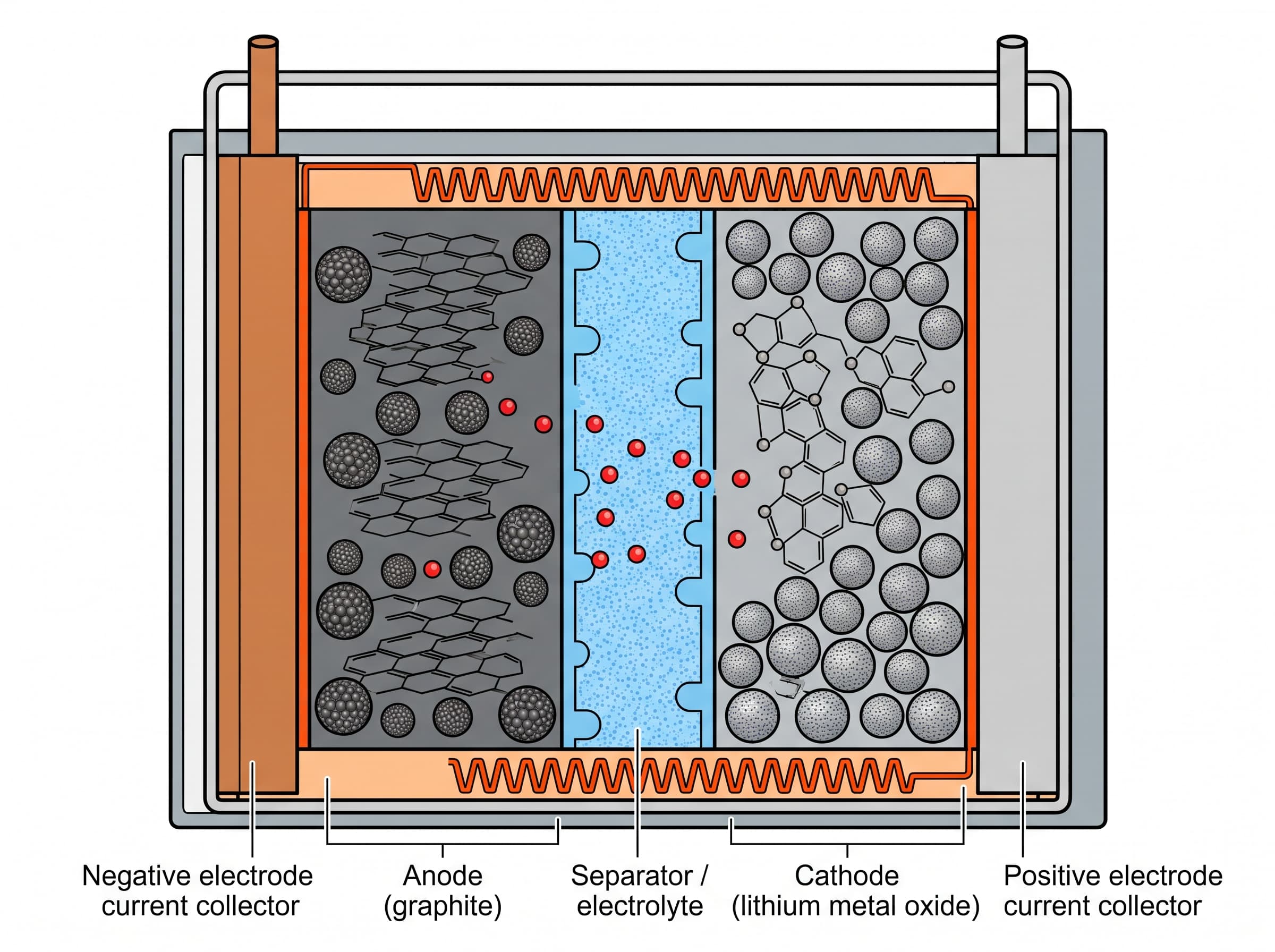
Operating conventional lithium-ion batteries at sub-zero temperatures initiates severe physical transport limitations inside the cell. When internal cell temperatures dip below 0°C, the liquid electrolyte viscosity increases significantly, leading to a marked decrease in lithium-ion conductivity across the cell separator. Simultaneously, the charge-transfer resistance across the solid electrolyte interphase (SEI) rises due to a steep increase in the desolvation energy barrier, while the solid-state lithium-ion diffusion coefficient within the graphite anode lattice contracts sharply. This sluggish transport induces substantial voltage sag under load, reducing usable discharge runtime.
The most hazardous operational risk in cold-storage AMR deployment is attempting to recharge cells below 0°C. When a charging current is applied under freezing conditions, lithium ions arrive at the negative electrode faster than they can intercalate into the contracted graphite host matrix. This mismatch forces metallic lithium to deposit directly on the anode surface—a failure mechanism known as lithium plating. Over repeated cycles, plated lithium morphs into dendritic structures that permanently consume active lithium inventory and can penetrate the separator, causing catastrophic internal short circuits and thermal runaway risks. Standard battery management systems (BMS) therefore enforce an automatic low-temperature charge lockout near 0°C to protect standard cells from irreversible destruction.
Battery Thermal Architecture: Internal Self-Heating vs. External PTC Blankets
To maintain fleet uptime without causing cell degradation, engineers deploy specialized thermal architectures. Conventional pack-level thermal management relies on external positive temperature coefficient (PTC) silicone heating blankets or resistance mats positioned along the battery chassis walls. While functionally straightforward, external blankets heat cells from the outer casing inwards. This creates steep internal thermal gradients across large pouch or prismatic modules, risking localized lithium plating in cell cores that remain below freezing while outer surfaces reach target temperatures.
Advanced sub-zero designs utilize self-heating cell structures that embed micro-thin nickel foils directly inside the electrode assembly1. When activated below freezing, internal switching circuitry routes current through the embedded foils, utilizing the cell's stored energy to achieve rapid and uniform volumetric warm-up. Empirical evaluations show that an all-climate cell architecture warms internal temperatures to 0°C within 20 seconds at -20°C and within 30 seconds at -30°C, expending merely 3.8% and 5.5% of total cell capacity, respectively1. Upon reaching 0°C, the cell achieves a discharge and regeneration power of 1,061 W/kg and 1,425 W/kg at 50% state of charge under -30°C conditions, delivering 6.4 to 12.3 times the power of standard cells while allowing rapid opportunity charging without dendrite formation1.
Thermodynamics of Optical Sensor Condensation in Dynamic Cold Chains
While batteries dictate runtime, LiDAR sensors, stereo depth cameras, and 2D barcode floor cameras govern localization and safety. Optical sensors suffer operational failure during dynamic zone-crossing intralogistics. When an AMR transitions from a -25°C deep-freeze storage vault into an ambient picking area or receiving dock at +4°C to +20°C, moisture in the warmer air immediately comes into contact with the chilled robot body and cold sensor windows.
Condensation is governed by dew point thermodynamics. When the surface temperature of the optical lens or LiDAR protective dome rests below the dew point temperature of the surrounding air, water vapor undergoes an immediate phase transition into liquid droplets. The resulting liquid film or microscopic droplet clusters diffuse and scatter near-infrared laser pulses and visible light, triggering false obstacle detections, blinding safety fields, and corrupting simultaneous localization and mapping (SLAM) navigation pipelines.
Hardware Engineering: Transparent Conductive Coatings and Sealed Enclosures
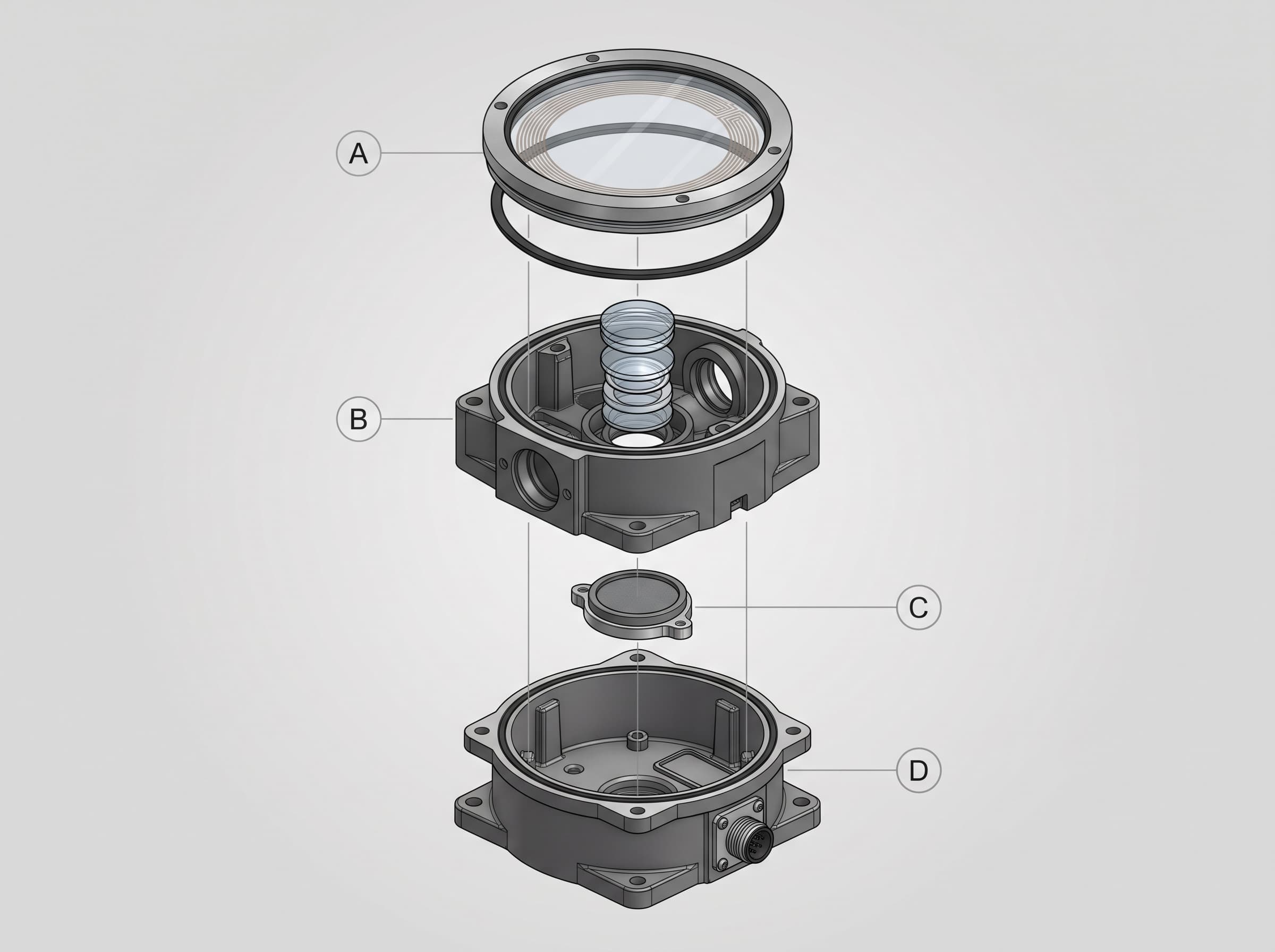
Eliminating optical sensor condensation requires a dual hardware strategy: keeping external optical surfaces above the ambient dew point and controlling the internal moisture volume within the sensor housing. Industrial manufacturers achieve surface temperature control by integrating transparent conductive thin films onto the inner side of glass protective lenses. Laser-structured indium tin oxide (ITO) layers provide high optical transmission in the visible spectrum—reaching approximately 90% transmission—while delivering uniform resistive heating that maintains the lens surface temperature just above the local dew point.
At the module level, optical-structural cavity optimization prevents internal fogging behind the lens. Research into camera module thermodynamics demonstrates that optimizing structural boundaries—such as reducing internal lens cavity volume by 72.6 mm³ and increasing the first lens thickness from 0.9 mm to 1.6 mm—dramatically lowers enclosed water vapor mass while maintaining critical conductive warmth. This structural modification increases the critical quenching temperature difference before condensation triggers from 42°C to beyond 60°C while preserving modulation transfer function (MTF) optical fidelity above 0.5 at 83 line pairs per millimeter. To protect sensitive optoelectronics, enclosures achieve IP67 or IP68 ingress protection and incorporate expanded polytetrafluoroethylene (ePTFE) vents that rapidly equalize internal and external pressure differentials, reducing seal stress and minimizing internal condensation while blocking liquid and solid contaminants2.
| Mitigation Strategy | Operating Mechanism | Thermal Response Time | Energy Overhead | Primary Failure Mode / Limitation |
|---|---|---|---|---|
| External PTC Heating Pads | Chassis-mounted resistance pads conduct heat through outer battery casing | Slow (15 to 45 min, typical design benchmark) | Moderate to High (continuous standby draw) | Creates steep core-to-surface thermal gradients; risks internal lithium plating |
| Internal Self-Heating Cell Foils | Embedded nickel foils utilize pack current for uniform internal ohmic heating | Rapid (20s to 0°C at -20°C; 30s to 0°C at -30°C) | Low (3.8% capacity at -20°C; 5.5% at -30°C) | Requires specialized cell manufacturing and complex cell-level switching BMS |
| Transparent ITO Heated Lenses | Resistive conductive coating maintains sensor window temperature above dew point | Near-instantaneous surface thermal stabilization | Low (1 to 5 W per module, typical design benchmark) | Requires precise closed-loop control to avoid thermal expansion and image defocus |
| Desiccant Vestibules (Airlocks) | Intermediate humidity-controlled transit chambers lower ambient air dew point | Passive stabilization during travel (30 to 90 s, typical design benchmark) | High facility HVAC investment; zero robot energy draw | Bottlenecks traffic throughput if transit vestibule cycle times are misaligned |
Facility Integration: Airlocks, Fast-Roll Doors, and Charging Protocol Design
Robot-level engineering must be reinforced by strict facility-level environmental controls. Cold storage warehouses should never expose AMRs to direct openings between sub-zero freezers and unconditioned ambient docks. Integrating automated high-speed insulated roll doors paired with an intermediate dehumidified vestibule (airlock) prevents warm, moisture-laden air from infiltrating cold zones. Operating active dehumidification systems inside airlocks keeps air dew points lower than the thermal mass temperature of incoming AMRs, effectively eliminating condensation during transit.
Fleet charging protocols must be tailored to sub-zero operational constraints. Fast opportunity charging should take place in conditioned areas at or above 0°C (recommended at +5°C or higher per industrial battery charging standards), or AMRs must utilize intelligent pre-heating cycles before docking. If charging within the freezer envelope is mandatory, the BMS must enforce a strict warm-up cycle—bringing cell core temperatures above 0°C before permitting high-rate charging current to flow1. Facility engineers should continuously audit dew point differentials and verify low-temperature charge lockout logs to maintain fleet longevity and operational safety.
Frequently asked questions
Q. Why does a standard lithium-ion battery lose capacity in sub-zero freezers?
A. Sub-zero cold increases electrolyte viscosity, decreases ionic conductivity, elevates charge-transfer resistance across the solid electrolyte interphase (SEI), and restricts solid-state diffusion of lithium ions inside the graphite anode, inducing severe internal voltage drops under load.
Q. Can cold storage AMRs be fast-charged while operating inside a -20°C freezer?
A. Standard lithium-ion cells cannot be recharged below 0°C without risking irreversible lithium plating and internal short circuits. Charging inside sub-zero freezers requires pre-heating the cell cores above 0°C using internal self-heating foils or heated charging bays before applying high currents.
Q. How do transparent heated coatings prevent LiDAR sensor blindness?
A. Transparent Indium Tin Oxide (ITO) thin films apply uniform resistive heating directly to the protective lens or cover glass, keeping the surface temperature above the ambient air dew point to eliminate condensation droplet formation.
Q. What is the function of a dehumidified airlock vestibule for cold chain robots?
A. An airlock vestibule equipped with desiccant dehumidification acts as an environmental buffer between freezer (-25°C) and ambient (+20°C) zones, lowering the ambient air dew point below the cold AMR chassis temperature to prevent moisture condensation during transit.
Sources
- Lithium-ion battery structure that self-heats at low temperaturesNature / PubMed
- Protective Vents, Screw-In Series for Outdoor Electronic EnclosuresW. L. Gore & Associates