 Industrial Solution Finder
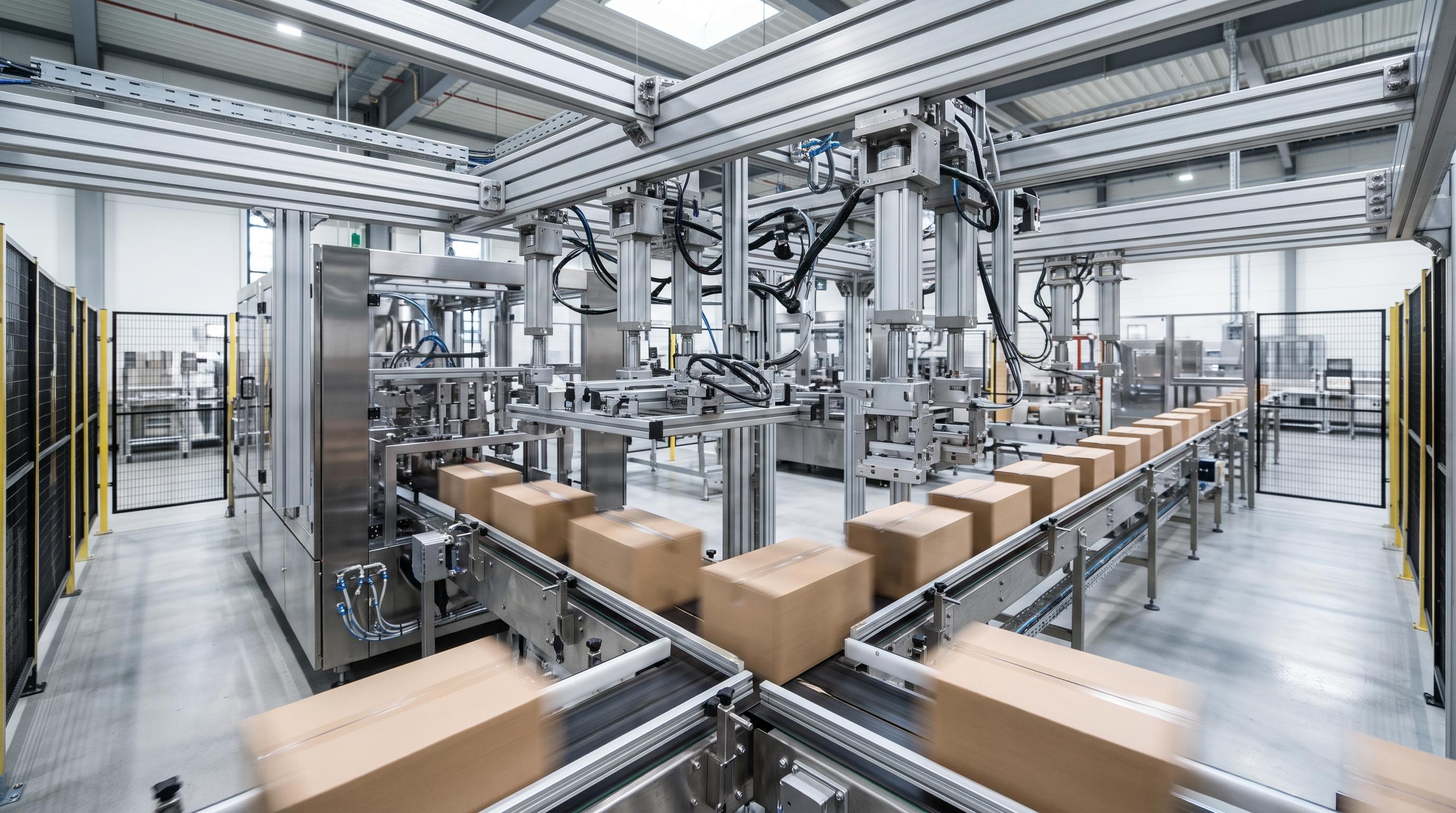
Replacing pneumatic cylinders with electric servo actuators in repetitive packaging stations yields full TCO payback in 1.1 to 1.8 years, driven by 75% to 85% lower motion energy costs.
Packaging automation engineers face a classic capital allocation dilemma when configuring linear motion axes for high-cycle stations such as carton pushers, case erectors, and pick-and-place transfer units. Pneumatic cylinders have historically dominated these stations because their upfront component purchase costs are deceptively low, typically requiring modest initial capital for a standard cylinder body and rod mount. However, examining only initial capital expenditure (CapEx) obscures the operating expenditure (OpEx) generated by continuous pneumatic fluid power.
When assessing repetitive packaging machinery operating across multi-shift production schedules (4,000 to 6,000 operational hours per year), total cost of ownership (TCO) shifts decisively. The thermodynamic inefficiencies of compressed air generation, combined with continuous distribution leaks and mechanical wear from uncontrolled end-of-stroke impact, erode initial CapEx savings within the first operating years. This guide provides an evidence-based financial and mechanical breakdown to calculate the true 3-year TCO payback timeline when replacing legacy pneumatic cylinders with electro-mechanical rod actuators and integrated servo drives.
1. The Thermodynamic Flaw of Compressed Air in Repetitive Motion
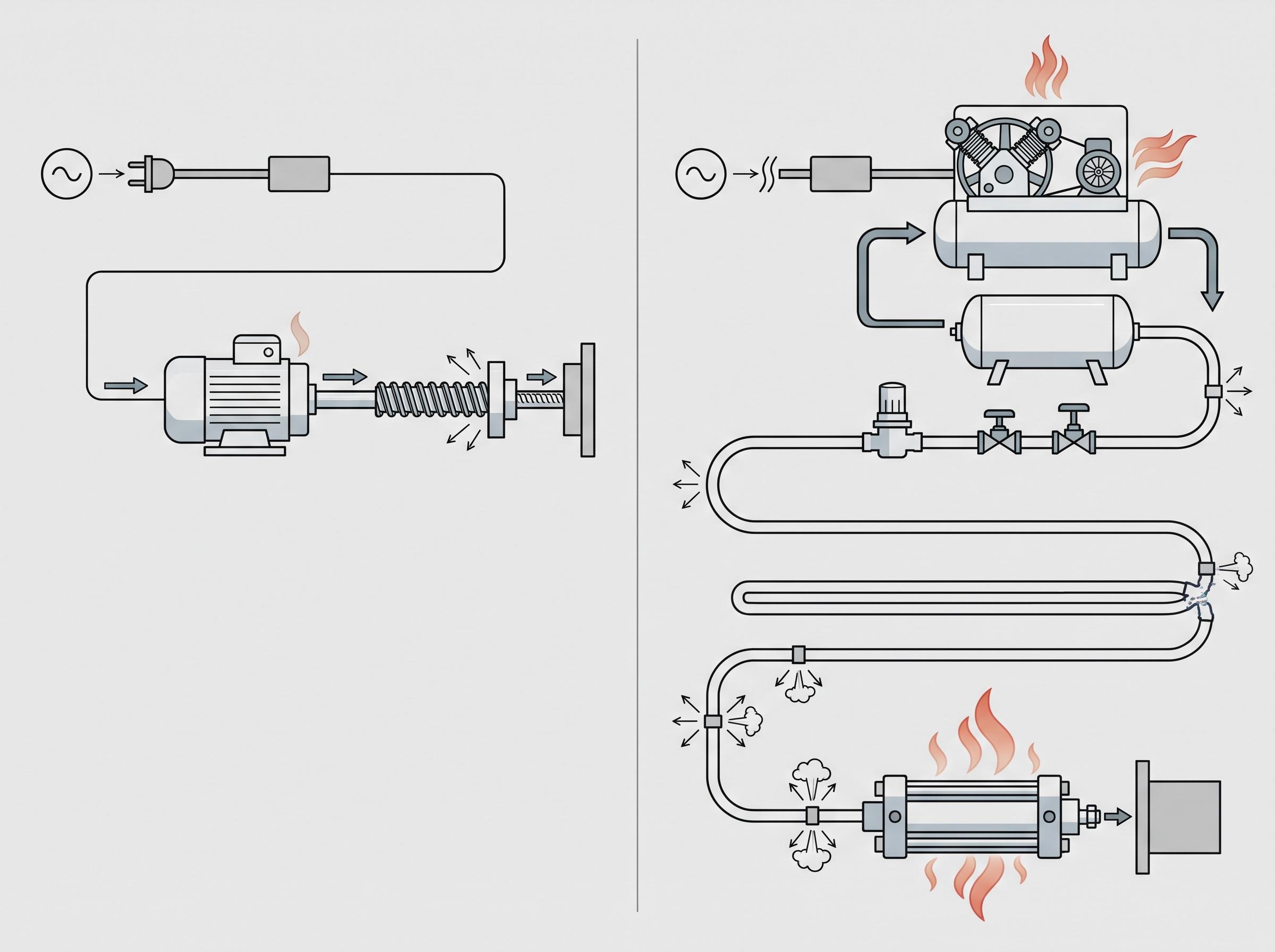
The primary economic driver behind pneumatic-to-electric conversion is the staggering difference in energy conversion efficiency between the two technologies. Standard industrial compressed air systems exhibit overall thermodynamic efficiencies of merely 10% to 15%3, as up to 80% of the electrical energy consumed by the compressor motor is lost immediately as waste heat during the air compression cycle1. Furthermore, field benchmarks documented by the United States Department of Energy demonstrate that operating a 1 hp pneumatic motor or tool requires roughly 7 to 8 hp of electrical power delivered to the main compressor1.
In direct contrast, electro-mechanical linear systems utilizing brushless servomotors coupled to precision ball screws operate at overall electrical-to-mechanical transfer efficiencies around 80%3. An electric actuator converts electrical wattage into mechanical thrust directly at the point of work without intervening thermal transformation or expansive volumetric displacement. Consequently, while pneumatic actuators convert only around 10% to 20% of input energy into mechanical output, electric actuators achieve roughly 80% efficiency, enabling dramatic reductions in machine electricity consumption34.
2. Quantifying Hidden Operating Costs: Leaks and Idle Power
Lifecycle financial models frequently fail because they evaluate fluid power under clean laboratory conditions rather than dirty plant reality. In real-world packaging environments, electricity accounts for approximately 76% of a compressed air system total lifecycle cost, with equipment purchase representing a one-time event that pales against ongoing utility overhead2. Plant piping leaks, push-to-connect fitting degradation, valve manifold seal decay, and cylinder rod packing wear collectively waste 20% to 30% of total compressor volumetric output before air ever reaches the tooling2.
The monetary cost of minor compressed air leakage is dramatic. For instance, according to Compressed Air Challenge data, a single 1/8-inch orifice leak across an active distribution system wastes around $2,095 per year in industrial electricity under continuous operation at a conservative utility rate of $0.05 per kWh1. In modern production environments where industrial electricity rates reach $0.12 per kWh, this single leak translates into over $5,000 in unrecoverable annual losses. Additionally, pneumatic cylinders demand continuous line pressure while resting at end-positions to resist back-driving forces, ensuring constant parasitic draw. Electric servo cylinders, conversely, consume near-zero active power during idle dwell states, significantly curbing unnecessary plant baseline load3.
3. The 3-Year TCO Modeling: CapEx vs. OpEx Across Packaging Stations
To establish an accurate 3-year TCO comparison, plant engineers must assemble an equation accounting for upfront purchase, mechanical installation, maintenance intervals, direct energy use, and unplanned downtime. The standard engineering TCO formulation is defined as initial capital purchase plus operating duration multiplied by yearly replacement costs, yearly maintenance, electric utility costs, and scrap or cycle-time losses3.
| Cost Parameter | Standard Pneumatic Axis (85 psi) | Integrated Electric Servo Actuator | Delta & Financial Impact |
|---|---|---|---|
| Initial Hardware CapEx | $420 (Cylinder, valves, flow controls, sensors) | $1,950 (Actuator, integrated servo motor, cables) | +$1,530 initial electric premium |
| Installation & Commissioning | $380 (Pneumatic tubing, FRL drop, hard stops) | $520 (Power drop, Ethernet bus config, tuning) | +$140 installation cost variance |
| Annual Energy Consumption | 7,800 kWh equivalent ($936/year) | 1,150 kWh ($138/year) | $798 annual electrical utility savings |
| 3-Year Cumulative Energy Cost | $2,808 | $414 | $2,394 net electric power savings |
| 3-Year Preventive Maintenance | $1,050 (3x seal kit overhauls, lubricators, filters) | $180 (Annual grease lubrication check) | $870 maintenance labor & parts savings |
| Cumulative 3-Year Total Cost | $4,658 | $3,064 | $1,594 net savings (TCO Payback in 1.4 years hardware / 1.5 years all-in) |
As demonstrated in the empirical packaging axis model, the higher initial capital expenditure of the electric servo system is fully amortized in under two years through recurring utility and maintenance cost reductions. Over the 36-month baseline, this single-axis conversion yields a cumulative net cash saving of $1,594. Based on the author's TCO calculation model applied to a multi-station secondary packaging cell operating 8 to 12 synchronized actuator axes, cumulative plant savings can reach $12,000 to $19,000 over 3 years, illustrating why multi-shift production lines prioritize high-duty axis conversion.
4. Mechanical Longevity, Shock Loads, and Product Scrap Reductions
Beyond raw electrical kilowatt reduction, the physical dynamics of motion play a pivotal role in total lifecycle payback. Pneumatic cylinders rely on internal air cushions or external polyurethane bumpers to decelerate moving masses. In high-cycle packaging operations exceeding 30 to 45 cycles per minute, pneumatic velocity changes create harsh mechanical shocks at stroke limits, accelerating seal extrusion, rod guide bushing wear, and structural fatigue3. When internal cylinder seals degrade, volumetric blow-by increases leakage exponentially, often remaining unnoticed until line pressure drops cause machine stalling2.
Electric actuators utilize programmable motion trajectories—such as controlled acceleration and deceleration profiles—which eliminate mechanical hard-stop impacts and provide repeatable positioning34. Controlled soft deceleration prevents carton crushing, pouch rupture, and material misalignment during high-speed push and divert routines. In sensitive packaging operations, replacing sudden pneumatic thrusting with smooth, programmable servo force profiles substantially improves yield by minimizing product handling damage and carton scrap3.
5. Safety Architecture: Safe Torque Off (STO) vs. Pneumatic Dump Valves
A crucial engineering consideration when transitioning from fluid power to electro-mechanical linear systems is functional machine safety. Traditional pneumatic stations commonly rely on soft-start and dump valves that exhaust trapped air during emergency stops. While simple, exhausting line pressure completely removes mechanical holding force, causing vertical axes to fall by gravity and horizontal axes to drift unless fitted with complex external mechanical rod clamps or pilot-operated check valves.
Modern electric servo systems achieve functional safety integration through built-in Safe Torque Off (STO) circuits4. Activating STO electronically cuts power to the motor drive transistors, preventing the motor from generating rotational force while keeping logic power intact. When integrated with mechanical holding brakes, electric axes hold position immediately during an emergency stop, creating a safer and more predictable environment for operators and maintenance personnel without the sudden lunging often seen when pneumatic circuits re-pressurize4.
6. Implementation Pitfalls, Sizing Rules, and Boundary Conditions
Despite compelling TCO metrics, switching from pneumatics to electric servo actuation is not an automatic panacea for every industrial axis. The most common engineering failure in conversion projects is improper thermal sizing and side-load management. Unlike pneumatic cylinders, which tolerate heavy side-loading and dissipate heat along metal barrels into ambient plant air, electric ball screws and planetary gearboxes require rigid external linear guides to absorb radial moments and prevent premature thrust bearing failure.
Furthermore, low-duty-cycle stations cycling fewer than 5 times per minute or operating only during single seasonal shifts may exhibit TCO payback periods extending beyond 4 to 6 years, weakening the financial business case. Harsh high-pressure washdown environments or hazardous classified zones also demand specialized stainless-steel electric actuators, which carry higher price premiums. Engineers must calculate baseline cycle frequencies, ambient thermal constraints, and utility rate structures before issuing capital conversion project orders.
Frequently asked questions
Q. What is the typical TCO payback period when replacing a packaging pneumatic cylinder with an electric actuator?
A. In multi-shift packaging stations operating 4,000 to 6,000 hours per year at high cycle rates, the typical total cost of ownership payback ranges between 1.1 and 1.8 years. The return is primarily driven by 75% to 85% motion energy savings and reduced seal maintenance.
Q. Can electric servo actuators handle washdown cleaning environments in food packaging?
A. Yes, but they require specialized IP67 or IP69K-rated stainless steel enclosures with hygienic seals and potted cable glands. These hygienic models carry a price premium over standard industrial actuators, which extends the payback timeline slightly compared to dry carton packaging.
Q. Why does compressed air consume so much electrical energy compared to electric drives?
A. Compressed air systems suffer severe thermodynamic losses, with roughly 80% of compressor electrical input lost as waste heat. Total pneumatic system efficiency averages 10% to 20%, compared to roughly 80% efficiency in electric servo motor ball screw actuators.
Q. How do electric actuators handle emergency stop safety compared to pneumatic exhaust valves?
A. Electric servo drives incorporate certified Safe Torque Off (STO) functions to reliably cut motor power. For vertical axes, spring-set friction brakes hold the mechanical load securely, avoiding the free-fall hazard of pneumatic air dump valves.
Sources
- Softening the Blow of Compressed AirEnergyWise Nebraska (NPPD / U.S. Department of Energy Data)
- Compressed Air Cost Per CFM: Formula and Benchmark NumbersAir Compressor Zone
- Electric actuators vs. pneumatic cylinders: Total cost of ownershipLinear Motion Tips
- Pneumatic or electric cylinders?Rollco