 Industrial Solution Finder
Sparkplug B establishes a fixed topic namespace and bidirectional birth-death state tracking via Protobuf, turning raw vanilla MQTT into deterministic brownfield PLC telemetry.
Manufacturing plants undertaking digital transformation frequently encounter an architectural impasse: how to extract real-time telemetry from decades-old programmable logic controllers (PLCs) without disrupting active production cycles. Brownfield environments rely on heterogeneous fieldbuses—Modbus RTU/TCP, Siemens S7comm, Rockwell DF1, and PROFIBUS—that operate on synchronous, cyclical master-slave polling. Transporting this raw operational data into modern Unified Namespace (UNS) platforms or enterprise historians demands a decoupled, event-driven transport mechanism. While standard (vanilla) MQTT has emerged as the default publish-subscribe transport for lightweight IIoT communications, its protocol-level minimalism exposes critical operational vulnerabilities when applied to industrial process control without additional constraints.
Vanilla MQTT, standardized under OASIS MQTT v3.1.1 and v5.0, deliberately refrains from prescribing payload formats, schema definitions, topic naming rules, or holistic device lifecycle tracking. A plant floor running plain MQTT leaves every system integrator free to invent custom topic trees—such as 'plant1/packaging/filler_speed' or 'cellB_tags'—and serialize telemetry into arbitrary JSON strings, raw strings, or custom binary structs. Consequently, supervisory control and data acquisition (SCADA) systems cannot dynamically discover what tags an edge node provides, nor can they determine whether an absence of incoming data reflects an idle production line, a broken Ethernet drop, or a frozen controller. Eclipse Sparkplug B was engineered precisely to bridge this deterministic operational technology (OT) requirement and the decoupled pub/sub nature of MQTT.
The Architectural Gap: Why Vanilla MQTT Fails Brownfield Telemetry
To understand why brownfield PLC integration requires more than standard MQTT, engineers must examine the failure modes of unmanaged pub/sub topologies on the plant floor. In a vanilla MQTT deployment, an edge gateway interrogates legacy PLCs via cyclical polling and pushes updates to an MQTT broker. Because plain MQTT treats payloads as transparent byte arrays, the gateway engineer must unilaterally decide tag payload structures. Typically, teams adopt JSON due to its readability. However, parsing serialized JSON strings at sub-second rates across thousands of Modbus and EtherNet/IP registers imposes substantial compute overhead on low-power gateway microprocessors, bloats payload sizes with repetitive ASCII keys, and lacks native schema enforcement 1.
More critically, plain MQTT lacks native, bidirectional state awareness across industrial applications. While vanilla MQTT provides a Last Will and Testament (LWT) feature to notify clients when a broker detects an ungraceful socket disconnection, LWT does not manage multi-tiered field device lifecycles. If an edge computer remains connected to the broker over cellular or industrial Ethernet, but its local serial RS-485 link to a Modbus PLC severs, the vanilla broker continues reporting the gateway as online. Downstream SCADA and analytics engines continue referencing stale values because the broker retains no contextual information about the subordinate PLC 1. Furthermore, vanilla MQTT provides no built-in mechanism for an edge publisher to detect whether the central SCADA host is online and listening, creating data loss scenarios during supervisory system failovers.
Standardized Topic Namespaces: Deconstructing the spBv1.0 Hierarchy
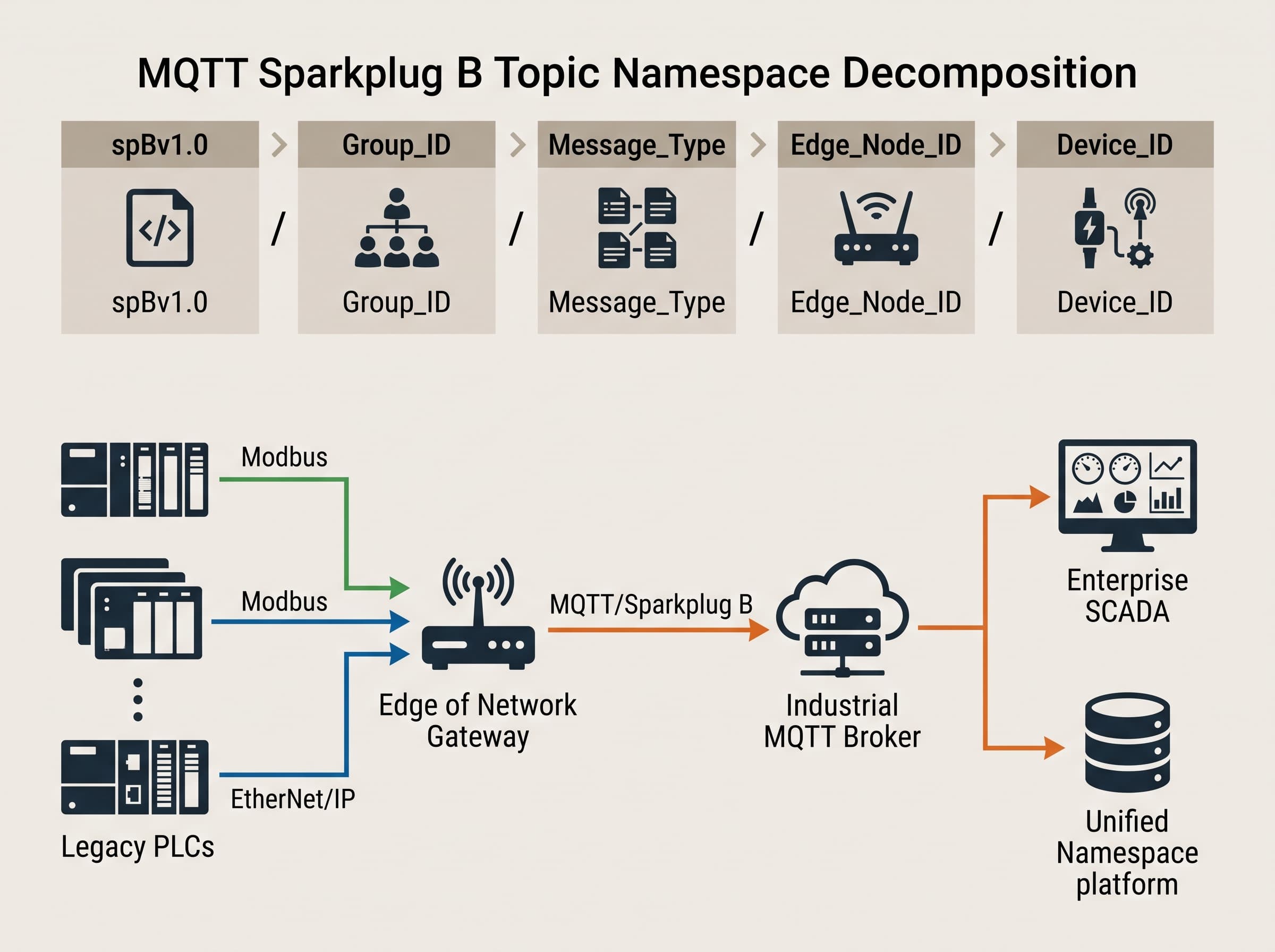
Sparkplug B eliminates the chaos of arbitrary topic paths by enforcing a rigid, canonical topic namespace across all edge publishers, intermediaries, and subscribers. Defined under Eclipse Foundation specifications and internationalized under ISO/IEC 20237, every Sparkplug B topic must follow a strict five-element pattern: 'spBv1.0/Group_ID/Message_Type/Edge_Node_ID/[Device_ID]' 1. The prefix 'spBv1.0' standardizes the protocol version, preventing version collisions across shared enterprise message brokers. The 'Group_ID' represents a logical cluster, typically aligned with physical enterprise hierarchies such as an ISA-95 site or manufacturing facility (e.g., 'Dallas_Plant' or 'Packaging_Hall_2').
The second half of the namespace isolates physical and virtual hardware boundaries. The 'Edge_Node_ID' uniquely designates the Edge of Network (EoN) node—the physical industrial PC, gateway, or edge computing box interfacing directly with field networks. The optional 'Device_ID' element identifies specific end devices operating downstream of the EoN gateway, such as individual brownfield PLCs, remote terminal units (RTUs), or smart drives connected via serial or industrial Ethernet drops 1. By segmenting the node from its attached devices, Sparkplug B allows an edge gateway to independently report operational telemetry and connection status for each attached legacy machine without needing to establish separate physical MQTT client sessions for every PLC.
The central pillar of this namespace is the non-negotiable 'Message_Type' element, which dictates the operational intent of the payload. Sparkplug B specifies nine distinct verb tokens: NBIRTH, NDEATH, DBIRTH, DDEATH, NDATA, DDATA, NCMD, DCMD, and STATE 1. These message types eliminate guesswork by separating configuration and discovery semantics from real-time data streaming and command invocation. Brokers and consuming applications parse the topic string to immediately determine whether an incoming transmission contains a tag schema update, an operational telemetry change, or an emergency communication drop notification, completely bypassing the need for payload introspection.
Bidirectional State Awareness: NBIRTH, NDEATH, and the Primary Host State
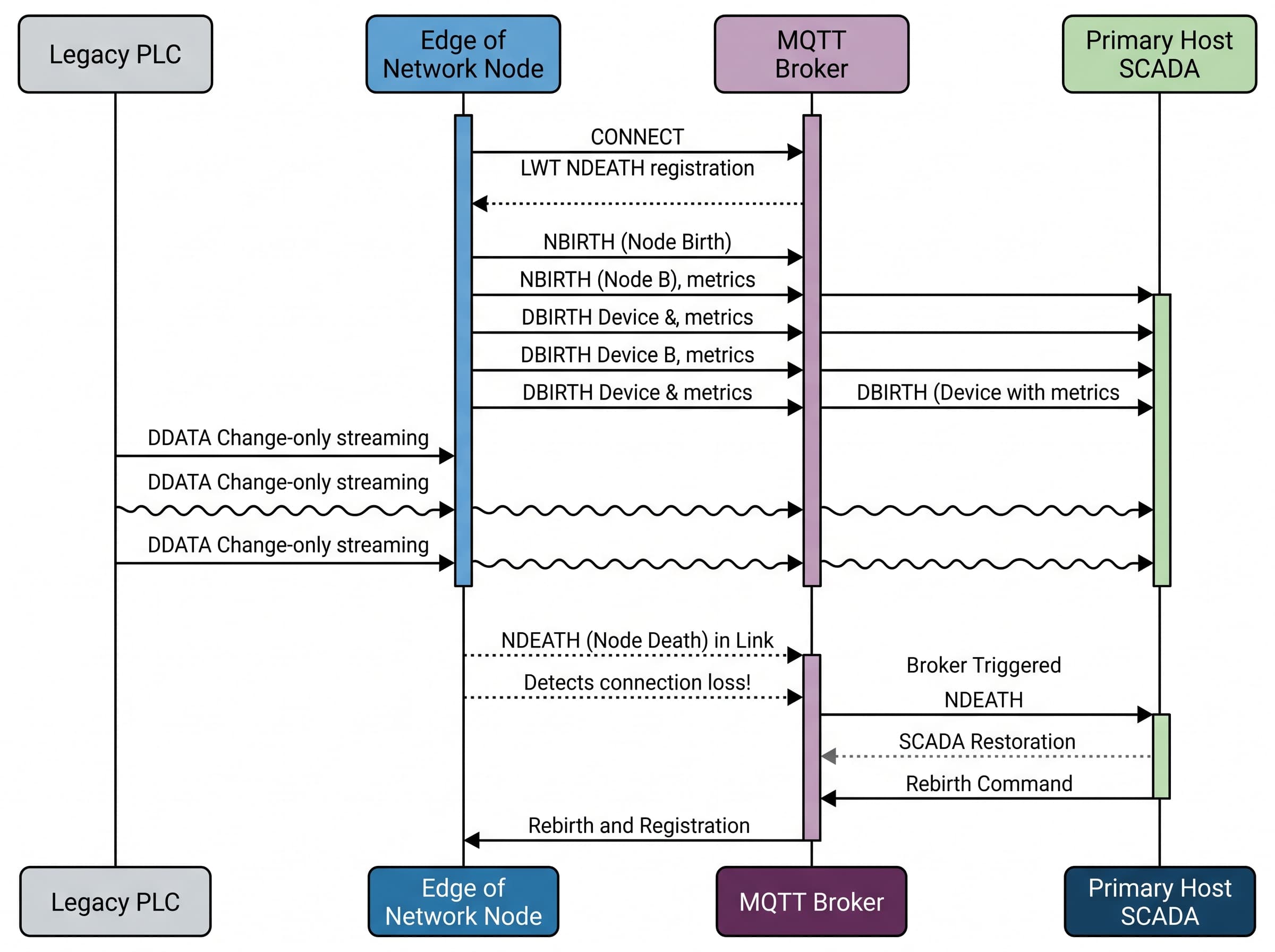
In high-reliability industrial automation, knowing that data is stale or unavailable is just as important as receiving updated values. Sparkplug B transforms MQTT from a best-effort streaming medium into a fully state-aware industrial communications framework through its birth-death lifecycle sequence. When an EoN gateway initializes, it configures an unmanaged MQTT CONNECT packet registering a Last Will and Testament payload containing an NDEATH message type on its node topic. The broker caches this instruction. The edge node then publishes an NBIRTH (Node Birth) certificate, followed by individual DBIRTH (Device Birth) messages for each attached brownfield PLC 1.
The birth certificate functions as a dynamic, self-describing manifest. Rather than requiring SCADA engineers to manually configure tag lists, engineering units, and data types in the central database, the NBIRTH and DBIRTH payloads define every single metric the edge device will ever publish, complete with initial values, metadata (e.g., engineering units, minimum/maximum scaling), data typing (Int32, Float, Boolean, String), and a compact 64-bit integer alias [claim-2, claim-6]. Crucially, each birth certificate carries a birth-death sequence counter ('bdSeq') that increments with every reconnect. When an ungraceful disconnect occurs, the broker automatically publishes the registered NDEATH carrying the corresponding 'bdSeq' token, allowing the host application to correlate disconnects accurately and ignore obsolete death packets caused by network race conditions 1.
State management in Sparkplug B operates symmetrically through the Primary Host Application mechanism. A designated primary host (such as an Ignition SCADA or enterprise platform) maintains an active MQTT session and publishes a retained 'STATE' message to 'spBv1.0/STATE/{host_id}' using MQTT Quality of Service (QoS) 1, transmitting an 'online: true' payload 1. Edge nodes continuously monitor this topic. If the central host disconnects or crashes, the broker issues the host's LWT state payload ('online: false'). Recognizing that the supervisory host is offline, edge gateways immediately switch from active reporting to historical buffer mode, storing timestamped PLC telemetry in local flash storage to prevent industrial data loss until the host returns and issues an NCMD Rebirth request 1.
Integrating Legacy PLCs: Protocol Polling, Tag Aliasing, and Report by Exception
Connecting legacy automation hardware—such as an Allen-Bradley SLC 500, Siemens S7-300, or a Modbus power meter—to an MQTT broker involves bridging deterministic OT polling and asynchronous IT pub/sub architectures. The brownfield PLC lacks the TCP/IP stack or processing power to run an MQTT client directly. Instead, an EoN gateway interfaces with the PLC's serial port or control backplane, executing local cyclical reads against holding registers, DB blocks, or data files at high frequencies (e.g., 50 ms to 250 ms). The gateway maps these raw physical memory offsets into logically named metrics within the Sparkplug B runtime environment.
Once the initial tag definitions are broadcast in the DBIRTH payload, Sparkplug B enforces Report by Exception (RBE) data collection. Instead of continuously publishing every tag value on every polling cycle, the edge gateway evaluates incoming PLC register reads against configured deadbands. Only when a tag value changes or exceeds its deadband does the gateway publish a DDATA message 1. Because the DBIRTH packet previously bound every tag name to an integer alias, the DDATA message omits lengthy descriptive strings entirely, transmitting only the integer alias and the updated value serialized via Google Protocol Buffers (Protobuf) 1. This architecture reduces factory network bandwidth consumption by 80% to 95% compared to vanilla MQTT JSON transmissions or cyclic master polling 1.
Architectural Comparison: Vanilla MQTT vs. MQTT Sparkplug B in Unified Namespaces
Designing an enterprise Unified Namespace requires evaluating the trade-offs between unrestricted flexibility and rigorous standard conformance. Vanilla MQTT grants system architects total freedom over topic taxonomy, making it attractive for lightweight greenfield prototypes or non-industrial applications where device structures are fluid. However, across large enterprise deployments comprising hundreds of edge nodes and tens of thousands of tags, that freedom invariably leads to semantic debt, integration silos, and fractured telemetry. The table below outlines how each approach handles foundational data collection, state tracking, and brownfield integration challenges.
| Evaluation Criteria | Vanilla MQTT Architecture | MQTT Sparkplug B Specification |
|---|---|---|
| Topic Hierarchy Definition | Completely unconstrained; user-defined string formats without standard segmentation. | Strictly enforced 5-element namespace: spBv1.0/{Group}/{Type}/{Node}/[{Device}] 1. |
| Payload Serialization | Format-agnostic; commonly JSON, plain text, or proprietary binary formats. | Standardized Google Protocol Buffers (Protobuf) binary schema with typed metrics 1. |
| Tag Discovery & Schema | Manual; consumers must know tag names, data types, and scaling rules prior to ingestion. | Dynamic zero-config discovery via NBIRTH and DBIRTH payload manifests 1. |
| Network Bandwidth Optimization | Variable; JSON field names repeated in every payload; high bandwidth consumption. | Optimized; integer aliasing and Report by Exception cut bandwidth by 80–95% [claim-5, claim-6]. |
| Multi-Tier State Awareness | Limited to basic broker-to-client LWT; lacks awareness of subordinate PLCs or host state. | Complete lifecycle: NBIRTH, NDEATH, DBIRTH, DDEATH, and Host STATE with bdSeq validation [claim-3, claim-4]. |
| Data Quality & Timestamps | No standard specification; depends on user custom JSON tag implementations. | Mandatory 64-bit millisecond timestamps and ISO-standardized data quality flags per metric. |
As demonstrated in the comparison, Sparkplug B enforces standard industrial behaviors directly within the MQTT transport layer. When integrating with a Unified Namespace, an organization can preserve ISA-95 hierarchical clarity at the enterprise broker by systematically mapping the Sparkplug B 'Group_ID' and 'Edge_Node_ID' to Enterprise, Site, and Area definitions. This eliminates the custom transformation microservices and bespoke parsing scripts that typically burden vanilla MQTT data pipelines.
Engineering Implementation, Edge Failure Modes, and Boundary Constraints
While Sparkplug B provides robust state handling, engineering teams must navigate distinct constraints during shop-floor implementation. A primary architectural consideration is the specification's strict Quality of Service rules: NDATA, DDATA, NBIRTH, DBIRTH, and DDEATH apply QoS 0 to minimize payload overhead by relying on underlying TCP integrity and sequence counters 1, but the NDEATH message registered as the Last Will and Testament with the broker, the Primary Host's STATE message, and bidirectional control commands (NCMD, DCMD) strictly mandate QoS 1 for operational reliability [claim-1, claim-4]. If plant Wi-Fi or cellular networks suffer packet drops that sever the TCP session, telemetry sent during that immediate socket rupture will drop unless the EoN gateway implements an edge-level store-and-forward caching engine.
A second operational trap involves gateway polling saturation and brownfield PLC cycle times. Legacy controllers running on serial RS-485 Modbus networks have limited processing bandwidth. If an engineer configures an EoN gateway to poll hundreds of registers at 50 ms intervals, the PLC's serial communication processor can easily exhaust its buffers, triggering communication timeouts and false DDEATH triggers. Engineers should configure the gateway's field polling to align with physical process dynamics, apply deadbands judiciously to maximize RBE efficiency, and reserve edge-side timestamping to the exact moment the gateway reads the physical register.
Finally, organizations must recognize architectural boundary conditions where Sparkplug B may not represent the optimal tool. While ideal for telemetry acquisition, SCADA integration, and cloud historians, Sparkplug B is not designed for deterministic real-time motion control or closed-loop safety interlocking, which strictly require deterministic industrial Ethernet protocols such as PROFINET IRT, EtherCAT, or CIP Safety over private OT subnets. Furthermore, where full object-oriented information modeling, companion specifications, and complex RPC methods are mandatory across multi-vendor machine tools, combining Sparkplug B with OPC UA at the edge layer provides a balanced, robust architecture.
Frequently asked questions
Q. Can legacy PLCs natively publish MQTT Sparkplug B without an edge gateway?
A. Most brownfield PLCs (e.g., Allen-Bradley ControlLogix, Siemens S7-300, Modbus RTU devices) lack native TCP stacks or compute resources for Protobuf serialization and MQTT clients. They require an Edge of Network (EoN) gateway, such as an industrial PC or smart IoT gateway, to poll registers locally and publish Sparkplug B payloads.
Q. How does Sparkplug B prevent stale data when a network link drops?
A. Sparkplug B configures an NDEATH payload as the edge node's MQTT Last Will and Testament (LWT) at the broker using QoS 1. If the edge connection drops, the broker automatically publishes the NDEATH message. Consuming applications use this notification and birth-death sequence counters (bdSeq) to immediately mark all associated tags as offline and stale.
Q. Why does Sparkplug B utilize Google Protocol Buffers instead of JSON?
A. Protocol Buffers provide compact binary serialization and rigid schema enforcement, dramatically reducing payload byte size compared to verbose text-based JSON. Combined with metric aliasing, Protobuf allows Sparkplug B to achieve an 80% to 95% reduction in network bandwidth consumption.
Q. What is the role of the Primary Host Application in a Sparkplug B network?
A. The Primary Host Application (typically the central SCADA or MES) manages operational authority by publishing a retained STATE message at QoS 1. Edge nodes monitor this state; if the primary host goes offline, edge gateways buffer telemetry locally and await a reconnect or Rebirth command before resuming normal reporting.
Sources
- Sparkplug Specification 3.0.0 (ISO/IEC 20237)Eclipse Foundation
- MQTT Version 5.0 StandardOASIS Standard
- What is Sparkplug?Cirrus Link Solutions