 Industrial Solution Finder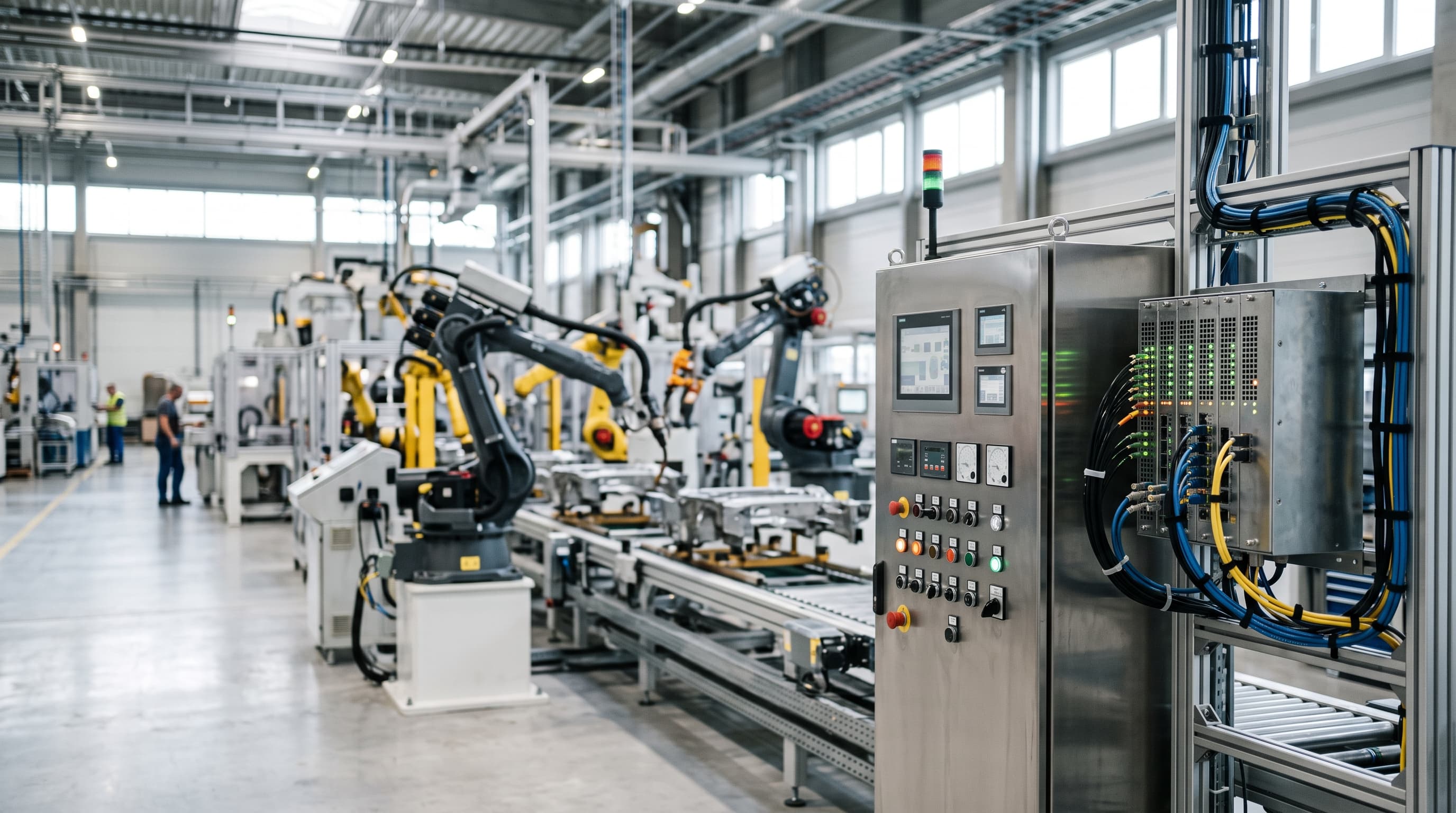
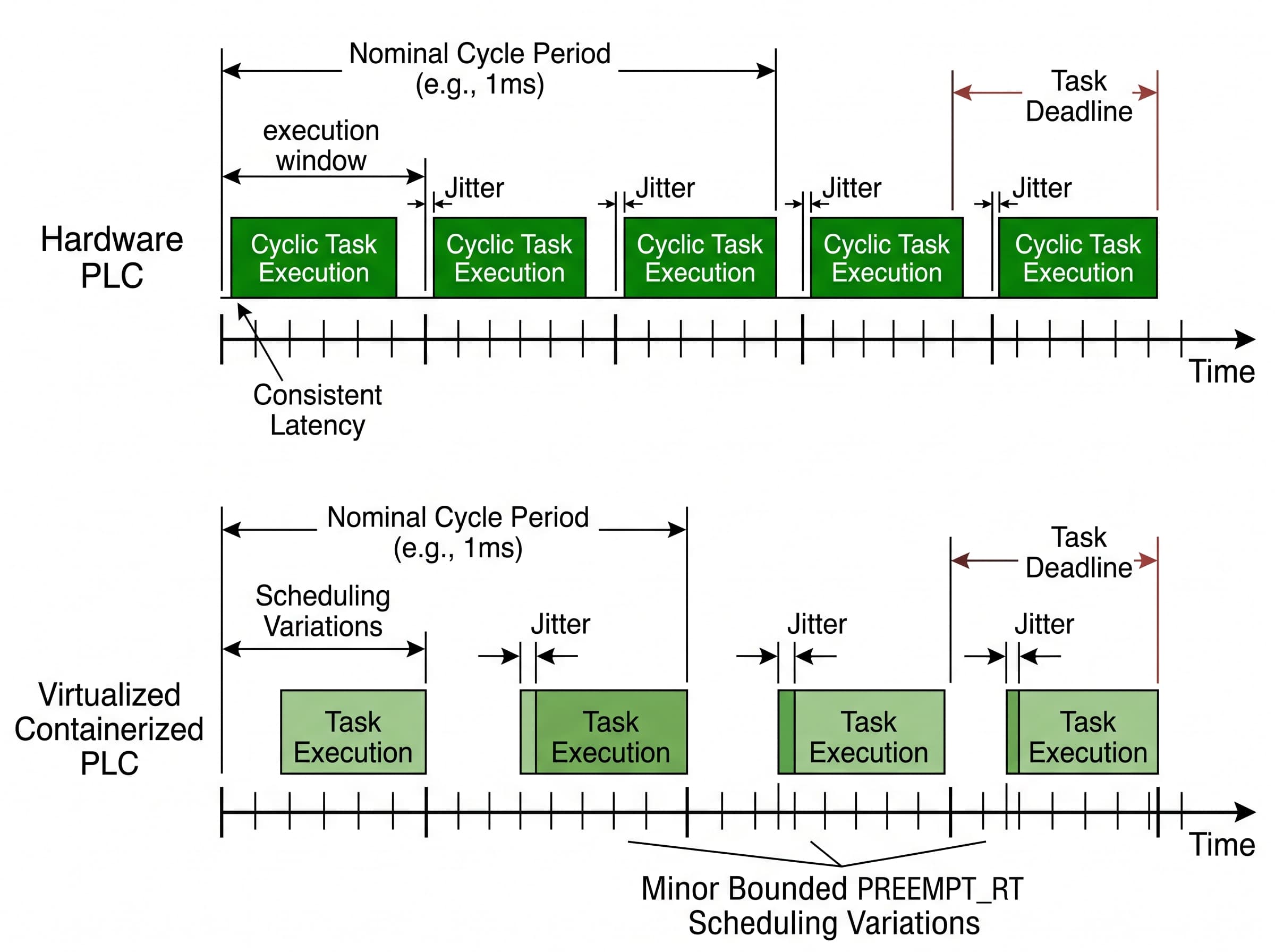
Properly tuned PREEMPT_RT virtual PLCs achieve worst-case jitter of 10–50 µs at 1 ms cycle times, closely matching hardware PLCs, but hardware still leads in sub-millisecond motion control.
Defining Determinism and Jitter in Modern Industrial Control
In industrial automation, determinism defines whether an automation controller executes its cyclic control loop within an exact, bounded time envelope. Programmable Logic Controllers (PLCs) operate on an iterative scan model: sampling physical inputs, executing user application logic defined by IEC 61131-3 standards, and refreshing physical outputs across an industrial fieldbus network. When evaluating whether software-defined virtual programmable logic controllers (vPLCs) can displace hardware controllers, engineers evaluate cycle time jitter—the statistical deviation between the target cycle execution interval and the actual elapsed time. Unlike general computing workloads where average throughput dictates efficiency, real-time industrial control mandates zero tolerance for unbounded tail latency. A single delayed cycle can cause synchronization loss across electronic line shafting, mechanical collisions on high-speed packaging lines, or dangerous process instabilities in continuous processing plants.
Dedicated hardware PLCs have historically dominated safety-critical and high-speed motion operations because their underlying system architecture is stripped of non-deterministic computing overhead. Traditional hardware controllers rely on bare-metal firmware or hard real-time operating systems (RTOS) like VxWorks or QNX running on dedicated microprocessors, Field Programmable Gate Arrays (FPGAs), or Application-Specific Integrated Circuits (ASICs) 2. In this dedicated hardware paradigm, interrupts are routed through hardwired silicon pipelines, and memory execution pathways are strictly isolated from background services. A traditional PLC operating with a 1-millisecond nominal cycle routinely demonstrates worst-case jitter within sub-microsecond or low single-digit microsecond windows under full operating load 2. When industrial automation engineers assess virtual PLCs running on commercial off-the-shelf (COTS) computing platforms, the fundamental engineering hurdle is determining whether an abstracted operating system layer can guarantee equivalent temporal predictability without hardware-enforced timing execution paths.
PREEMPT_RT Architecture and Containerized Real-Time Execution
Standard general-purpose Linux distributions optimize for maximum aggregated throughput, utilizing coarse locking mechanisms and non-preemptible critical sections that trigger unpredictable latency spikes ranging from hundreds of microseconds to several milliseconds under heavy I/O loads. To achieve industrial determinism, virtual PLC platforms deploy Linux kernels modified with the real-time patch set known as PREEMPT_RT, which has progressively transitioned into the mainline Linux kernel. PREEMPT_RT fundamentally restructures kernel internals: it transforms standard spinlocks into sleepable rt_mutex structures, converts hardware interrupt handling routines into schedulable kernel threads with configurable priority levels, and enforces priority inheritance protocols to prevent catastrophic priority inversion incidents 1. Under PREEMPT_RT, high-priority user-space control tasks can reliably preempt in-kernel routines, dramatically reducing scheduling latency and bounding kernel wake-up delays to predictable microsecond limits.
Containerization runtimes such as Docker, Podman, and lightweight Open Container Initiative (OCI) engines wrap the virtual PLC runtime—such as CODESYS Virtual Control SL or Siemens SIMATIC S7-1500V—into an isolated application namespace. Containers do not virtualize raw hardware through an intermediate hypervisor emulation layer; rather, they share the host kernel while utilizing Linux control groups (cgroups) and namespaces. Consequently, containerization itself introduces minimal theoretical execution latency, provided the containerized task is executed with POSIX real-time scheduling policies (SCHED_FIFO or SCHED_DEADLINE) and memory paging is suppressed 1. Benchmarking evaluations demonstrate that the execution overhead of container primitives is negligible when compared to native processes 4. However, determinism degrades rapidly if CPU resource contention, unmanaged page caching, or involuntary thread context switches occur unmitigated across the shared host operating system.
Empirical Cycle Time Jitter Benchmarks: Virtual vs. Hardware
Empirical latency diagnostics using benchmarking utilities such as cyclictest reveal stark operational contrasts across different execution environments. On an unoptimized Linux host running standard container runtimes under stress (heavy disk writes, concurrent network saturation, and dynamic memory allocation thrashing), cyclictest regularly records worst-case wake-up latencies exceeding 500 microseconds, with sporadic outliers climbing into several milliseconds. In contrast, on an enterprise-grade industrial PC (IPC) configured with an isolated CPU core, disabled processor power throttling, and a PREEMPT_RT kernel, maximum task scheduling jitter consistently caps between 10 and 45 microseconds across tens of millions of continuous test cycles [claim-1, claim-3]. The distribution tightly congregates around a median latency of 8 to 15 microseconds, providing the deterministic repeatability necessary for industrial control loops.
While a 10 to 45 microsecond worst-case jitter figure represents remarkable stability for a containerized application, it remains distinctly wider than dedicated hardware PLCs. Microcontroller-based or ASIC-driven industrial controllers routinely maintain task execution repeatability within 0.5 to 3 microseconds 2. For standard machine sequencing, process automation, discrete material handling, and building management—where fieldbus cycle intervals sit between 2 milliseconds and 20 milliseconds—a virtual PLC jitter margin of 50 microseconds consumes less than 2.5% of the total timing budget, proving functionally indistinguishable from dedicated hardware. Conversely, for high-speed multi-axis servo synchronization operating at 250 microseconds or 125 microseconds, that same jitter margin represents a prohibitive 20% to 40% timing deviation 4. In such ultra-short cycle domains, any jitter spike threatens the drive interpolator buffer, risking instantaneous position deviation errors and drive fault shutdowns.
| Metric / Architecture | Dedicated Hardware PLC | Tuned PREEMPT_RT Linux vPLC | Untuned Standard Linux vPLC |
|---|---|---|---|
| Worst-Case Scheduling Jitter | < 1 µs to 5 µs | 10 µs to 50 µs | 250 µs to > 5,000 µs |
| Minimum Practical Cycle Time | 125 µs to 250 µs | 500 µs to 1,000 µs | 10 ms to 20 ms |
| OS / Execution Layer | Bare-metal firmware or hard RTOS (VxWorks, QNX) | Mainline Linux kernel with PREEMPT_RT enabled | Standard general-purpose Linux kernel |
| Core Isolation Requirement | Hardwired discrete processor / ASIC | Mandatory isolcpus, cgroup pinning, nohz_full | None (shares scheduler dynamically) |
| Industrial Ethernet Determinism | Onboard hardware MAC with FPGA/ASIC timestamping | Real-time driver with DPDK, AF_XDP, or SR-IOV passthrough | Standard kernel network stack (virtio / bridge) |
| Safety Certification (SIL 3 / PL e) | Native certified redundant hardware & architecture | Supported via certified virtual safety runtimes (e.g., S7-1500VF) with IEEE 1588 time base | Unsuitable for safety-critical loops |
Hardware Latency Pitfalls: C-States, Memory Locking, and Kernel Isolation
Achieving deterministic cycle times on virtualized platforms requires treating the host computing hardware with strict discipline. The single most common failure in virtual PLC deployments stems from CPU power-saving features. Modern x86 and ARM64 processors aggressively transition inactive execution cores into deep low-power sleep states (C-states) and dynamically throttle clock frequencies (P-states). When a real-time cyclic control thread awakens, the physical transition latency from a deep C6 or C7 sleep state back to an active execution state can exceed 100 microseconds. Consequently, production edge servers running vPLCs must enforce static BIOS power profiles, disable energy-efficient stepping, set the Linux CPU governor to performance, and pass the kernel parameter processor.max_cstate=1 [claim-1, claim-3]. Disabling simultaneous multithreading (SMT/hyper-threading) is likewise essential to eliminate microarchitectural contention on shared execution pipelines and L1/L2 caches.
Memory management represents an equally critical risk factor. Standard Linux virtual memory utilizes dynamic page allocation, on-demand paging, and background memory compaction. If a cyclic PLC task triggers a page fault or encounters lock contention from kernel swap daemons (kswapd), cycle execution halts indefinitely while virtual memory pages are swapped or allocated from swap space. Virtual PLC engines avoid this by calling the mlockall POSIX API to lock all existing and future process memory directly into physical RAM 1. Furthermore, virtual PLC hosts must allocate static HugePages to prevent translation lookaside buffer (TLB) misses and configure Linux container runtimes without memory overcommit boundaries to prevent catastrophic runtime preemption by the Out-Of-Memory (OOM) killer daemon.
Beyond memory locking, host engineers must apply comprehensive CPU isolation parameters via the bootloader configuration to insulate real-time control cores from operating system housekeeping 1. The kernel boot argument isolcpus=<cores> isolates specific physical cores from the general Linux task scheduler, preventing non-real-time user processes from being scheduled on those cores. To eliminate timer tick interruptions on these isolated cores, engineers append nohz_full=<cores>, configuring the kernel to operate in tickless mode whenever a single real-time thread executes. In parallel, passing rcu_nocbs=<cores> offloads Read-Copy-Update (RCU) callback invocations to designated housekeeping cores. Interrupt affinity must also be strictly constrained: engineers must disable the irqbalance service and redirect all hardware peripheral interrupts—such as storage controllers and general networking—away from real-time execution cores by writing explicit bitmasks to /proc/irq/*/smp_affinity.
Industrial Ethernet Integration: The Fieldbus Network Hurdle
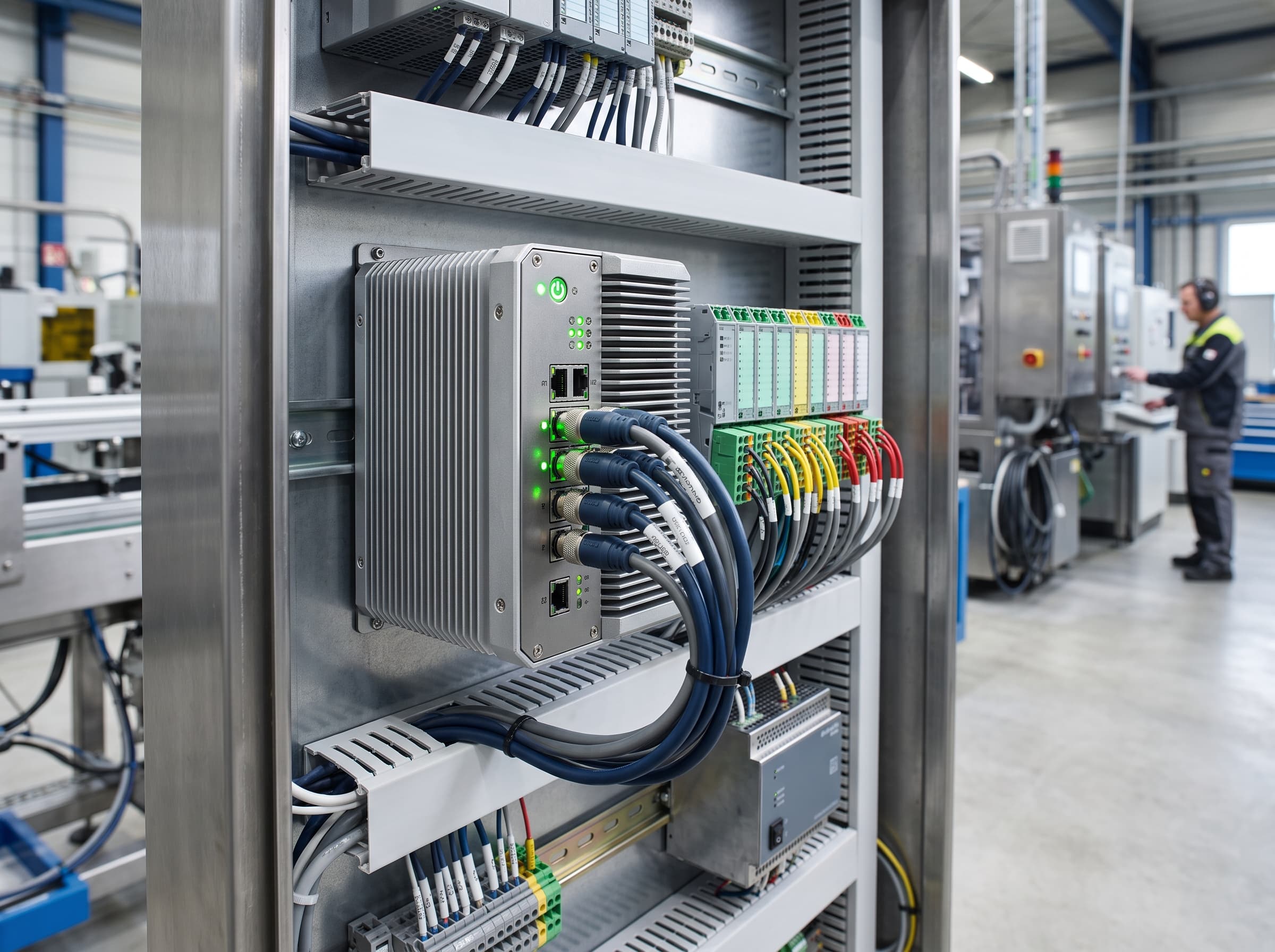
A real-time controller is useless if its calculated output data cannot reach physical drive actuators and discrete I/O modules on time. In a hardware PLC, specialized communication silicon handles protocols like PROFINET IRT, EtherCAT, and EtherNet/IP with sub-microsecond hardware timestamping. In contrast, containerized virtual PLCs transmitting data through conventional Linux network bridges or standard virtual network interfaces (veth) encounter unpredictable software routing latencies and buffer queues 4. Standard TCP/IP stacks incur kernel socket buffering, context switching between kernel space and user space, and unpredictable network queue delays that easily shatter fieldbus synchronization windows and produce jitter spikes exceeding hundreds of microseconds.
To match the determinism of physical fieldbus controllers, virtual PLC implementations must bypass the standard Linux kernel network stack. Industrial implementations leverage Single-Root I/O Virtualization (SR-IOV) or dedicate physical Ethernet controllers to the real-time container via raw socket interfaces, AF_XDP (XDP socket), or the Data Plane Development Kit (DPDK) 4. In platforms such as Siemens SIMATIC S7-1500V, running on dedicated Industrial Edge hardware with Resource Manager subsystems, dedicated network interfaces are mapped directly to the virtual controller instance, enabling PROFINET RT communication loops down to 1 millisecond without packet collision or dropped frames 3. By offloading packet filtering and passing raw Ethernet frames directly into container user space, the communication jitter collapses to single-digit microsecond tolerances matching physical network interfaces.
Implementation, Functional Safety, and Empirical Verification Pipeline
Engineers planning the migration of cyclic control logic from physical controllers to containerized virtual PLCs must conduct formal latency stress testing prior to commissioning machine logic. Synthetic load tools such as stress-ng and hackbench must run concurrently with cyclictest for a continuous qualification duration of at least 24 to 72 hours 1. A standardized validation pipeline executes cyclictest with parameters such as sudo cyclictest -p 99 -m -n -a <core> -t 1 -i 1000 -l 86400000 to simulate a 1-millisecond cyclic control task across 24 hours under maximum stress. The latency output is fed into a histogram generation script to evaluate the tail distribution; any maximum latency sample exceeding 50 microseconds indicates hardware SMI interference, improper IRQ isolation, or CPU frequency throttling, requiring immediate configuration remediation before deployment [claim-1, claim-3].
Furthermore, engineering teams must evaluate functional safety compliance when consolidating automation infrastructure. Early virtual PLC systems lacked certified fail-safe execution, forcing industrial plants to maintain dedicated safety hardware. Today, the landscape has matured: solutions such as the Siemens SIMATIC S7-1500VF virtual controller deliver certified fail-safe operation up to SIL 3 according to IEC 61508 and PL e / Cat. 4 under ISO 13849-1 within virtualized environments 3. To satisfy rigorous safety integrity criteria without dedicated safety ASICs, virtual safety controllers utilize dual-channel diverse software execution paths paired with an isolated time base. For instance, the S7-1500VF architecture leverages an Industrial Edge Virtual Timeservice paired with a dedicated IEEE 1588 (PTP) hardware network card equipped with an onboard crystal oscillator to form an independent safe system clock 3. TÜV certification validates that software faults or OS timing delays trip the system into a safe state via PROFIsafe communication, proving that software-defined automation can safely execute fail-safe logic alongside deterministic machine control.
Frequently asked questions
Q. Can a virtual PLC achieve the same cycle time as a dedicated hardware PLC?
A. Yes, for cycle times of 1 millisecond and above, a virtual PLC running on an isolated core with PREEMPT_RT Linux delivers functionally equivalent determinism. However, for ultra-high-speed motion control loops requiring 125 to 250 microsecond cycles, hardware PLCs with dedicated ASICs still offer superior sub-microsecond jitter boundaries.
Q. What is the primary cause of jitter spikes in real-time Linux containers?
A. The most frequent causes are CPU power management transitions (deep C-states), dynamic CPU frequency scaling, memory page faults caused by lack of mlockall implementation, and interrupt handling interference from unisolated CPU cores.
Q. How do virtual PLCs handle fieldbus protocols like EtherCAT or PROFINET?
A. They bypass standard Linux virtual network bridges using dedicated physical network interface cards (NICs), SR-IOV passthrough, or real-time user-space packet drivers like DPDK or AF_XDP, delivering raw packets directly to remote I/O devices.
Q. Are virtual PLCs certified for functional safety applications (SIL 3 / PLe)?
A. Yes. While early virtual PLC deployments required external safety relays, modern solutions like the Siemens SIMATIC S7-1500VF achieve TÜV-certified SIL 3 (IEC 61508) and PL e (ISO 13849-1) fail-safe ratings. These controllers utilize dual-channel redundant software execution and a dedicated IEEE 1588 precision time base with an onboard crystal oscillator to maintain safe operational boundaries via PROFIsafe.
Sources
- Realtime Linux and PREEMPT_RT Project ArchitectureOpen Source Automation Development Lab (OSADL)
- Performance Optimization for Linux-Based CODESYS Control SystemsCODESYS GmbH
- SIMATIC S7-1500 Virtual Controller CPU 1517V(F) Function ManualSiemens Industry Online Support
- Evaluating Docker for Lightweight Virtualization of Distributed and Time-Sensitive Applications in Industrial AutomationIEEE Transactions on Industrial Informatics